


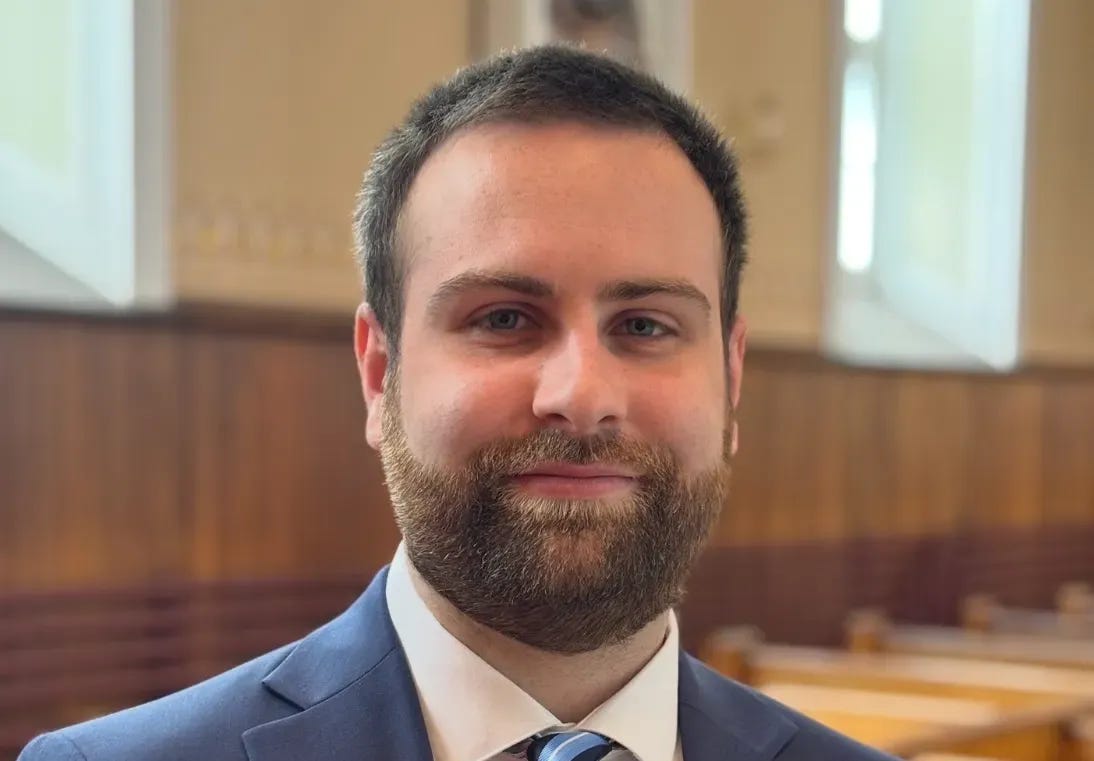
The Vermont Republican Party announced Monday that Jace Laquerre of Milton has accepted its nomination for Chittenden County State’s Attorney, and that if he wins in November he intends to resign — leaving the office to be filled by Gov. Phil Scott.
The party’s release calls Laquerre “a placeholder candidate.” He said he is putting his name on the ballot so voters can decide whether they want a change in leadership, and that if elected he would step down after taking the steps needed for an orderly transition.
This is not a short caretaker stint. Chittenden County State’s Attorney is a four-year term, and the office serves the state’s largest county — Burlington, South Burlington, Essex, Colchester, Williston and the rest, roughly a quarter of Vermont’s population. If the plan works, the person prosecuting crime in Chittenden County until early 2031 would be chosen by the governor, and no voter would have cast a ballot for that person.
Incumbent Sarah George, who won the Democratic primary on Aug. 11, responded the same day in a message to supporters. A vote for the party’s placeholder, she wrote, is “a vote to have no elected State’s Attorney at all.”
What you can check yourself
The November ballot and your registration status: vote.vermont.gov
Nominating papers for any general election candidate, including the statement of nomination and consent form described below, are public records held by the Secretary of State’s Elections Division: 802-828-2363.
How a Candidate Got Onto a Ballot That Was Already Set
When Vermonters voted on Aug. 11, this race looked finished. No candidate filed in either the Republican or Progressive primary, so the Democratic winner was the only major-party name headed for November.
The route an ordinary independent candidate would use had already closed. Under 17 V.S.A. § 2402, an independent has to file nominating petitions — 100 signatures for a county office — by 5 p.m. on the Thursday before the primary. That was Aug. 6, five days before anyone voted.
What remained is a different provision. Section 2381 lets a party committee put a name on the general election ballot when that party fails to nominate anyone in the primary, and § 2382 assigns county offices to the county committee. The mechanics are spelled out: five days’ written notice to committee members naming the offices (§ 2383), a majority vote of those present (§ 2384), and a sworn statement from the committee’s chair and secretary with the notice attached and the candidate’s signed consent (§ 2385), all filed with the Secretary of State (§ 2387).
The deadline is the part worth writing down. Under § 2386, a nomination made because a party failed to nominate by primary must be filed by 5 p.m. on the sixth day following the primary — Monday, Aug. 17.
The Vermont Republican Party used the same subchapter at the state level this month, naming replacements for attorney general, auditor and treasurer after H. Brooke Paige won four statewide primaries and withdrew from three. Those vacancies came from withdrawals rather than an empty primary, which puts them on a different clock, but the nominating body works the same way. Chair Paul Dame said the goal was assembling as full a slate as possible.
Two questions about the Chittenden nomination are answerable from the file at the Secretary of State. The release is dated Aug. 31, two weeks after the § 2386 deadline; the paperwork will show when the statement of nomination was filed. And the release comes from the state party, while the statute assigns county nominations to the county committee; the paperwork will show which committee met, when, and whether the required notice went out.
The Case the Party Is Making
The release argues that George has never been challenged in a general election, that she won the August primary narrowly on low turnout, and that she lost the city of Burlington.
The first point is accurate. George was appointed in 2017 and won in 2018 and again in 2022 without general election opposition.
The Burlington point holds up as well. Bolts reported that Bram Kranichfeld carried the city by about 60 votes while losing countywide.
The margin has been reported two ways: 49 to 46 percent in unofficial results on election night, and 52 to 48 in the count Bolts reported afterward. The vote totals don’t fully reconcile either. VTDigger reported George at 15,931 and Kranichfeld at 14,923 — a combined 30,854 — while WCAX reported more than 32,000 votes cast, a difference of roughly 1,150 the published results do not explain.
Whether that turnout was low is a comparison the release does not make. What is documented is the money: as of late July, Kranichfeld had raised about $108,000 to George’s $44,000, better than two to one.
The release also faults George for declining to prosecute several people arrested during a confrontation with law enforcement this year. It does not name the case. The declination that drew the most attention involved six people arrested at a March protest; George told Vermont Public that while video showed some protesters engaged in criminal behavior, it did not show it for the six she declined to charge, and that her decision was “based on fairness and equity, not politics.”
Laquerre’s objection is that the county cannot afford four more years of what he calls George’s “catch-and-release” prosecution. He said those policies have made communities less safe, pointed to recent problems in Burlington as evidence, and described himself as a new father who wants a prosecutor who works closely with law enforcement.
Compass examined the county court’s own caseload records against these arguments before the primary, and covered both candidates’ entry into the race in March.
The Case George Is Making
George’s argument is that the office’s record is the answer. Over nine years, she wrote Monday, the office has taken on domestic violence, gun violence, homicide-related offenses and the drug crisis “with every tool that we know works,” and did it by building partnerships across the county and across party lines rather than “tearing our community down to score points.”
On the nomination itself, she wrote that anyone who wants to debate the direction of the office is welcome to run for it, and that this is how the process is supposed to work. Her objection is to the design: the country is living through a moment, she wrote, when “people who lose elections keep looking for ways around the voters.”
She also wrote that she was outspent by more than $100,000 and faced “significant infiltration from Republicans” in the August primary. The spending figure checks out — Vermont Public reported after the primary that Kranichfeld spent about $100,000 more than George. The crossover claim cannot be measured from the returns. Vermont’s primaries are open, any voter may take any party’s ballot, and how they voted is secret.
What Happens If It Works
The appointment power the release is counting on comes from the Vermont Constitution, Chapter II, Section 20. In plain English: the governor fills any vacancy in any office, however it came about, until the office can be filled the way the law otherwise provides.
Vermonters have seen this power used in this county before. Scott appointed Sarah George to this exact office in January 2017, when T.J. Donovan left to become attorney general. She then had to win an election to keep it.
The question the Constitution’s language leaves open is how long an appointee serves. The release offers an answer, and the answer is where its account breaks down.
Vermont Already Ran This Experiment. Not the Way the Release Says.
The release states: “In 2022, Jennifer Barrett won the election in Orleans County but immediately resigned, and Governor Scott also made an appointment for the full four-year term.”
That is not what happened.
Barrett had been Orleans County State’s Attorney since 2015. In August 2022 she ran unopposed and won both the Democratic and Republican primaries.
On Aug. 30, 2022 — more than two months before the general election — Scott appointed her to the Vermont Superior Court. She left the prosecutor’s office that September.
She did not win in November and then resign. She was already gone, and her name could not be taken off the ballot. Scott’s own office said afterward that Barrett “cannot assume the role, leaving the vacancy.”
Scott told reporters at the time he was unaware Barrett was on the November ballot and that it played no part in the judicial appointment. Asked whether he would call a special election, he said, “We will figure it out.”
Scott then appointed Farzana Leyva, who had been serving as acting state’s attorney, to the full four-year term.
Nobody in Orleans County ran as a placeholder. The vacancy came from a judgeship the governor handed out before the election, not from a candidate’s stated plan to quit after one.
The release also leaves out what happened next. A Vermont attorney went to court arguing the vacancy could only be filled by a special election. On Feb. 1, 2023, Superior Court Judge Daniel Richardson declined to block Leyva from taking office. Attorney General Charity Clark, representing Scott and Leyva, wrote that there is “no textual, structural, or historical support” for the argument that a special election was required. The ruling was preliminary — Richardson gave the plaintiffs a week to fill gaps in their filing — and Compass has not established the case’s final disposition.
So the Orleans County example cuts both ways, and Chittenden County voters should have both halves. It substantiates the central factual claim George is making: an appointee was given a full four-year term no voter had voted on, and a judge asked to stop it declined. It also undercuts the reassurance the release draws from it, because the one case the party cites to show this is routine is the case somebody sued over.
The release’s other example — Scott’s 2023 appointment of Bram Kranichfeld in Franklin County — was a mid-term resignation by a prosecutor facing an impeachment inquiry. No one designed it.
What a Vote Would Decide
Read the release’s own headline and Laquerre’s own words next to each other.
The headline: “VTGOP Appoints Candidate for State’s Attorney as Referendum on Sarah George.”
Laquerre, in the same document: “I am not asking voters to elect a particular successor.”
And, earlier in that document: “I trust Governor Scott to appoint someone who will lead the office effectively.”
The party calls it a referendum. The candidate says he is only offering a choice, while telling voters what he expects the outcome to be and declining to say who it would be.
That leaves Chittenden County voters with an unusual ballot in November. One name belongs to a prosecutor who has run the office for nine years and whose approach voters have now weighed in three elections. The other belongs to a candidate who says he does not intend to serve. A vote for the second is a vote to transfer the choice to the governor, for four years, with no further election in between — a governor who has already made this appointment once, in 2017, and chose Sarah George.
His mistake was announcing he'd resign. There's enough dissatisfaction with the incumbent, he could have beat her.