


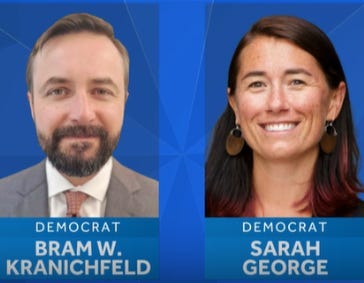
You vote August 11. This race is a referendum on a philosophy of prosecution: Sarah George built her career on it, and Bram Kranichfeld rejects it. Compass pulled the county court’s own books to ask a plain question — is it working? Here’s what the numbers say, and the more honest answer about what they can’t.
If you live in Chittenden County, you have a choice to make on August 11, and under all the campaign noise it comes down to one real disagreement: what is a prosecutor for?
Sarah George
Sarah George, the county’s top prosecutor since 2017, has a clear answer and doesn’t hide it. She belongs to a national network of reform-minded prosecutors called Fair and Just Prosecution, and she runs on its ideas: stop asking for cash bail, steer people toward treatment and diversion instead of jail, charge fewer low-level cases. Her campaign puts it plainly — a prosecutor’s job is “to seek justice, not convictions at any cost.”
She believes the old tough-on-crime approach failed the people it processed, and that a smarter, more supportive system is a safer one. She also treats it as a long project, telling supporters when she launched this campaign that there was still work to do.
Bram Kranichfeld
Her challenger, Bram Kranichfeld, doesn’t accept that a prosecutor should remake the system from the bench. His view of where bail policy belongs is blunt: if Vermont is going to replace cash bail with something else, he’s said, that’s a job for the Legislature, not for a state’s attorney deciding it office by office.
He wants tougher, escalating consequences for people who keep reoffending. He’d know the work: he runs the prosecutor’s office one county north, in Franklin, after taking over there in 2024 — and he’s a former colleague of George’s from that same Chittenden office, the candidate the county Democratic committee actually favored for the 2017 appointment that George ultimately received.
A Vote on Philosophical Differences
So the ballot question isn’t really about two personalities. It’s whether George’s philosophy of prosecution is working — well enough to earn more time, or not. Compass went looking in the one place that keeps score without taking a side: the county court’s own books.
One caution before any number. These are court records — a measure of the workload, not a prosecutor’s grade. How fast cases move depends on judges, public defenders, and court staffing as much as on the prosecutor. The numbers can frame the question. They can’t, on their own, answer it. Hold onto that, because it matters most at the end.
What the numbers say
The one idea you need. Picture the court as a sink. Cases pour in the top; the court drains them out the bottom as they’re resolved. Drain at least as fast as they pour in, and the level holds. Fall behind, and the water rises — a backlog. Officials track this with a “clearance rate”: cases finished for every 100 that come in. Over 100, the sink is draining. Under 100, it’s filling. That’s the whole trick.
Chittenden built up a property-crime backlog — and worked most of it back down.
George told Vermont Public that for a time her office deprioritized low-level cases like retail thefts, to focus on a spike in gun-violence and homicide cases in 2022 — and that it took until this year to resolve all of those cases.
The books line up with the shape of that account. In the 2022 fiscal year the sink was filling: for every 100 property felonies coming in, the court finished only 82, and hundreds of cases sat waiting at year’s end. By the 2025 fiscal year it had flipped — the court was finishing more property cases than were arriving, and the waiting pile of property felonies had shrunk by about a quarter.
One thing the numbers can’t tell you, though it’s fair to ask: whether some of that came from reducing charges rather than resolving cases as filed. The data counts cases the court finished, not what they were ultimately charged as. Given George’s stated preference for charging fewer low-level cases and dismissing where she can, a reader can reasonably wonder — the books just can’t answer it either way.
A backlog is a choice, not weather
A backlog doesn’t fall on a county like a storm. It’s the sum of choices — including a prosecutor’s — and there’s a reading of these numbers that isn’t kind to George. If you don’t ask for bail, and low-level cases get pushed to the back of the line, then some of the same people move through the system again and again, stacking up new cases while the old ones wait. Under that reading, “the backlog got worked down” and “her approach helped build it” are the same story told from opposite ends.
We can’t prove that from the court books. But we don’t have to guess whether the problem is real, because George herself has named it — and what she did about it is the whole race in miniature.
By her own account, a small, hard core of people drives a large share of the churn. When Governor Phil Scott announced a new Community Accountability Court for Chittenden County in October 2025 — a dedicated docket and special prosecutor for people with five or more open cases — George didn’t resist it. She co-signed it, in her own words: “We have 50 to 70 people in Chittenden County repeatedly causing harm to multiple victims,” she said, people “not succeeding in existing diversion and deflection programs.” (This new court came after the court data above, so it isn’t what turned those 2025 numbers around; it’s the next chapter, aimed at the hardest cases still in the pile.)
George — the reform prosecutor — is conceding that her signature approach doesn’t reach everyone. And that matters, because reaching those people with treatment instead of jail is the core of her philosophy. Two years earlier, in 2023, her office had built a program for exactly this population: Incentives for Success, launched with the nonprofit Vermonters for Criminal Justice Reform, offering repeat low-level offenders case management and small rewards for showing up, with charges dropped if they stay clean for 12 weeks.
A neutral evaluation by the national policy group Results for America describes the machine your gut was already turning over: “a relatively small number of individuals were responsible for a disproportionate share of property crimes,” and, “released without any additional support services, these individuals often picked up additional charges while awaiting sentencing.”
So here is the real fault line between the two candidates. George’s bet is that you break that cycle by fixing what drives the offending — and when the softest tools don’t reach the hardest core, you add a faster court, not a harsher philosophy. Kranichfeld’s bet is that for people cycling through with case after case, the consequences themselves have to come faster and mean more, or nothing changes.
Does the treatment approach work?
The most neutral scorekeeper on that question is the U.S. Department of Justice’s CrimeSolutions clearinghouse, which rates individual justice programs on the same evidence scale regardless of politics. Its picture is genuinely mixed: some restorative and diversion programs are rated “Promising” or “Effective,” others “No Effects,” and one long-running Chittenden County diversion program — the Rapid Intervention Community Court, which predates George — is rated “Ineffective” at reducing reoffending.
Across the research, the reductions in reoffending tend to be real but small — and they shrink further in the most rigorous studies, likely because these programs are voluntary, so the people who enroll and finish are already the most motivated to change. That is the built-in catch for a program like Incentives for Success: it does the most for the people most ready to change, and the least for the service-resistant core — the same 50 to 70 George pointed to.
A 2025 WCAX investigation of Vermont restorative-justice programs put a sharp point on it, reporting low reoffending among first-time participants but, among those who keep cycling back through, recidivism running as high as roughly 90 percent.
One number, two counties
Kranichfeld runs Franklin County now, so the same ledger grades his shop too — with the caveat that the 2025 fiscal year is his only full year in the job, a snapshot, not a trend. (He isn’t seeking reelection there; he’s running for George’s seat.) That year, for every 100 cases coming in, Chittenden’s court cleared about 104 and Franklin’s about 91. George’s county kept its head above water; Kranichfeld’s fell a little behind. It doesn’t crown either prosecutor — courts move cases, not just prosecutors — and it complicates any tidy “he’s the tougher, more effective one” story.
One more Franklin number, because it cuts both ways just like everything else here. Low-level property cases coming into Franklin’s court jumped from 160 in 2022 to 728 in 2025 — more than four times as many. It might mean property crime there surged. It might mean Kranichfeld is charging cases another prosecutor would drop — which is close to the tougher approach he’s running on. The books count how many cases showed up; they don’t say why.
The gap that matters most: the number that would answer the question isn’t published anymore
Here’s the honest heart of it.
Everything above measures how fast courts clear cases. None of it measures the thing you actually want to know: do the same people keep coming back? That’s the real test of whether a lenient approach works or quietly feeds itself — and it’s the one number nobody publishes.
The state used to publish part of it. Through 2020, the Judiciary reported, county by county, how cases ended — plea, trial, or dismissed. For George’s early years it’s on the record, and it shows her office dismissing a rising share of felony cases (with a spike in 2020, the COVID year, when dismissals jumped in courts statewide). Then Vermont changed its court computer system, and that breakdown stopped appearing in the Judiciary’s annual reports. We did not find it published anywhere after that. Which means Kranichfeld’s entire record in Franklin — how he actually resolves his cases — isn’t in those reports either, and there is no public county figure for how often the same defendants reoffend.
So the single most useful measure for judging these two — as prosecutors, not as caseload managers — dropped out of public view in 2020, right when a countywide race is being fought over it. That’s not a knock on either candidate. It’s a hole in what the state lets voters see.
What these numbers can’t tell you
Court speed isn’t a prosecutor’s grade — judges, defense lawyers, and staffing all move cases. Anything resolved before it reaches court — a case sent to diversion, like Incentives for Success — never appears in these books at all, so the true workload is bigger than the ledger on both ends. The older and newer numbers come from two different court computer systems and can’t be stacked directly, so we compared trends within each era, not raw totals across them. And none of this reaches what the campaign actually fights about: which cases a prosecutor declines before charging, the cash-bail policy, the traffic-stop policy. Anyone who tells you these books settle the race is reading them for more than they hold.
What it comes down to
Strip it all away and the choice is simple, even if it isn’t easy. Sarah George has run a clear, deliberate experiment in what prosecution can be — no cash bail, treatment over jail, programs that try to fix people instead of just processing them — and when the hardest core didn’t respond, she backed a faster court to reach them. She says the larger project takes time, and that it’s working. You’ve now seen most of a decade of it, along with the backlog that built up on the way and the extra court it took to help work it down.
So on Tuesday the question is really this: is that an approach that has earned more time to prove itself — or one the county has now seen enough of? Bram Kranichfeld is betting a lot of voters will say enough. George is betting they’ll say keep going. The court data can sharpen that question. It can’t answer it for you. That part is yours.
The primary is Tuesday, August 11.
A note on the numbers: The caseload figures come from the Vermont Judiciary’s annual statistical reports — the FY2020, FY2022, and FY2025 editions. Vermont’s court years run July through June, so “2022” and “2025” here mean those fiscal years, not calendar years. “Clearance rate” is simply cases finished divided by cases that came in. Two honest limits: the reports don’t say whether each figure counts cases or individual charges, so we describe them as cases and don’t treat them as head counts of distinct people; and the Judiciary changed case-management systems between 2019 and 2021, so we compare trends only within each era, never raw totals across the break. Sources for everything else — George’s record and positions, Kranichfeld’s, the accountability court, the diversion programs, and the effectiveness ratings — are linked inline above.
I'm a huge fan of objective journalism as evidenced here and am putting my money where my mouth is.
As for this topic, and prosecutors race, Sarah's had enough time. Chittenden County was trending down, and that trend hasn't changed, its gotten much worse. The fact that the re-offenders are the main problem, and only recently addressed was her main failure since that group caused the most long term damage. We need bonds.
This was a detailed writeup of a novel way of comparing the 2 candidates apples to apples, but it’s treatment of the backlog and how it got to be what it is left out an important fact.
The wording treated the backlog as if it stemmed from George’s policies, for instance see the section titled “a backlog is a choice, not weather”. Except that the backlog clearly was caused by the pandemic (which is similar to weather in that it’s unpredictable).
With no mention of the word “pandemic” to be found in a whole article that hinges on a court case backlog, I don’t know what to think of this article. How did this get missed?