


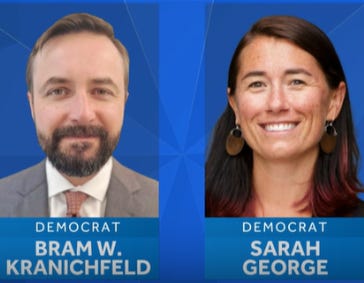
Bram Kranichfeld, who has served as Franklin County State’s Attorney since 2023 after stints as a deputy prosecutor in Chittenden County, executive director of the Vermont Department of State’s Attorneys and Sheriffs, and chief of the criminal division at the Vermont Attorney General’s Office, is formally kicking off his campaign today to challenge incumbent Chittenden County State’s Attorney Sarah George in the August 11 Democratic primary.
With no Republican candidate expected, the primary will almost certainly decide who leads Vermont’s busiest prosecutor’s office.
Compass Vermont reached both candidates this weekend and received on-the-record responses. What emerged is a portrait of two Democrats with fundamentally different theories of what a prosecutor is for — and a backstory that stretches back nearly a decade.
The History Neither Candidate Leads With
In late 2016, when then-State's Attorney T.J. Donovan vacated the Chittenden County seat to become Vermont's Attorney General, the Chittenden County Democratic Committee interviewed candidates to recommend to Governor Phil Scott for appointment. According to contemporaneous reporting, the committee ranked three nominees. Kranichfeld was ranked first. Ted Kenney was ranked second. Sarah George was ranked third.
Governor Scott appointed George.
Kranichfeld left the Chittenden County State’s Attorney’s Office, where he had worked since 2007, and eventually pursued a Master of Divinity degree at the Montreal Diocesan Theological College. He was ordained as an Episcopal priest and served two South Burlington congregations before being tapped by Governor Scott in September 2023 to stabilize the Franklin County State’s Attorney’s Office following the resignation of John Lavoie amid an impeachment investigation.
Scott made Kranichfeld’s appointment permanent in March 2024. He has lived in Burlington for nearly 20 years throughout, commuting to St. Albans to serve a county where he was not required by law to reside.
He will not seek re-election in Franklin County. His term runs through January 2027.
Asked directly about the 2017 history and how much it shapes his decision to run now, Kranichfeld told Compass Vermont: “They say when one door closes, others open up and that was certainly true for me. Although I was disappointed back in 2017, I quickly moved on. If I had gotten the appointment then, I would not have been able to do everything I have done over the last 10 years.”
George’s campaign press release, issued March 10 — two and a half weeks before Kranichfeld formally announced — already contained language that reads as a preemptive response to precisely this biography: “The Chittenden County State’s Attorney’s office has long attracted those who see it as a platform for higher ambitions, a well-worn stepping stone in Vermont politics. Sarah is not a stepping stone candidate... She is not running through Chittenden County. She is running for Chittenden County.”
Who Is Sarah George
George was appointed by Governor Scott in January 2017 and has held the position for nine years. She won her first full term in 2018 with 99.1% of the vote — running effectively unopposed — and defeated a primary challenger in 2022 with 61.8% of the final vote, according to official results from the Vermont Secretary of State, despite facing opposition from five Democratic state’s attorneys and six police unions who backed her opponent.
She holds degrees in criminal justice, psychology, and forensic psychology, and earned her law degree from Vermont Law and Graduate School. Before her appointment, she served six years as a deputy state’s attorney in the same office under Donovan.
George’s tenure has been defined by a set of progressive prosecution policies that have made her one of the most closely watched — and most debated — local prosecutors in New England. The signature policies:
Her office stopped seeking cash bail as a condition of release, a policy she has described in writing as necessary because “imposing cash bail penalizes individuals based on their financial status rather than on their flight or public safety risk.”
She declined to charge people for possessing buprenorphine, a decision that helped inspire 2021 legislation making Vermont the first state to legalize possession of the prescription drug used to treat opioid addiction.
Her office declines to prosecute charges arising from what it considers pretextual traffic stops.
She has significantly expanded the use of restorative justice and pre-charge diversion programs.
In October 2025, Governor Scott announced the establishment of a special Chittenden County Community Accountability Court to address the backlog of repeat-offender cases — an initiative he convened in coordination with the judiciary, law enforcement, the Defender General, and George's office, among others. George was a participant and publicly supported the effort.
Her relationship with local law enforcement has been openly antagonistic for much of her tenure. The Burlington Police Officers’ Association has publicly accused her office of a “pattern of non-prosecution” and “disastrous” results for public safety. George has countered that the police were, in some cases, declining to make arrests in cases she would have prosecuted, in order to make a political point.
Her 2026 campaign is framed substantially around resistance to the Trump administration. Her announcement statement declared that “as our federal government targets and terrorizes communities, strips funding from essential services, and tramples on Constitutional rights,” local prosecution must serve as an “independent firewall for Vermont’s values.” In February 2026, she declined to prosecute 13 people arrested during a sit-in at a Department of Homeland Security facility in Williston, stating the prosecution “would not serve the ends of justice or the best interests of the residents of Chittenden County.”
Who Is Bram Kranichfeld
Kranichfeld holds a B.A. from the University of Chicago and a J.D. from Cornell Law School. He has been a Vermont Bar member since 2007. His legal career spans roughly 14 years of prosecutorial experience at the county and state level, including time as chief deputy state's attorney and chief of the criminal division at the Vermont Attorney General's Office.
His resume includes:
Deputy State’s Attorney, Chittenden County (2007–2012)
Executive Director, Vermont Department of State’s Attorneys and Sheriffs (2013–2014)
Chief Deputy State’s Attorney, Chittenden County (2015–2017)
Chief, Criminal Division, Vermont Attorney General’s Office (2018–2019)
Franklin County State’s Attorney (2023–present)
He also served on the Burlington City Council and ran unsuccessfully for Burlington mayor in 2011.
In Franklin County, Kranichfeld inherited an office described by staff as traumatized following Lavoie’s tenure. He focused on stabilizing office culture, clearing a significant case backlog — his office cleared 442 pending cases between September 2025 and February 2026 without outside accountant assistance — and establishing a treatment court program designed to address the intersection of drug use and criminal behavior.
His campaign announcement statement said he had “heard from countless friends and neighbors in Chittenden County over the last few weeks about what our communities need and what kind of leadership it will take to move us forward.”
Where They Disagree: Bail
The sharpest policy divide between the candidates is cash bail — and the exchange with Compass Vermont illuminated it clearly.
Kranichfeld was direct: “Like it or leave it, bail is the only mechanism we have in Vermont to ensure that defendants show up in court. Dropping bail requests removes accountability for not showing up which, at best, profoundly delays the court’s ability to address cases, some of which involve issues of public safety. There may be other viable systems to ensure that defendants show up. But if we are going to replace bail with some other mechanism, that is a job for the legislature, not the State’s Attorney.”
He described the practical reality for prosecutors under the current system: “In court, State’s Attorneys do not always get what they ask for, but they get nothing if they don’t ask at all.”
That framing matters in context. In Franklin County, Kranichfeld sought $100,000 bail for an out-of-state drug dealer with multiple prior arrests — a defendant who did not live in Vermont and had, by pattern, returned to her home state between Vermont arrests. The court set bail at $2,500.
George’s response to Compass Vermont on bail pushed back on the framing of her policy: “I try not to give critics who base their critique on inaccurate information too much air, but will just say that this critique is not accurate and is not in line with the way that our laws work. My office does not decide who or who is not held on cash bail, nor do we decide who is held or released. That decision is entirely up to a Judge.”
Her campaign website, however, lists “eliminating cash bail” as a specific accomplishment of her tenure. The website states: “I’ve worked to reimagine what a State’s Attorney’s office can look like — reducing unnecessary charges, expanding diversion programs, eliminating cash bail, and decreasing incarceration where it doesn’t serve anyone.”
Readers can assess how those two statements fit together.
Where They Disagree: Public Safety and Law Enforcement
On the police union criticism of her office, George told Compass Vermont: “The unions did say that in 2022 and when asked to show evidence of this they were unable to do so. We decline to prosecute charges if we do not believe we can prove the case beyond a reasonable doubt, as is our ethical obligation.”
Kranichfeld’s campaign platform includes an explicit commitment to repair the relationship with law enforcement, which he describes as essential infrastructure for effective prosecution.
Asked what he would do on day one if elected, Kranichfeld was specific in a way that rarely emerges in Vermont political campaigns: “I would retract the no-bail policy. I would prosecute serious crimes discovered from traffic stops. And I would meet with law enforcement agencies to ensure that we have a healthy working relationship. Generally, I would make an immediate effort to be transparent. I would fight for better data so that the public can judge whether I am doing a good job and I would hold regular press conferences so Chittenden County has consistent updates on the work.”
The Empathy Question
One of the more striking elements of Kranichfeld’s candidacy is the way he integrates his years in the clergy into his prosecutorial philosophy — not as a contradiction, but as a complement.
“My experience as clergy has given me a greater understanding of the role empathy plays,” he told Compass Vermont. “I strongly believe that a state’s attorney needs to empathize with everyone in the community. My experience in the clergy reminds me to slow down, to look at every case individually, and to try to figure out what justice actually looks like in each individual case rather than try to apply the same solution to everything.”
George’s campaign biography similarly centers empathy and community: “I’ve spent my career believing that the justice system can actually work for people — all people... To me, a prosecutor’s job is to seek justice — not convictions at any cost.”
Both candidates claim the same value. What separates them is the policy architecture they’ve built around it.
What Residents Are Feeling
Kranichfeld offered a candid account of what he says he hears from Chittenden County residents: “What I hear most is a sense of frustration. Many I have spoken with feel that we need more transparency and that it feels like we are stuck in a hopeless cycle. This office, unlike most others in Vermont, is only up every 4 years, so I feel a strong call to step up and run now. Many in our community do not want to wait 4 more years for a change.”
George’s press release counters with a continuity argument: “That progress is not an accident. It is the result of steady, experienced, evidence-based leadership, the kind that can only come from someone who chose this community and never left.”
The Stakes
Chittenden County is home to nearly one-third of Vermont’s total population. It is the state’s most populous and most diverse county. The State’s Attorney is the chief law enforcement officer for that community — deciding which cases to prosecute, how aggressively to pursue detention, how to deploy the limited resources of a county prosecutor’s office, and how to relate to the law enforcement agencies whose arrests become the office’s caseload.
George has held that position since January 2017. No one has defeated her in an election.
The Democratic primary is August 11, 2026. The filing deadline for candidates is May 28, 2026. With no Republican candidate currently in the race, the primary winner will almost certainly serve the next four-year term.
George did not respond to Compass Vermont’s question about her third-term agenda on her official email, referring this publication to her campaign. Her campaign press release was provided after this story was filed. It is available in full at www.sarahgeorgeforsa.com.
Kranichfeld’s campaign kickoff is today, Monday, March 30, 2026, in Burlington.
Editor’s Note: An earlier version of this story credited State's Attorney George with independently launching the Chittenden County accountability court. The court was established by Governor Scott in October 2025 in coordination with multiple partners including George's office. In addition: a correction was made to clarify Bram Kranichfeld's prosecutorial experience. An earlier version implied his experience exceeded Sarah George's in total years, which is incorrect.
Compass Vermont contacted both candidates by email on Saturday, March 29, 2026. Both responded. All quotes are drawn from written responses provided on the record.