


At the bottom of this story: where to read the full guide, how to find out whether your town requires a permit for a march or amplified sound, and what the guide says to do when an officer tells you to move.
Vermont Attorney General Charity Clark’s office on Friday released an eight-page guide spelling out what Vermonters can and can’t do when they protest — what the First Amendment protects, where government can set limits, and what rights you have if police stop, search or arrest you.
It lands as organizers plan a week of action against ICE starting Sunday, Oct. 4, with events through Oct. 9. The ICE analysis center in Williston’s White Cap business park has drawn months of demonstrations, and protesters arrested there in July pleaded not guilty last week to unlawful trespass charges brought by Clark’s office.
The guide doesn’t mention Williston. But it lays out the law on both sides of the argument those charges set off — what the Constitution protects, and what it doesn’t.
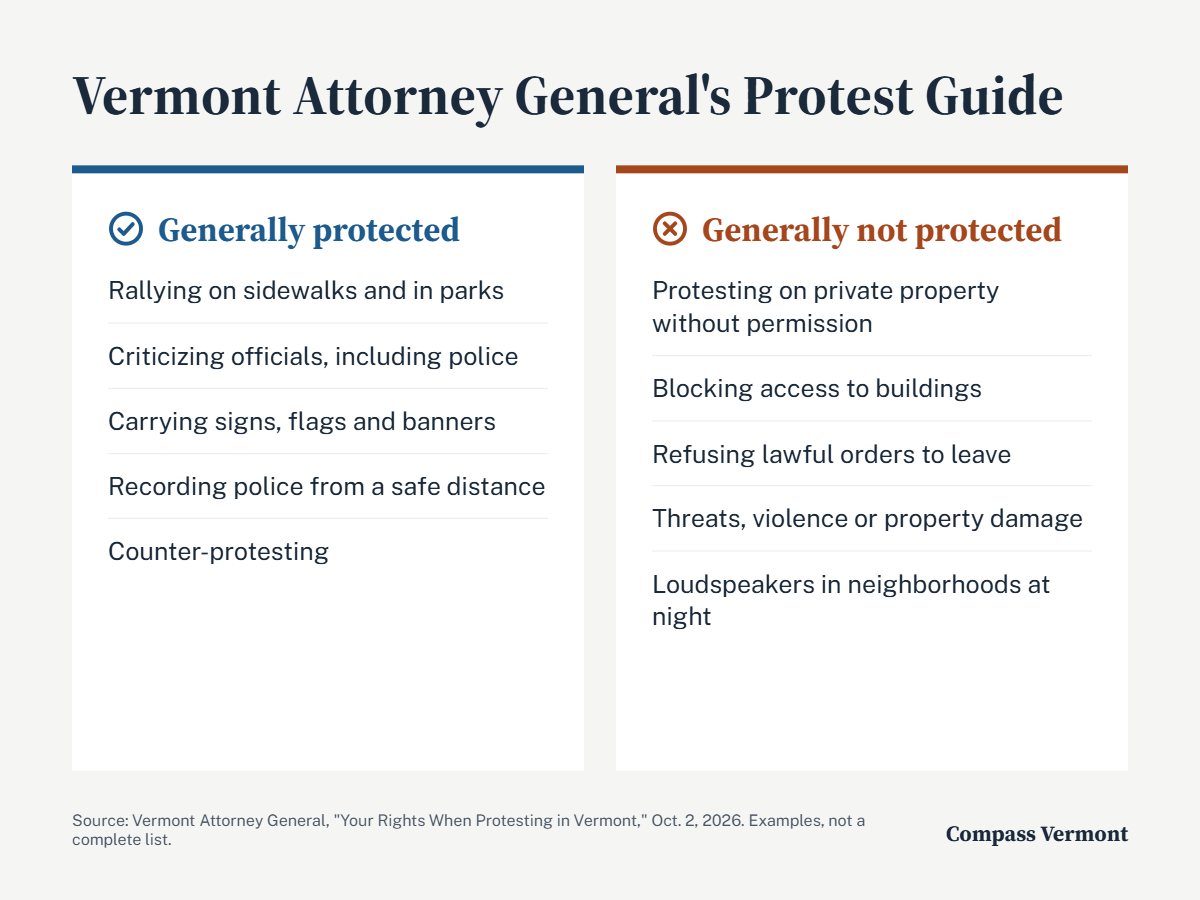
What the guide says the First Amendment generally protects
Gathering peacefully in public spaces like parks and sidewalks to make your point
Criticizing the government and government officials, including police
Carrying flags, banners or picket signs
Marching safely on public roads and paths, as long as you don’t keep others from traveling or reaching services
Saying things others find offensive, short of threats — the guide’s examples include flag burning and slurs
Photographing or recording police and other officials in public from a safe distance
Moving to another spot to keep demonstrating if police order you out of an area
Showing up to counter-protest
The guide also says government at any level can’t punish you, or deny you benefits, because it disagrees with your point of view. Courts call that viewpoint discrimination.
What it says the First Amendment generally doesn’t protect
Protesting on private property without the owner’s consent, or staying after being asked to leave
Blocking access to health care, government offices or private property
Blocking traffic without a permit or other authorization
Harming or threatening to harm anyone, or damaging property, including graffiti
Speech meant to spark violence or other crimes right away, and likely to do it
Interfering with police making a lawful arrest, or with medics treating the injured
Crossing without permission into a buffer zone police have lawfully set up between protesters and counter-protesters
Refusing lawful orders to leave, such as when a protest turns violent
Playing loudspeakers in residential areas at night
Where you protest matters
The guide’s rule of thumb: your rights are strongest on streets, sidewalks and public parks, and weakest on private property, where the owner decides who stays.
Public buildings fall in between. The rules depend on how the space is being used. A public meeting can have reasonable limits on speaking time and topic, but officials can’t silence a speaker because they disagree with the speaker’s viewpoint. A library room reserved for a gardening club can be kept on topic. The inside of a government office can be closed to demonstrations entirely, as long as the point isn’t to silence a viewpoint.
Even in the most open spaces, government can set what courts call “time, place and manner” rules — limits on when, where and how people demonstrate — as long as the rules are neutral about the message, no broader than needed to handle a real problem like traffic or noise, and leave people another way to get their point across. The guide’s examples are noise limits at night, permits to close a road, and caps on crowd size in an auditorium.
On permits: you generally don’t need one to march on sidewalks or lightly traveled roads if you aren’t blocking traffic, though police can tell an unpermitted march to keep to the shoulder. Many towns require a permit for amplified sound, usually handled by the police department or town clerk. Officials can’t deny a permit because they dislike your message or expect it to stir people up.
If police approach you
If you aren’t sure whether an officer is asking or ordering, you can ask. If you’re free to go, you can walk away.
If it’s an order, you can say you don’t consent while you comply. The guide warns that physically resisting or running can get you arrested.
You can record police in public, and officers generally can’t make you delete it. They can order you to back up so they can do their job or let medics work.
Officers generally need your consent or a warrant to search your phone, even if they take it during an arrest.
If you’re arrested, you have the right to stay silent and to ask for a lawyer. If you can’t afford one, you can ask for a public defender, and a judge decides whether you qualify. The guide says staying silent is always better than lying.
Applying it to Williston
Three questions have gotten tangled together in the Williston argument. The guide answers the first. The court will answer the second. The third is a judgment call.
What does the Constitution protect? The ICE facility sits in an office complex in the White Cap business park that also houses other businesses. According to state police affidavits described by Vermont Public, the July 24 protesters blocked the doors to the ICE facility, and when troopers issued dispersal orders — formal orders for a crowd to leave — they refused and chanted over the directions. Blocking access, staying on private property after being told to leave, and refusing lawful orders to leave all appear on the guide’s list of what the First Amendment doesn’t protect.
Did these defendants break the law? That’s for the court. The part of Vermont’s unlawful trespass law used in these cases covers entering or staying somewhere without permission after being told to leave — by the person in control, someone acting for them, or police acting on their behalf — or after posted signs give notice. It’s a misdemeanor punishable by up to three months in jail, a $500 fine or both. Everyone who appeared in court last week pleaded not guilty. The guide itself says it isn’t legal advice and that the answer in any one case depends on its facts.
Should prosecutors have charged them? Prosecutors don’t have to charge every case that fits a statute. Chittenden County State’s Attorney Sarah George declined to charge protesters arrested at the facility earlier this year and compared their actions to civil disobedience in the civil rights movement. In June letters explaining why she wouldn’t charge those earlier cases, she invited Public Safety Commissioner Jennifer Morrison to send future protest cases to Clark. State Police sent Clark the July cases, as Compass reported Sept. 23.
State Treasurer Mike Pieciak, a fellow Democrat, has called on Clark to drop the charges, saying prosecutors regularly decline cases “in the interests of justice or to preserve scarce government resources.” Gov. Phil Scott praised Clark for going forward, telling reporters the protesters would be “held accountable for violating the law,” Vermont Public reported. Clark told Vermont Public her politics can’t drive charging decisions and noted she has protested at the Williston facility herself. She declined to say whether her office would offer diversion — a program often used for first-time offenders that can resolve a low-level charge without a criminal conviction.
Federal prosecutors are on a separate track. On Sept. 30, the U.S. Attorney’s Office charged several protesters with knowingly obstructing access to the federal facility. Prosecutors allege a blockade on Feb. 9 and, for some of those charged, further blockades on May 14 or July 24. That charge carries up to 30 days in jail and a $5,000 fine. Some of them also face Clark’s state trespass charge. Everyone charged in both cases is presumed innocent.
The guide sets out where the First Amendment stops. Whether a case past that line should be prosecuted is a separate question, and the guide doesn’t answer it.
Deciding for yourself
We lay out what the rules say. What you do with them is your call.
Read the full guide: Your Rights When Protesting in Vermont. Contact the AG’s Civil Rights Unit for help getting it in other languages.
Immigration encounters: the AG’s separate guide, Your Rights When Encountering Immigration Officials in Vermont (June 11, 2025), covers what immigration officers can and can’t do.
Permits in your town: before a march that uses the road or amplified sound, call your town or city clerk or local police. Ask whether a permit is required and whether there’s a fee.
If an officer approaches: ask whether you’re free to go. If it’s an order, comply and say you don’t consent. Don’t run or resist.
If you’re arrested: say you want a lawyer. If you can’t afford one, ask for a public defender.