


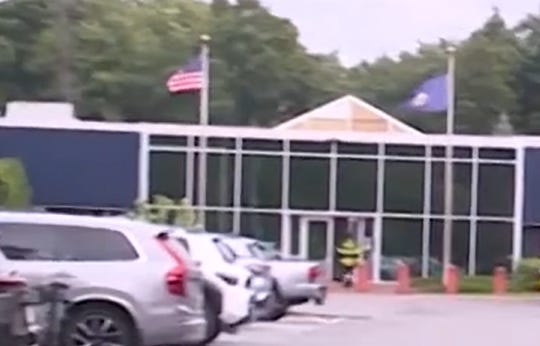
Vermont Attorney General Charity Clark’s office is prosecuting protesters cited at a July 24 sit-in at the Immigration and Customs Enforcement surveillance center in Williston. Chittenden County State’s Attorney Sarah George declined to charge protesters from two earlier sit-ins at the same building.
A spokesperson for Clark confirmed Tuesday that all 13 people cited in July will be prosecuted, and they are due in court Thursday, Sept. 24, on misdemeanor unlawful trespass, Seven Days reported. State Police have started sending these cases to the attorney general instead of to George, according to the same report.
The State Police count has varied. One version of the department’s July 24 release listed 12 adults and one juvenile. Another listed 13 adults.
Can someone else prosecute a case the county prosecutor won’t? Under Vermont law, yes, and it has happened before, including to George.
Two Offices, the Same Power
Most criminal cases in Vermont are handled by the elected state’s attorney in each county. But 3 V.S.A. § 152 gives the attorney general the same authority anywhere in Vermont as a state’s attorney. Lawyers call this concurrent jurisdiction. In plain English, either office can file the same case, and neither one needs the other’s permission.
So a state’s attorney’s decision not to prosecute doesn’t bind the attorney general.
How the Cases Ended Up With the Attorney General
The route around George took shape over the spring:
February. State Police arrested 11 people and cited two more on Feb. 9 after they refused to leave the White Cap Business Park building that houses ICE’s National Criminal Analysis and Targeting Center. George declined all 13 cases. Her letters said prosecuting them “would not serve the ends of justice or the best interests of the residents of Chittenden County,” Vermont Public reported. She noted that most had little or no criminal history, several were elderly, and all were nonviolent.
April. George declined to charge six people arrested March 11 while protesting an ICE raid in South Burlington. She referred three of the cases to the Burlington Community Justice Center for a restorative process instead of court. At a press conference later that month with Gov. Phil Scott, Public Safety Commissioner Jennifer Morrison, who oversees the State Police, said, “I understand now clearly that she is an activist first and a prosecutor second,” the Boston Globe reported. “We follow the rule of law.”
May arrests. Police arrested four more protesters at the Williston building on May 14. George later declined those cases too, saying she would not spend her office’s limited resources on them. Her letters noted that Morrison planned to send such cases to the attorney general. “We invite her to do so if she disagrees with our decision,” George wrote, the Rutland Herald reported.
The July cases went to the attorney general. Clark’s office has a policy against discussing pending cases. George told Seven Days she could not comment on the attorney general’s decision until after the arraignment.
It Has Happened Before, Including to George
In December 1978, a state trooper arrested a driver in Windsor County for drunken driving. In January 1979, Windsor County State’s Attorney Michael Sheehan decided not to prosecute. Attorney General Jerome Diamond met with the trooper, other State Police and a member of the governor’s office, then asked Sheehan to reconsider. When Sheehan said no again, Diamond filed the charges himself. Sheehan sued to stop him. The Vermont Supreme Court ruled against Sheehan, holding that the two offices share equal authority to bring criminal cases. By declining, the court said, the state’s attorney “did not preempt the field — he withdrew from it.”
In 2019, George dismissed three murder and attempted-murder cases because she said she could not rebut the defendants’ insanity defenses. Scott asked then-Attorney General T.J. Donovan to review them. Donovan refiled the first in September 2019 and eventually refiled all three. George publicly called his reasoning “disingenuous and hypocritical.” A jury convicted one of the three, Aita Gurung, in 2022. In 2025 the Vermont Supreme Court upheld the conviction and the attorney general’s authority to refile.
What’s different this time is the order of events. In 1979 and 2019, the attorney general stepped in after a county prosecutor had reviewed the specific case and said no. This time, the police sent the July cases straight to the attorney general.
What the Protesters Face
Vermont’s trespass law sets different penalties for different kinds of trespass:
Staying after being told to leave. Entering or staying somewhere without permission after being told to leave carries up to three months in jail, a $500 fine, or both.
Entering a locked building. Entering a nonresidential building that is normally kept locked carries up to one year in jail, a $500 fine, or both.
The specific charges will be read at Thursday’s arraignment, the first court appearance, where each person enters a plea.
If You’re Cited at a Protest in Vermont
Two offices can charge you. Either the county state’s attorney or the attorney general can file the case. A decision not to prosecute by one office doesn’t bind the other, or a future state’s attorney.
A citation doesn’t guarantee a prosecution. A prosecutor still decides whether to pursue the case. For prosecution deadlines, though, Vermont law counts an arrest without a warrant or the issuing of a citation as the start of the prosecution.
Seven clergy members were arrested at the same building Sept. 4 and cited for unlawful trespass, with a court date of Oct. 20. The group now calls itself the Clergy 7, and its members have said they will keep demonstrating. Where their cases go may show whether sending protest cases to the attorney general is becoming routine.