


Vermonters Yelled. Then Montpelier Listened on the Road Rule.
How “freedom and unity” became “dividing Vermont” in 18 days — and why the pivot came after the public pressure, not before it.
What Act 181 and the Road Rule actually did
Act 181, passed in 2024 over Governor Phil Scott’s veto, rewrote Vermont’s half-century-old land use review law. In plain terms, the law sorted every piece of Vermont into one of three tiers.
Tier 1 — downtowns, villages, and designated growth centers — got looser rules meant to speed up housing construction.
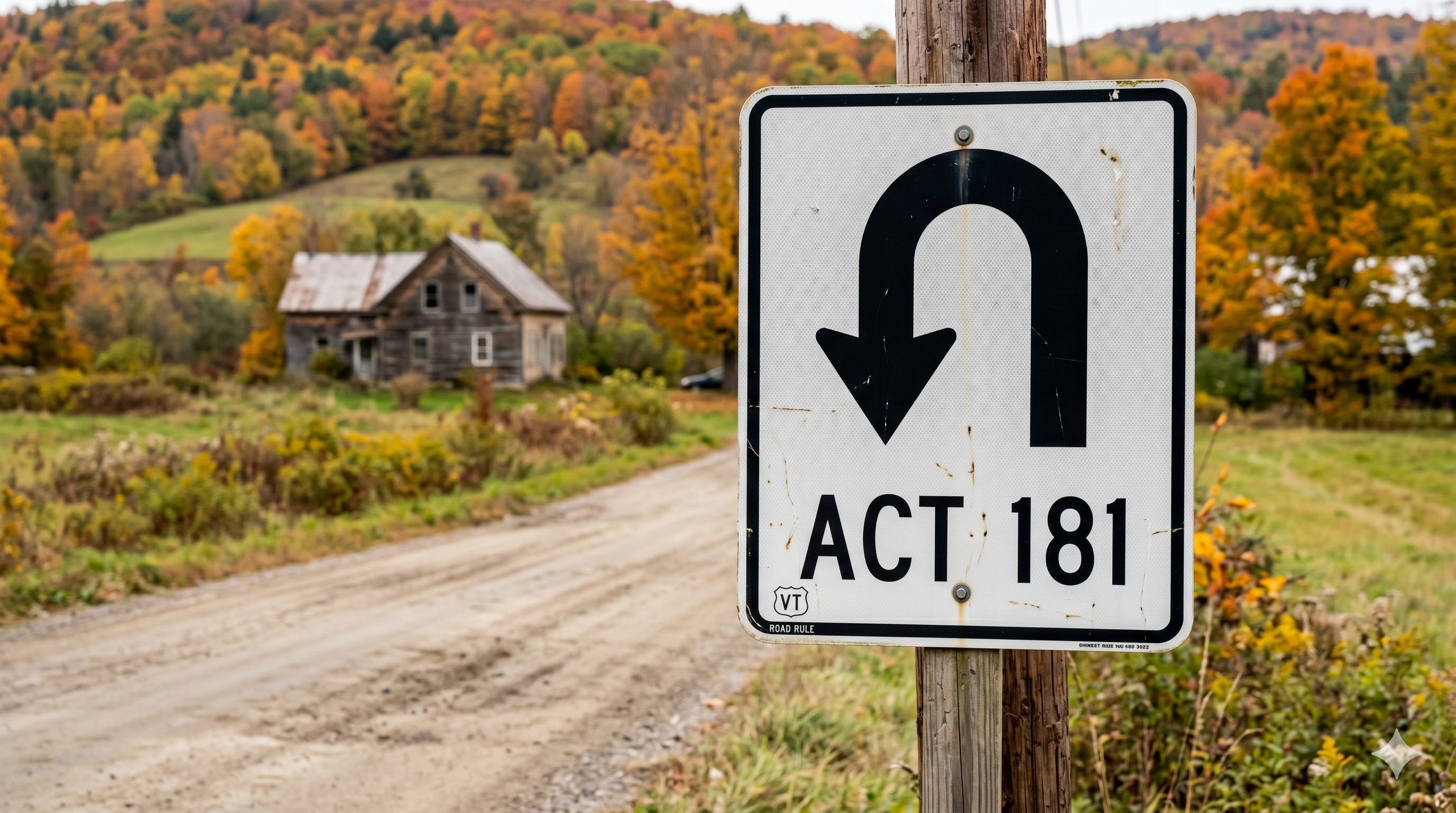
Tier 2 — covering most of rural Vermont — got a new “road rule.” Any private road longer than 800 feet, or any combination of roads and driveways longer than 2,000 feet, would subject a project to state Act 250 review. For a rural landowner, that meant extending a driveway to a new house at the back of a property, running a road to a new parcel for a child to build on, or expanding a working-lands business could all pull the owner into state-level permitting.
Tier 3 — areas the state designated as ecologically sensitive, such as headwater streams and habitat connectors — got enhanced environmental review that could further restrict what owners could build.
The law handed map-drawing responsibility to the state-level Land Use Review Board and Vermont’s regional planning commissions. For a rural Vermonter who owned land, the practical effect was this: what you could do on your own property would increasingly be shaped by lines drawn on a map in Montpelier — not by your town, not by your deed, and not by the rules you understood when you bought the property.
That is the law the House is now moving to partially repeal.
The 18-day pivot
On March 27, House Environment Committee chair Amy Sheldon, D-Middlebury, invoked Vermont’s state motto to defend Act 181. “We’re balancing freedom and unity, right? That’s what we do,” Sheldon told VTDigger and Vermont Public, explaining why she was not open to rolling back elements of the 2024 law she helped draft.
Eighteen days later, on April 14, Sheldon told her own committee the law was dividing Vermont. “We don’t need our shared interest in protecting our environment to divide Vermont, particularly at this moment,” she said at the committee hearing, announcing she was “looking at repealing the road rule and the Tier 3 and revisiting how we structure that.”
By the public record, nothing material changed in those 18 days. The draft maps were already public. The Senate had already voted on March 26 to postpone implementation. Hundreds of rural landowners had already rallied on the Statehouse steps on March 24. What appears to have changed was the political viability of defending the law.
The trigger for Sheldon’s pivot was not a single committee witness. Vermont Business Magazine reported on April 13 that the Rural Caucus had sent legislative leadership a letter requesting full repeal of the road rule and Tier 3 — a letter Vermont Business Magazine reported carried 57 signatures: 36 Republicans, 19 Democrats, and 2 Independents. The caucus had initially asked only for delays, Vermont Business Magazine also reported, but escalated to a full repeal demand as implementation detail came into focus. Nineteen Democrats signing a repeal letter on a signature bill of the Democratic caucus represented the kind of caucus-discipline break that reshaped the political arithmetic.
Senate President Pro Tempore Phil Baruth, a Burlington Democrat, told Seven Days he was “shocked” by Sheldon’s pivot. Representative Ela Chapin, D-East Montpelier, a Sheldon ally on the Environment Committee, captured the mood in the room on Tuesday: “I’m sort of, like, mourning that we have to start over in some ways.”
The warnings that were on record
The specific harms critics warned Act 181 would impose on rural Vermont were not a surprise on April 14. They had been laid out in detail, in writing, in public, weeks earlier — including by a former top Scott administration forestry official.
On March 24, Sam Lincoln, former Deputy Commissioner of the Vermont Department of Forests, Parks, and Recreation, took the microphone at the Statehouse rally. Lincoln told the crowd he had written to Speaker Jill Krowinski multiple times with specific examples of exclusion of rural Vermonters from the Act 181 process, offered to discuss them, and received no response.
On March 26, Governor Scott’s office published a commentary by Lincoln laying out three specific permitting scenarios he described as real cases of regulatory harm. Lincoln wrote that a bark mulch operation had faced a three-year permitting process on land a town had already zoned for industrial use. He wrote that a logger had been denied a municipal permit to process firewood because the business was located in a forest conservation zone. And he wrote that a small business had paid one hundred thousand dollars in fees, expert witnesses, and other conditions to get permitted to produce the wood fuel chips that heat buildings including the Statehouse — chips, he noted, now hauled in from out-of-state suppliers.
“I’ve written to the Speaker of the House multiple times with specific examples of exclusion or indifference toward rural Vermonters, with an offer to discuss them,” Lincoln wrote in the commentary. He called for repeal of the road rule and Tier 3. The commentary was subsequently republished in Vermont Daily Chronicle, Vermont Business Magazine, the Bennington Banner, the Brattleboro Reformer, and the Williston Observer.
On March 29, Compass Vermont sent Speaker Krowinski’s office a direct set of questions citing Lincoln’s commentary. The questions asked whether Lincoln’s account of writing to her office without response was accurate; whether she disputed any of the three specific permitting cases he had documented; what mechanisms beyond public comment sessions would ensure that rural landowners, foresters, and working-land businesses had substantive input in any Act 181 revision; and whether the House intended to take up Lincoln’s specific call to repeal the road rule and Tier 3. Compass requested a response by Monday, March 30.
Speaker Krowinski’s office did not respond.
Seventeen days later, on April 15, Speaker Krowinski issued a press release endorsing repeal of the road rule and Tier 3 — the same call Lincoln had made publicly, in writing, twenty days earlier. “Following extensive feedback from communities across Vermont, it is clear that the ‘Road Rule’ and ‘Tier 3’ need to be repealed,” the statement read. “Vermonters voiced their concerns, we heard them, recognized the issue, and we are taking action to make sure that areas of Vermont are not unnecessarily harmed.”
The same press release committed the Speaker to “a robust public engagement process that will give Vermonters an opportunity to share what is working and what needs to be fixed.” Act 181 itself was passed in the final days of the 2024 legislative session.
The top-down comparison
Krowinski’s April 15 statement compared Act 181 to Governor Scott’s proposal to consolidate Vermont’s school districts. “Vermonters have been clear that a top-down approach, whether it be land use policy or the administration’s proposal to force school consolidation into five districts, is not the right approach for shaping the future of our state,” the Speaker said. She invoked the House’s education bill, H.955, as a successful example of listening: “After listening to Vermonters from every corner of the state, we’ve taken their feedback and incorporated it into our current education bill, H.955.”
Act 181 itself imposed a top-down land-use framework of a kind Vermont had not seen since Act 250 — a state-imposed tiered classification system superseding key aspects of regional planning commission decisions and municipal zoning. H.955 has advanced in the House without a finalized district map, and Act 73’s School District Redistricting Task Force voted in November 2025 to recommend a voluntary-merger framework rather than submit prescribed statewide consolidation maps. The House is now repealing two of Act 181’s three regulatory pillars while citing a separate, ongoing education bill whose map has likewise not been completed.
Watson: “deal-breaker” to “unlikely to resist”
Senator Anne Watson, D/P-Washington, chair of the Senate Natural Resources and Energy Committee and Act 181’s Senate-side principal architect, followed a parallel but slower arc.
In February, Watson told VTDigger that fully repealing the road rule would be “a deal-breaker.” She defended the law on substantive grounds, saying she believed Vermont could build more housing and protect the environment at the same time.
On March 19, Watson co-issued a statement with Senate Majority Leader Kesha Ram Hinsdale framing S.325 — the Senate’s delay bill — as keeping Act 181’s work moving forward while acknowledging rural concerns as “real.”
On March 24, Watson took the podium at the Statehouse rally and was booed by protesters. She told the crowd she wanted to hear their concerns and work together. That same day, she told WCAX: “Act 181 has made a difference in turning around our housing crisis. We are actually starting to see more housing in Vermont because of Act 181 and that’s very encouraging.”
Compass Vermont reported in March that Watson’s 39% housing-starts figure, which her office attributed to Federal Reserve data, could not be substantiated. Act 181’s primary deregulatory housing tools, the Tier 1A and Tier 1B exemptions, took effect on January 1, 2026, giving them roughly 12 weeks of operational time when Watson cited the figure. Tiers 2 and 3 do not take effect until December 31, 2026. Vermont Housing Finance Agency 2026 reporting shows the actual annual pace of homebuilding remained at approximately 2,500 units — and decreased in 2025 relative to 2024. Federal Reserve building permit data for Vermont (FRED series VTBPPRIV, covering all structure types) shows significant month-to-month volatility, including a 666-unit spike in September 2025 followed by 123 in November and 108 in December. Watson’s office did not respond to Compass Vermont’s request for the underlying data series.
On April 15, after Sheldon’s pivot, Watson told Seven Days she would take testimony before deciding but was “unlikely to resist” the House’s change. Her new framing: the goals of Act 181 remained good, but there might be other ways to achieve them.
The arc: “deal-breaker” in February, celebrating unsubstantiated housing data in late March, “unlikely to resist” repeal in mid-April. Two months, three positions, one common thread — a defense that did not survive contact with either the data or the constituents.
A law passed on a data vacuum
Compass Vermont has previously reported that Vermont has no unified statewide buildable land analysis — confirmed on the record by the Vermont League of Cities and Towns, the Vermont Housing Finance Agency, the Department of Housing and Community Development, and Representative Marc Mihaly. The Legislature passed Act 181 in 2024, and overrode Governor Scott’s veto, without an authoritative answer to the fundamental question of how much Vermont land is actually available for housing development.
The road rule and Tier 3 were regulatory frameworks built on top of that absent foundation. When the Land Use Review Board and regional planning commissions began producing draft maps in early 2026, rural landowners could for the first time see what the law would do to their property. What followed — the Facebook organizing, the Lincoln commentary, the March 24 rally, the Rural Caucus letter, the committee testimony — was consistent with criticisms that had been raised before passage.
Governor Scott’s position throughout 2024 was that Act 181 was “a conservation bill” that did too little to promote housing in rural areas. Two years later, the Democratic House Speaker and House Environment chair are moving to repeal the two provisions Scott’s office warned would harm rural Vermont. Compass Vermont has not identified any public statement from Democratic leadership acknowledging that Scott’s veto warning had been borne out.
What happens next
The House Environment Committee will need to take a formal vote to amend S.325. The full House would then vote. The bill returns to the Senate, where Watson has indicated she is unlikely to resist the House’s changes. Sheldon and committee members indicated on April 14 that they intend to develop alternative approaches to protecting sensitive ecosystems outside the Act 181 framework — the shape of which has not yet been defined.
Part 1 of a two-part series. Part 2 will examine what the Road Rule rollback does not fix — and what Vermont still needs to do to meet its housing targets.