


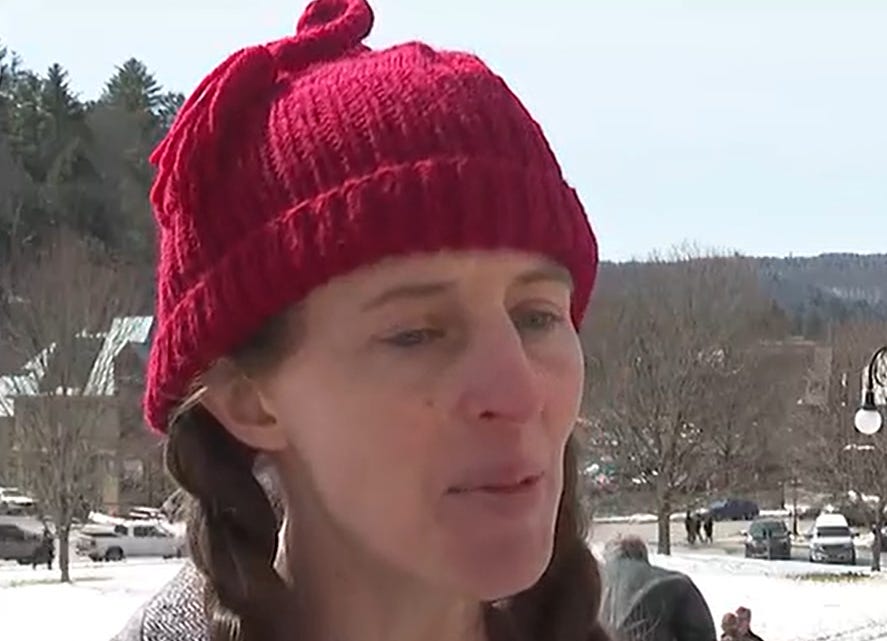
Several hundred Vermonters — farmers, landowners, maple producers, small business owners — packed the Statehouse steps in Montpelier on Tuesday in one of the more striking displays of rural frustration the Legislature has seen in years. Wearing workwear and carrying signs reading “Hands Off Our Land,” “Property Rights Are Not Up for Negotiation,” and “Repeal Act 181: Let Vermonters Pass Down Their Land,” the crowd had come to deliver a message about Act 181, the sweeping land-use overhaul passed by the Democratic supermajority in 2024 over Governor Scott’s veto.
The protest had bipartisan energy behind the podium. Sen. Russ Ingalls, R-Essex, organized the rally, and Republicans are planning to push forward amendments to repeal Act 181 in whole or in part. Several Democrats and independents joined them.
Then Sen. Anne Watson — D/P-Washington, the chair of the Senate Natural Resources and Energy Committee and one of Act 181’s principal architects — stepped to the microphone. And got booed.
What Act 181 Does — and Where
Act 181 set in motion a transformation of Vermont’s landmark development-review policy, Act 250, mandating a first-of-its-kind mapping effort that will essentially dictate where future development is subject to Act 250 scrutiny and where it won’t be, through a tiered land-use classification system. The intent was to encourage more homebuilding in already-developed areas while boosting environmental protections in rural ones.
Understanding the geography of that trade-off is essential to evaluating what the law has actually accomplished. The Tier 1 growth centers — the areas where Act 181 actually removes regulatory barriers to housing — cover an estimated 2.1% of Vermont’s land area, according to state planning data. The remaining 98% of the state falls into Tier 2 or Tier 3, where existing rules remain in place or new restrictions are being added.
The protesters’ chief complaints center on two aspects of Act 181. The first is the “road rule” — a provision requiring that a private entity wanting to build a road longer than 800 feet, or a combination of roads and driveways longer than 2,000 feet, apply for a state Act 250 permit. A detail largely absent from coverage elsewhere: the 2,000-foot combined-length trigger can be met by a single home on a large rural parcel — a driveway, not a subdivision road — subjecting a family building on their own land to the same complex permitting process as a major commercial developer.
Ian Ackermann, a maple sugar operator from Cabot, told the crowd: “It seems pointless to buy land and have a dream when maps are being made by people you’ve never met, by people that have never stepped foot on your property, and yet they’re trying to control the very land you own.”
Loralee Tester, director of the Northeast Kingdom Chamber of Commerce, framed it in economic terms: “It limits what families can do with land that is often their only meaningful wealth. We are against policies that place every burden on the people with the fewest resources and the least political power, and then call it progress.”
Watson’s Claim — and What’s Behind It
Sen. Watson, D/P-Washington, who chairs the Senate Committee on Natural Resources and Energy, was one of Act 181’s principal architects. She took the podium Tuesday to defend it.
Her on-camera statement to WCAX: “Act 181 has made a difference in turning around our housing crisis. We are actually starting to see more housing in Vermont because of Act 181 and that’s very encouraging.”
WCAX also reported — confirmed directly to Compass Vermont by WCAX — that Watson stated housing starts in Vermont are up 39% since Act 181 was implemented, citing what she described as a Federal Reserve analysis.
Compass Vermont identified the likely source as FRED — the Federal Reserve Bank of St. Louis’s publicly available data portal, which aggregates building permit data from the U.S. Census Bureau’s Building Permits Survey. FRED does not publish a Vermont-specific housing starts series. It publishes building permit authorizations.
That distinction is not minor. A building permit is a government authorization to build. A housing start is actual construction — a shovel in the ground. They are not the same thing, and in Vermont’s constrained market, a significant number of permitted projects never reach the construction phase due to financing costs, labor shortages, and interest rates.
Compass Vermont contacted Watson’s office requesting the specific data series, the time period used for the comparison, and clarification on whether the figure refers to permits or actual starts. Watson’s office did not respond by the time of publication.
Why the 39% Figure Doesn’t Hold Up
Even setting aside the permits-versus-starts problem, the claim has several additional layers of difficulty.
Problem one: Timing. Act 181 was enacted June 17, 2024. But its primary deregulatory housing tools — the Tier 1A and 1B exemptions — didn’t take effect until January 1, 2026. Tiers 2 and 3 don’t take effect until December 31, 2026. Watson is crediting a 39% increase to provisions that have been operational for roughly 12 weeks.
Problem two: The baseline makes 39% look small. Vermont’s housing production was already so far below need that a large percentage gain barely moves the needle. Vermont permitted just 2,302 new homes in 2022 — considered a strong recent year — still well below the 5,000 to 7,000 homes needed annually to meet the state’s needs. A 39% increase off that baseline yields roughly 3,200 units — against a target of up to 7,000. Vermont is currently building only 27% of the homes it needs annually to meet its 2030 targets.
Problem three: The data points the other direction. According to VHFA’s 2026 reporting, the actual annual pace of home building remained at approximately 2,500 units — and actually decreased in 2025 relative to 2024. The raw FRED permit data also shows significant month-to-month volatility, including a spike of 666 units permitted in September 2025 followed by 123 in November and 108 in December. Any annual or period percentage calculation is highly sensitive to which months are selected as the comparison window. A calculation that captures a spike month and compares it against a prior low can produce a large percentage gain that evaporates the following quarter.
Problem four: The 40% contradiction. Watson’s own side of the argument undermines her claim. Vermont’s own planning agencies found that roughly 40% of Vermont’s housing targets must be met outside of the Tier 1 growth centers where Act 181 provides relief. Act 181 simultaneously deregulates an estimated 2.1% of the state’s land while adding new regulatory burdens — the road rule and Tier 3 — in the areas where nearly half the needed housing has to be built. Vermont needs 36,000 additional year-round homes between 2025 and 2029. The law’s own structure may be hindering nearly half of that goal while Watson celebrates results from a sliver of the map.
The Infrastructure Catch-22
There is a structural problem embedded in Act 181 that received almost no coverage in Tuesday’s protest reporting. To qualify for Tier 1A — the designation that actually delivers regulatory relief for housing — a municipality must have public water and sewer systems, permanent zoning, and professional planning staff. Most rural Vermont towns have none of these things and lack the tax base to build them. There is no funded state pathway to qualify. The law’s primary benefit is structurally inaccessible to the towns that need it most.
Where Things Stand
The day after hundreds of Vermonters rallied on the Statehouse steps, the Vermont Senate put Act 181’s most contested provision to a recorded vote. Senators Ingalls and Heffernan pushed a floor amendment to repeal the road rule outright. It failed 13-17 — the Republican caucus could not peel off enough Democrats. S.325, the delay-to-2030 version backed by Watson and Senate Democratic leadership, then passed 18-12, with at least five Democrats or independents crossing the aisle. The bill now moves to the House, where a steeper climb is expected.
Rep. Mike Tagliavia of Corinth, who supports full repeal of the road rule, captured the underlying equity argument plainly after Tuesday’s rally: “Rural Vermont needs a leg up like Tier 1 needs a leg up. Act 181 advanced one small area of Vermont over another area.”
Lt. Gov. John Rodgers, asked by Vermont Daily Chronicle whether a delay to 2030 merely kicks the fight to the next administration, said that is precisely why enforceable, forward-looking legislation needs to pass this year.
Watson told protesters she was willing to hear them out: “I want to know your concerns. I want to hear from you. I want to work together with you to figure this out.”
Act 181’s supporters argue the protests are built on misinformation. Lauren Hierl, director of the Vermont Natural Resources Council, said that claims suggesting entire towns will be covered by Tier 3 rules are “inflated, overstated, and purposefully stoking anger.”
Vermont’s housing crisis is not in dispute. The shortage of homes affordable to purchase has contributed to a tripling of Vermonters experiencing homelessness between 2019 and 2024, and Vermont’s per capita homelessness rate is now the fourth highest in the nation. The legitimate debate is whether Act 181 solves that problem or trades one set of barriers for another while concentrating its limited benefits on an estimated 2.1% of the state.
Watson’s 39% figure — drawn from a building permits database, attributed to the Federal Reserve, applied to a law whose main provisions are roughly 12 weeks old, against a baseline so far below need that even a large percentage gain changes little — does not make the case she intended it to make. What it illustrates instead is how a number, stated with confidence at a podium and credited to the Federal Reserve, can move through a news cycle without anyone stopping to ask what it actually measures. The Senate’s own vote Wednesday tells a similar story: thirteen senators tried to repeal the road rule Watson defended. Seventeen held the line — for now. The fight moves to the House, where the outcome is far from certain.
Editor’s Note: The original headline identified Senator Watson as “Housing Chair.” As the article states, Watson is the Chair of the Senate Natural Resources and Energy Committee. The headline has been changed to reflect the correction.
The key to affordable housing lies in the Tier 2 and 3 land that Act 181 has effectively removed from development. Most Vermont homes built since the 70’s when Act 250 was adopted were built on reasonably priced land that was zoned “farming and rural residential” or similar and allowed homes on minimum 2 acre lots so that a drilled well and primary and replacement leach fields could be sited. The vast majority of the subdivisions that created these building lots did not need Act 250 permits. There is still plenty of such land that could support single family homes for young families that want the Vermont heritage lifestyle of a house, room for the kids to play, a garden plot, an accessory building for a customary home industry (such as home building) and broadband access. But Act 250 is a showstopper. It will make reasonably priced land unavailable because it will deter land owners from even considering going through the approval process, which has neither predictable cost, timelines or outcomes. Repeal Act 181 if you want young people to come to, or stay in Vermont.