


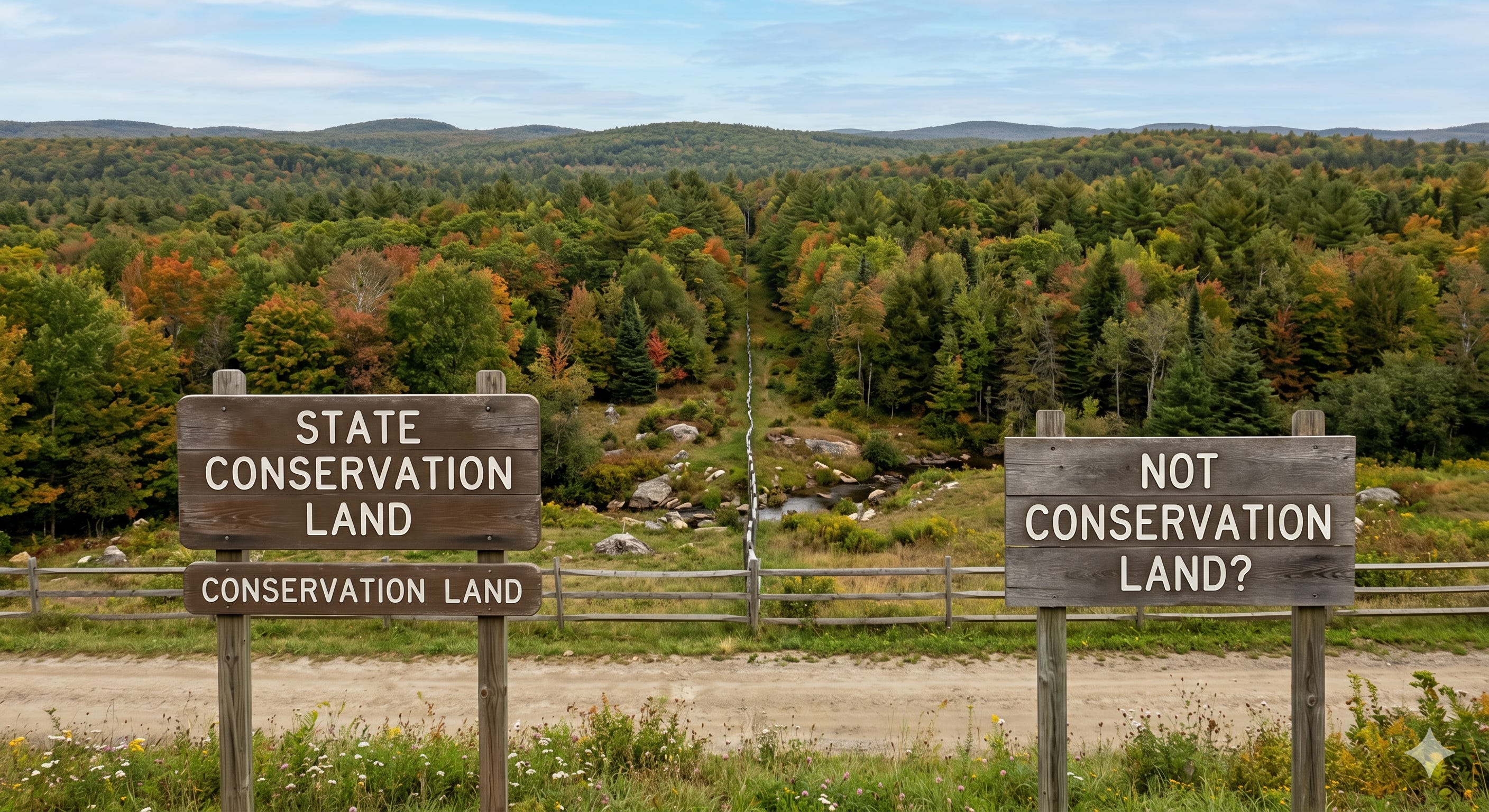
On Tuesday, the Vermont House voted 58-80 against allowing a floor vote on H.70, a bill that would expand the state’s definition of “conserved” land to include the 2.5 million acres enrolled in Vermont’s Use Value Appraisal — the working farms and forests held under the state’s current use tax program.
It was the second time in three months Republicans have used a Rule 51 motion to try to pry the bill loose from the House Environment Committee, where it has sat without a vote since March 2025. A February attempt failed 48-86. The May attempt added 10 votes.
The substantive question — what counts as conserved — has already been answered differently by the other nine states with a formal 30x30 commitment: a goal of conserving 30 percent of the state's land by 2030.
What members said about their votes
Eleven members put statements on the record. Among yes votes, the framing was consistent: working lands and conservation are not opposites. Rep. Bailey of Hyde Park said “rural Vermonters have been caring for this land for generations, and our farmers understand better than anyone that conservation and working lands go together.” Rep. Brigham of St. Albans Town said “too often we treat conservation and agriculture like separate conversations, but in Vermont they are deeply connected.” Rep. Hango of Berkshire warned that excluding working lands “risks letting that acreage go fallow to grow up into brush and forcing rural Vermonters to migrate to other states where the regulatory climate is less restrictive.”
One statement came from a no vote. Rep. Olson of Starksboro voted against bringing the bill forward and explained the vote this way: “I am informed that the entity and the agency charged with implementing Act 59 intend to include land enrolled in the Use Value Appraisal program into the Conserved Land Inventory and the Conservation Plan. My constituents and many other Vermonters will understandably hold the entity and the agency accountable for those promises.”
What current use does
Vermont’s Use Value Appraisal program, almost always called “current use,” is a tax mechanism created in 1978. A landowner enrolls eligible farmland or forestland, agrees to keep it in active agricultural or forestry use, and accepts a recorded restriction against developing the enrolled portion. In exchange, the state taxes the land at its use value rather than its market value. The tax savings can be substantial. Roughly 19,000 properties covering 2.5 million acres — about 42 percent of Vermont’s total land area — are currently enrolled. It is the single largest land conservation mechanism in the state by acreage, larger than every easement and public landholding combined.
Landowners can withdraw, but doing so triggers a Land Use Change Tax of 10 percent of the fair market value of the withdrawn portion. The financial incentive structure is heavily weighted toward staying enrolled, and most landowners do.
What Vermont counts
Act 59 of 2023, the Community Resilience and Biodiversity Protection Act, set Vermont’s conservation goals: 30 percent of the state’s land conserved by 2030, 50 percent by 2050. The Vermont Housing and Conservation Board, the agency tasked with maintaining the conserved-lands inventory, defines conservation as “an area with permanent protection from conversion.”
By that definition, Vermont’s inventory stands at 27 percent — 1.6 million acres. The 2.5 million acres in current use are excluded because owners can withdraw, even though most don’t, and even though withdrawal carries a financial penalty.
What other 30x30 states count
The National Caucus of Environmental Legislators’ January 2026 midpoint report summarizes how each of the ten states with a formal 30x30 commitment defines “conserved.” Vermont is the only one that does not, in some form, count working lands.
Maine. Goal language: “Increase by 2030 the total acreage of conserved lands in the state to 30% through voluntary, focused purchases of land and working forest or farm conservation easements.” Working lands are named in the goal itself. The Maine Climate Council’s 2025 Annual Report puts the state at 22.5 percent.
Maryland. Definition: “permanently protect land from development through purchase, donation, perpetual conservation or an open space easement, or fee ownership to preserve the cultural, historical, ecological, or agricultural value of the land.” Maryland hit its 30 percent goal in May 2024, six years ahead of schedule — the first state in the country to meet a formal 30x30 goal. It is now working toward 40 percent by 2040.
California. Pathway 9 of the state’s 30x30 plan addresses working lands as complementary conservation measures: “Our state’s working lands, including agriculture, implement actions specified by this pathway.”
New Jersey. Implementation document is titled the 2024 Natural and Working Lands Strategy. Working lands in the title.
New Mexico. Foundational principles of the state’s 30x30 plan include “a role for natural and working lands.” Conserved means “any land in a primarily natural or traditionally managed condition.”
Massachusetts. Conservation definition includes “agricultural preservation restrictions, watershed preservation restrictions, and other deed restrictions” alongside outright ownership.
What this looks like to a Vermont landowner
If you own land in Maine and you sign an agreement restricting development on it, the state counts your land as conserved. If you own land in Maryland, the same. California, New Jersey, New Mexico, Massachusetts — all the same. The mechanisms differ. But the principle is consistent: when a landowner accepts a binding restriction against development, the state acknowledges the act of conservation.
Vermont has 19,000 landowners who have done exactly that. They have signed agreements with the state, recorded against the deed, restricting development on their land in exchange for tax relief. Some of those agreements have been in place for more than forty years. The financial penalty for withdrawing — 10 percent of the land’s full market value — keeps most landowners enrolled across generations. The state has the largest working-lands tax program of any state in the Northeast, covering 42 percent of Vermont’s total land area.
Vermont does not count any of it.
The structural mismatch
Vermont set the most ambitious conservation goal of any state — 50 percent by 2050, the only government in the world to enshrine 50x50 in statute. Vermont also chose the narrowest definition of conservation among the ten states with formal 30x30 commitments.
The math creates the political dynamic. Closing a 23-percentage-point gap between Vermont’s 27 percent inventory and its 50 percent goal, with the current definition, requires roughly 1.4 million additional acres of permanent easements or public land acquisition by 2050. The state does not have the budget for that scale of easement purchase. The only other lever is regulatory — using land-use restrictions to either constrain development on private rural land or to make conservation easements financially attractive by limiting alternatives.
That is the regulatory rationale behind the Act 181 road rule, the Tier 3 mapping, expanded ANR jurisdiction over working forests, and the recent push for state wildlands designations under H.276.
Counting current use would change the math. Vermont’s official inventory would jump from 27 percent to roughly 70 percent. The state would already be past both its 2030 and 2050 goals. The structural case for additional regulation of rural Vermont would substantially weaken.
That is the substantive issue H.70 raises, and what 18 months of committee inaction has so far prevented from coming to a vote. It is also what produced the Act 181 road rule backlash and the House Environment Committee’s 19-day pivot in April from defending the law to repealing significant portions of it.
What the record shows
Act 59’s own purpose statement names working lands as part of the vision: “supports working farms and forests.” Governor Scott, in his 2023 signing statement letting the bill become law without his signature, warned that the bill’s definitions were “so broad and vague as to be virtually meaningless.” Three years later, the definitional question those words anticipated is the question H.70 raises.
The fifty-eight House members who voted to bring H.70 to the floor are not asking the legislature to declare a tax-program enrollment equivalent to a permanent easement. They are asking why Vermont set a 50x50 goal without acknowledging the 2.5 million acres of working farms and forests that Vermont landowners have voluntarily kept undeveloped for decades. Maine has answered that question. Maryland has answered it. California, New Jersey, New Mexico, and Massachusetts have answered it.
The Environment Committee heard from eight witnesses on H.70 in February 2026 — including the Nature Conservancy and Audubon Vermont — and the bill has not advanced. Tuesday’s vote was about whether the question gets debated. The substantive question itself remains unanswered.
Compass Vermont is independent and reader-supported. If you value this work, please subscribe.
Because that land can be converted into a housing development anytime the landowner wants? After receiving years of tax relief?
A significant problem here is in the last line above. There is no question that Vermont needs more housing that is reasonably affordable to most working folks. There is debate about the size of this shortage. The most frequently cited assessment shows the short-term need varying by more than 11,000 units, depending on what assumptions are made in projecting that need.
But the uncertainty - some of which is inevitable in a discussion like this one - does not have to be resolved to realize that the debate over the inclusion, or not, of working lands in state conservation goals is not tightly connected to the housing issue. The only way thousands of housing units can be added within the next few years is to build those units where there is already infrastructure, or where central water, wastewater, and storm water utilities, and roads can be easily expanded. Very little of the land included in anyone's vision of conservation falls into that category. Letting rural Vermonters add a few homes on large lots (or not) within a framework of reasonable regulations is barely relevant to the housing shortage.
What is most relevant, and I do not see in the conversation, is the question of how to provide the necessary infrastructure that housing development will follow. This could be done in the existing growth centers and by building new infrastructure in small communities where that makes sense. Centering the housing conversation on access to infrastructure would shift it from abstract, large numbers (which get everyone excited, if not panicked, but do not change the reality that housing gets built one unit at a time) to the difficult, highly specific, on-the-ground questions about where infrastructure can be added and how it can be afforded. And building from there, to the question of how to make whatever housing gets built more affordable. That's what the Legislature should be talking about.
Focusing the housing conversation on infrastructure would also free the conservation conversation from what is, honestly, a distraction. Neither "side" wants to build vast tracts of housing in rural Vermont. Some people want it to be a little wilder, some want it to be more pastoral. And there is the hard question about the permanence of protections that is raised in Peter Erb's comment. It is impossible to navigate these questions in the abstract (which, in this case, too, is the enemy of clear thinking), but Vermonters are capable of dealing with it in a process that brings them together to talk about specific landscapes. The Legislature should get that process running (expensive, I know, but cheap compared to losing and then having to buy land back and restore it).
To recap, there is no pressing need to entangle the housing and conservation conversations. In fact, doing so at this time makes both more difficult. They will intersect, but if the proper foundations have been laid, the questions that must be answered at that time will no longer be abstract. They will focus on specific places where hard choices must be made. That's not as much fun as talking about lofty goals. But it is the only way folks will get a Vermont that works.