


Vermont property taxpayers are caught in a squeeze with no scheduled relief. The legislature has delayed Act 73’s foundation formula — the mechanism designed to restructure how the state funds public education — until at least 2030.
Education spending keeps growing at 5 to 7 percent annually. Revenue supporting the Education Fund grows at roughly 1.7 to 2.6 percent. That gap hits your property tax bill every year, and it will keep hitting it until the formula takes effect.
Now the Senate Education Committee wants to raise the formula’s starting price before it even begins.
What’s happening
Act 73 set the foundation formula base at $15,033 per weighted pupil. The law specifies that this base grows each year by a standard government inflation index called NIPA — the National Income and Product Accounts implicit price deflator. The Senate Education Committee is proposing to replace that index for the first two years with something faster: actual education spending growth.
At an April 7 briefing, Joint Fiscal Office analyst Ezra Holben showed the committee what that switch would cost. Education spending grew 5.8 percent in FY26 and is projected to grow 4.2 percent in FY27. NIPA, by comparison, grew about 6 percent cumulatively over those same two years.
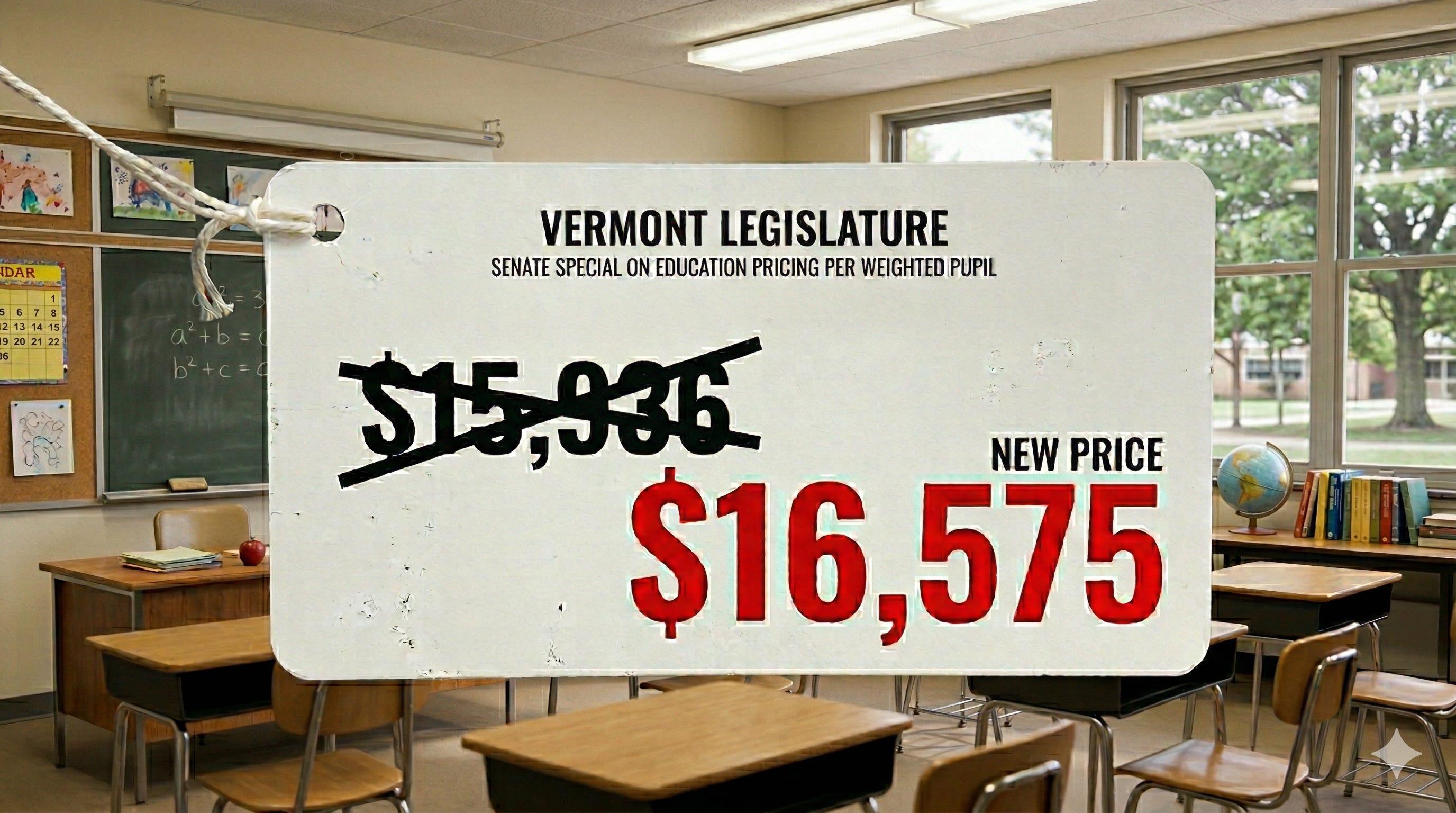
The result: by FY27 the base would be $16,575 under the Senate concept versus $15,936 under the law as written. That is $639 more per weighted pupil — a 4 percent increase over what Act 73 specified.
Why two years becomes forever
After the two-year window, both paths revert to NIPA. But they grow from different starting points. The higher base never comes back down. The JFO’s projections show the gap widening through at least FY2030: $17,907 under the Senate concept versus $17,217 under NIPA — a spread of $690 per pupil, still growing. Two years of a different inflator, permanently higher costs.
What it costs you
The base is not just a number. It is the number. Every student in the formula gets multiplied against it — and many students carry weights that magnify the effect. An English Learner at Level 1 counts as 2.11 weighted pupils. A student with the most significant disabilities counts as 2.49. A student from an economically disadvantaged family counts as 1.02. All of those multiply against whatever the base is. The weights do not adjust for inflation. Only the base moves. So when the base goes up, everything goes up.
In FY26, Vermont’s total weighted pupil count was 142,564 according to the JFO. At $639 per weighted pupil, the statewide cost difference between the two paths is approximately $91 million. Property taxes fund roughly two-thirds of the Education Fund. That cost lands on property taxpayers.
The circular logic
The foundation formula was designed to slow education spending growth by replacing local budget-driven increases with a measured, inflation-indexed base. The Senate’s proposal uses the very spending growth the formula was built to constrain — 5.8 and 4.2 percent, well above general inflation — to set the formula’s permanent starting point. The pattern the formula is supposed to fix becomes the input that sets the formula’s price.
And this is happening at the same time the House has pushed the formula’s start date to 2030 via H.955, which Compass Vermont covered in detail. Taxpayers are being asked to wait longer for the fix and pay more when it arrives.
The governor says it wasn’t the deal
Act 73 was a negotiated compromise. Governor Phil Scott, speaking at an April 8 press conference, said the Senate’s approach departs from what was agreed to. “I think we all agreed when we passed Act 73 to begin with last year on what the amount would be,” he said. “So it isn’t consistent.”
Scott described Act 73 as “a compromise from our original proposal, which we negotiated in good faith with both the House and the Senate,” and expressed frustration with the pace of reform: “It appears our fears were validated. So far, the House has punted the difficult decisions, as well as the work we need to do and committed to doing just 10 months ago.”
He did not say whether the inflator language was a veto-level concern.
What to watch
The Senate Education Committee has not yet voted on the inflator language. The JFO noted its modeling is preliminary — based on March 20 budget data, with some district budgets still being finalized. But the structural finding is clear: the Senate proposal would permanently raise the base, permanently increase district funding obligations, and permanently increase the property taxes needed to pay for them.
No one on the committee has publicly explained why taxpayers should absorb a higher starting cost for a formula that has not yet taken effect, built on the same spending growth the formula was designed to slow down. That question deserves an answer before the vote, not after.
This story is based on a Joint Fiscal Office presentation delivered by Ezra Holben, Fiscal Analyst, to the Senate Education Committee on April 7, 2026, and Governor Scott’s remarks at an April 8 press conference.
I find it hard to believe that people reading this and other sources aren't saying anything here.... Costs are out of control....