


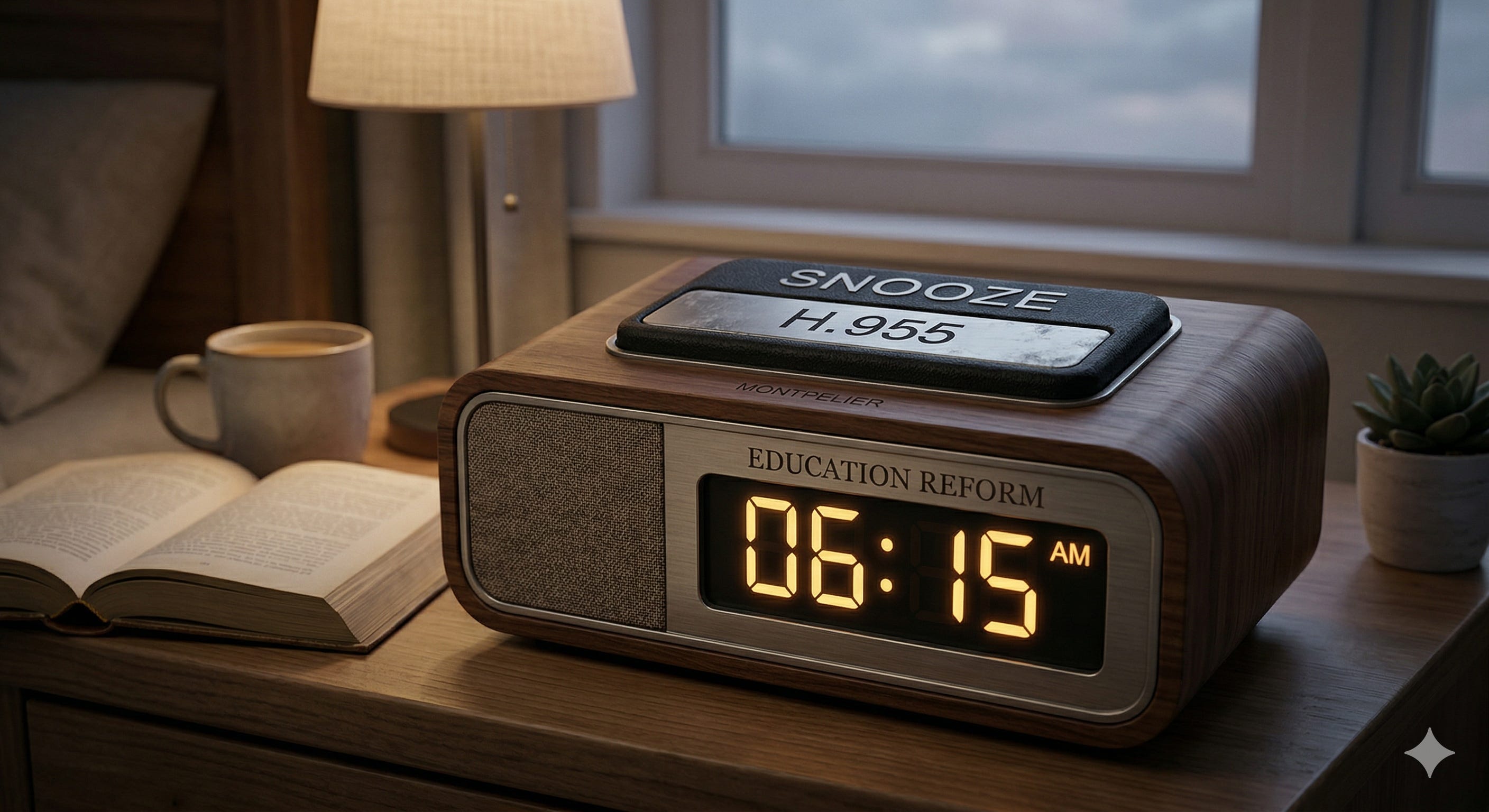
You go to work every day. You have a number to hit. If you don’t hit it, there are consequences. Nobody resets your clock.
This week, the Vermont legislature reset its clock. A committee vote pushed the most significant structural fix to Vermont’s education funding system two years further into the future. The new arrival date: 2030. The same system driving property tax bills upward every year gets to keep running until then.
This is not the first reset. It may not be the last. And independent research raises serious questions about whether the fix being built will work even when 2030 arrives.
What just happened, in plain English
The House Education Committee advanced H.955 this week, a bill that overlays seven regional “Cooperative Education Service Areas” — CESAs — over Vermont’s existing 119 school districts. These regional entities would facilitate the sharing of services like special education, human resources, and professional development among member districts.
The bill’s merger process is worth understanding precisely. Every school district would be required to participate in a study committee examining the advisability of forming a merged district — participation in that process is mandatory. But the final decision to merge rests with local voters. It is a mandatory process with a voluntary outcome.
The bill differs from Gov. Phil Scott’s preference for mandatory consolidation based on specific district maps. Scott has publicly threatened to veto the state budget absent a more prescriptive reform plan, according to reporting by VTDigger. H.955 passed on a party-line vote and now moves to the House Ways and Means Committee.
Buried in the fine print: H.955 moves the effective date of Vermont’s new education foundation formula — as originally established in Act 73 of 2025 — from July 1, 2028 to July 1, 2030. That detail matters more than anything else in the bill.
The argument Vermonters keep hearing
Every version of this debate carries a similar premise from consolidation supporters: larger systems can share services and achieve economies of scale. Education Secretary Zoie Saunders has publicly argued Vermont needs to “move to scale,” telling the House Education Committee that smaller districts will be “at an inherent disadvantage” without consolidation.
It’s a reasonable-sounding argument. The available evidence, however, is more complicated.
What the research actually found
Vermont tried large-scale consolidation before. Act 46, passed in 2015, reduced approximately 270 school districts down to 119 — the same 119 that H.955 now proposes to consolidate further. Earlier laws, Acts 153 and 156, had already reduced the count from a higher number before Act 46 took effect. The stated goal in 2015 was identical to today’s: scale, efficiency, savings.
A Yale University thesis by researcher Grace Miller, using regression analysis on 15 years of Vermont school spending data, examined what actually happened. Merged districts did save roughly 6.5% on administrative costs and contracted services, according to Vermont Public’s reporting on the thesis. But those savings were largely erased by a predictable mechanism: when districts merge, labor unions typically negotiate to bring all staff up to the highest existing salary schedule among the merging entities. Teacher contract costs rise, student support spending increases, and transportation costs climb. Merged and unmerged districts, the analysis found, ended up spending approximately the same overall.
According to a December 2024 analysis by Campaign for Vermont, a nonprofit nonpartisan advocacy organization, education spending in Vermont increased by $606.8 million — 42% — since 2014, while the student population shrank. Federal pandemic relief funds temporarily inflated per-pupil spending between 2020 and 2023 — but Vermont’s structural spending trajectory was already steep before the pandemic and has continued climbing since. Academic performance over the same period dropped from historically among the best in the country to middle of the pack nationally, according to state and national assessment data.
On outcomes, Agency of Education assessment data shows that Burlington’s school district — roughly 3,200 students — has historically produced test results comparable to much smaller districts, including Royalton at approximately 320 students. If scale reliably drove better outcomes, that difference should appear in the data.
Campaign for Vermont noted in its March 2026 legislative update: “The predominant viewpoint in both the House and Senate seems to be acceptance that larger districts inherently perform better on a cost or outcomes basis. The data does not support that assumption.”
Two independent analyses — a Yale statistical study and Vermont’s own Joint Fiscal Office — along with Campaign for Vermont’s longitudinal research, all point in the same direction. The JFO, in a 2023 report required by law, examined education cost containment options and found that consolidating administrative services “does not necessarily directly impact teachers, students, or education outcomes.” Potential savings, the JFO wrote, “could” be realized — not “will.”
Taken together, the available evidence does not clearly establish that consolidation alone will deliver major statewide savings or meaningfully better student outcomes.
The accountability gap
Act 46 of 2015 required the Agency of Education to submit annual progress reports through 2021. In response to a Compass Vermont press inquiry, Toren Ballard, the Agency’s Policy and Communications Director, confirmed that the AOE produced a single report covering the entire 2015-2021 period — and did not publish it until 2024.
Six years of legally mandated annual accountability reporting were condensed into one document delivered nearly a decade after the law’s passage. The agency currently advocating for a further move toward scale has provided, in total, one report on what the last move to scale produced.
The number nobody ran
Here is a specific gap in this week’s legislative action. The legislature pushed the foundation formula — the mechanism designed to restructure how education dollars flow and change the incentives driving costs upward, as stated in Act 73’s legislative purpose — two years further into the future. The Joint Fiscal Office’s fiscal note on Act 73 did not provide a statewide taxpayer cost estimate for the delay, and no such estimate has appeared in publicly available legislative documents as of publication.
The JFO noted that estimating the transition cost “depends on future policy decisions that would affect property tax rates.” The delay to 2030 extends that uncertainty two additional fiscal cycles. Meanwhile, lawmakers are again using one-time funds to manage this year’s tax increases — a bridge that addresses the symptom without touching the structure.
Vermont homeowners know what their property tax bill is. They know what it was two years ago. The legislature extended the current system by another two years without a public accounting of what that extension costs.
What this means
Vermont’s education property tax keeps rising because school costs are growing significantly faster than the revenue base supporting them, according to Joint Fiscal Office Education Fund data. The foundation formula, now pushed to 2030, was designed — as stated in Act 73 — to change that incentive structure. It may still do so, if it survives the political process between now and then.
The record on consolidation as a cost-cutting tool is what it is: the available analyses raise serious questions about the premise. The legislature’s own accountability mechanism for the last round of consolidation has produced, in total, one report — delivered nearly a decade late. And the cost of the latest two-year delay has not been publicly calculated.
Vermont’s property taxpayers — the people whose tax bills arrive on schedule regardless of what Montpelier votes — have a reasonable interest in seeing those numbers before the clock gets reset again.
Compass Vermont is an independent, reader-supported news outlet covering Vermont policy. If this reporting is useful to you, please consider supporting it.