


“We are tired of being told to hate each other.”
That was part of James Talarico’s message after winning a U.S. Senate seat in Texas this week, The Wall Street Journal reported. In Kansas, fellow Democrat Adam Hamilton pledged to work closely with Republican Sen. Jerry Moran. Moran responded that the two shared a responsibility to deliver results for Kansans, KWCH reported.
Vermont governors have repeatedly put that willingness into practice. Democrat Howard Dean retained Republican Gov. Richard Snelling’s human services secretary. Democrat Peter Shumlin invited Republican Lt. Gov. Phil Scott to his cabinet meetings. Scott subsequently retained officials appointed by Shumlin.
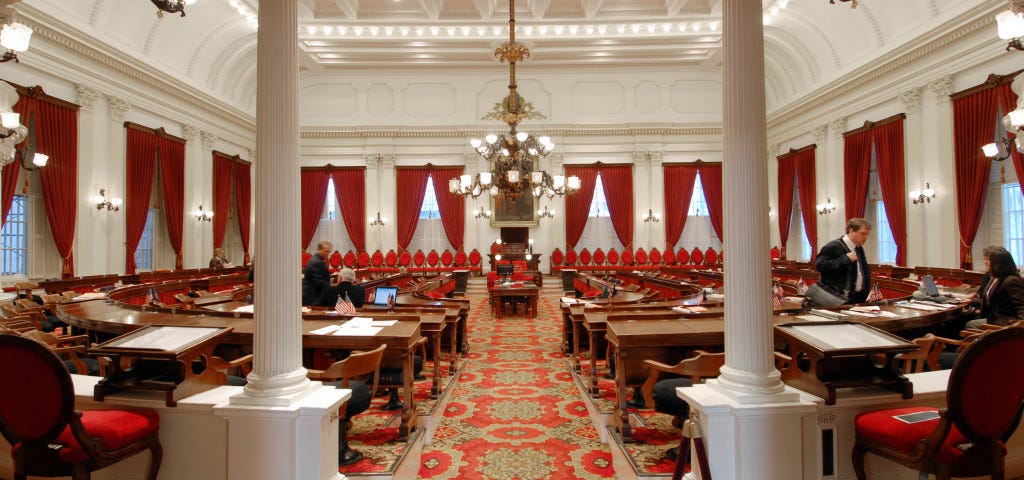
The coming legislative session raises a question about how far that approach can extend: Will the governor and lawmakers turn their stated willingness to cooperate into agreements they can carry out together?
One Vermont example began with a governor waiting outside the speaker’s office.
What Cooperation Took in 1991
On the opening day of the 1991 legislative session, Democratic House Speaker Ralph Wright looked out his office door and found Republican Gov. Richard Snelling waiting in a small alcove.
Vermont faced a growing deficit, and Snelling had come to ask the Democrat for help. Snelling gave ground on his own plan, taking on more taxes than he wanted and putting more of the burden on the wealthy. The two men built a package of cuts and $90 million in new revenue, the largest tax increase in state history at the time, Chris Graff wrote. When the House split 72–72 on the bill, Wright cast the deciding vote for the agreement they had negotiated.
Seven Days later wrote that Snelling, Wright and Democratic Senate leader Doug Racine each spent political capital inside their own parties on a deal none of them fully liked.
A Long Record, With Exceptions
1966. Democratic Gov. Phil Hoff appointed Republican Franklin Billings Jr. to the Superior Court, and Democratic Gov. Tom Salmon later named him to the Vermont Supreme Court.
1992. Dean and Con Hogan, the human services secretary he kept from Snelling’s cabinet, expanded Dr. Dynasaur to cover eligible children through age 17.
2002 and 2016. Dean and Shumlin each filled the same open Senate seat with a Republican.
2017. Scott also kept Shumlin’s education secretary, Rebecca Holcombe, who later ran for governor as a Democrat.
There are exceptions. Under Dean, a Democrat filled a vacant Republican House seat in 2002, according to the House clerk’s records. This April, Burlington Democrats objected when Scott passed over their three nominees to fill a House vacancy.
The Legislature Has Done It Recently, Too
Nationally, the parties have drifted apart. A study of state legislators’ voting records from 1996 to 2020 found the two parties moving further apart in 88 of the country’s 99 legislative chambers.
That measures how far apart the parties sit, not whether they can still make deals. Act 73, the 2025 law meant to overhaul how Vermont governs and pays for its schools, passed because members broke from their caucuses. In the House, Rep. Tom Burditt, R-West Rutland, said he was “reaching across the aisle and voting yes to form an alliance to help keep this bill alive,” according to the House Journal. In the Senate’s final vote, 10 of the 17 yes votes came from Republicans because Democrats split over the bill, according to the Senate Journal.
Starting in January, Democrats will hold enough seats to override Scott’s vetoes without any Republican votes, as Compass reported Wednesday.
What They Said This Week
Scott framed his sixth term around the same idea Talarico and Hamilton did. “We don’t have to abandon our principles to work together,” he said Tuesday night.
Legislative leaders also described how they wanted to work together. House Majority Leader Lori Houghton, who is running for speaker, told Vermont Public she would rather pass proposals backed by all three parties. But she said Scott needs to change how he talks about lawmakers, and that his claim they aren’t working with him is not accurate. Sen. Andrew Perchlik, running for president pro tem, said he also wants buy-in from both branches. But he said the supermajority opens the door to ideas Scott opposes, such as a surcharge on income over $500,000.
Others warned their own side against overreaching:
Rep. Kate McCann, D-Montpelier, also running for speaker, said supermajorities tend to spend and lawmakers have to answer for every dollar.
Natalie Silver, a Democratic strategist, said Democrats don’t need to defer to Scott but shouldn’t read the election as a mandate to tax and spend.
Rep. Brian Cina, P-Burlington, warned that using the numbers to force bills through would bring another Republican wave, and soon.
Rep. Gina Galfetti, R-Barre Town, the Republican candidate for speaker, said she is already working with a Progressive on a down payment assistance bill. She said lawmakers should pick issues where they can show progress quickly, so Vermonters can see the Legislature still works for them.
Municipal leaders have put their expectations in writing. In October, members of the Vermont League of Cities and Towns unanimously adopted a policy for the next two years calling for “a robust and transparent partnership between state and local government.” Their requests include support for towns sharing services, preservation of local control and municipal funding options beyond the property tax.
Scott gives his inaugural address and budget in January. In 1991, the first move came from a governor waiting outside the speaker’s door.
Help Compass Vermont give Vermonters the full picture—including facts and perspectives that don’t fit either side’s argument—so you can reach your own conclusions. Become a paid subscriber. Support Vermont reporting that holds every side to the same standard.
..........."Will the governor and lawmakers turn their stated willingness to cooperate into agreements they can carry out together?"..... That is the $64,000 question...... Based on the last 10 yrs., I don't have high hopes......