


At the bottom of this story: how to find who represents your town in Montpelier, and how to see how they voted on any bill named here.
Vermonters on Tuesday reelected Republican Gov. Phil Scott to a sixth consecutive two-year term, something no Vermont governor had done before. Scott beat Democrat/Progressive Amanda Janoo.
On the same ballot, voters gave Democrats and Progressives back enough seats to override his vetoes in both the House and the Senate, by the reported count.
Scott acknowledged in his victory speech that Democrats had regained their supermajority.
That split is not new. Scott took office in January 2017, and in every year since, Democrats have controlled both chambers of the Legislature. Republicans have not held a majority in either chamber at any point in his tenure. Democrats have run the House since the 2004 election and the Senate since the 1996 election.
So when Vermonters ask why property taxes keep climbing or housing stays scarce, the answer depends on which decision they mean. Some were made by lawmakers over Scott’s objection. Some were stopped by his veto, which enough lawmakers voted to uphold. Others were passed by lawmakers and signed by Scott.
The Split, Term by Term
A governor’s veto can be overridden only if two-thirds of the members present in each chamber vote to do it. With everyone in their seats, that’s 100 of the 150 House members and 20 of the 30 senators. A party, or two allied parties, holding that many seats in both chambers is what people mean by a supermajority.
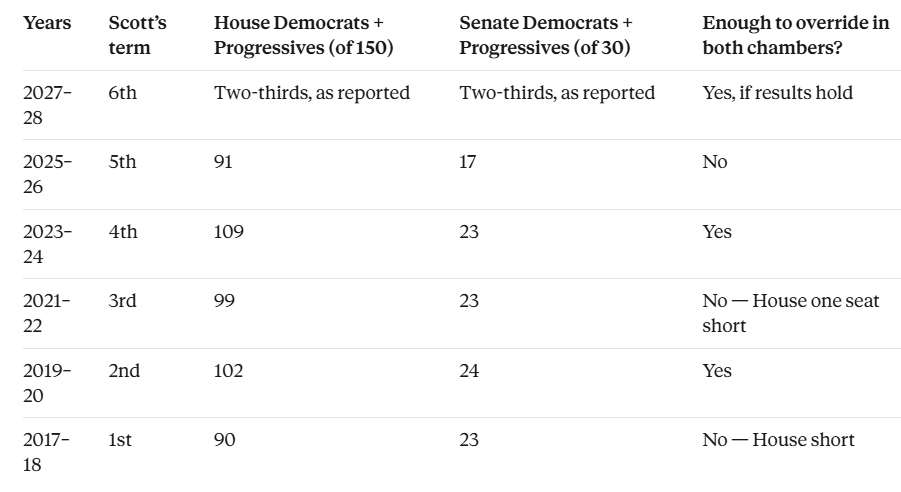
Seat counts are as of the start of each term. House figures are from the House clerk’s party records. Senate figures are from 2017–18, 2019–20, 2021–24 and 2025–26 election records.
Counting through the end of his new term, Scott will have faced override-sized majorities in both chambers for six of 12 years, if the reported results hold. In the other three terms, Democrats and Progressives started without enough seats to override him on their own if every member showed up.
Six Decisions, and Who Made Them
The record on each of these bills shows who approved it or blocked it. It doesn’t, by itself, show how much any one of them changed what a household pays.
Enacted over Scott’s veto
Property taxes, 2024. Each year the Legislature passes a “yield bill” that sets the statewide education property tax rates needed to pay for the school budgets local voters approved. The 2024 version was projected to raise the average education property tax bill 13.8%. Scott vetoed it, writing that Vermonters couldn’t afford a double-digit increase. House Speaker Jill Krowinski called the bill a critical step toward tax relief and a stable school system, and lawmakers overrode the veto in June 2024. The rate on that year’s tax bills was set over the governor’s objection; the school budgets behind it were set by local voters.
Act 250 overhaul, 2024. Act 250 is Vermont’s 1970 law requiring state review of larger development projects. The 2024 rewrite, H.687, sets up a tier system that decides how much review a project gets based on where it is, temporarily exempts some housing while the tiers are drawn, and adds new review for forest blocks and road building. Scott vetoed it, arguing it leaned toward conservation and would slow housing. Backers, including then-Lt. Gov. David Zuckerman, noted it was largely based on recommendations from a study led by Scott’s own administration. Lawmakers overrode the veto on June 17, 2024.
Blocked by Scott’s veto, with lawmakers sustaining it
Paid family leave, 2020. H.107 would have created a paid family and medical leave program funded by a payroll tax. Scott vetoed it over the tax. The House fell one vote short of overriding him, even though Democrats and Progressives held 102 House seats, two more than an override needed. Some of them voted with the governor.
Heating fuels: a veto held, then an override. The Clean Heat Standard would have required companies that sell heating fuel to cut the carbon pollution from what they sell, by paying for things like heat pumps and weatherization. Scott vetoed it in 2022, and the House fell one vote short of overriding him. The next year, with larger majorities, lawmakers passed a revised version, the Affordable Heat Act, and overrode his veto; in the Senate, the override got exactly the two-thirds it needed. That override did not start the program. The law requires lawmakers to vote again before it can take effect, and in January 2026 the Public Utility Commission closed its case because that vote never came.
Passed by lawmakers and signed by Scott
Housing, 2023. The HOME Act, S.100, required towns to allow duplexes wherever single-family homes are allowed and up to four units in areas with town water and sewer. It capped parking requirements and temporarily exempted more housing in downtowns and village centers from Act 250. Scott signed it June 5, 2023, during a term when Democrats and Progressives could have overridden him.
Education, 2025. H.454, now Act 73, set Vermont on a path to fund schools through a statewide per-student formula and to redraw school districts into fewer, larger ones, with the details left to later laws. That year Democrats and Progressives lacked the seats to override a veto without help from Republicans or independents. Scott’s policy director testified before the House-Senate committee that wrote the final version, and Scott signed the bill July 1, 2025.
What Changes in January
The split itself has held through six elections. What shifts is whether Democrats and Progressives have the seats to override Scott, and if the reported results hold, they will in January, for the third time in his tenure.
Those numbers would let Democrats and Progressives enact laws over Scott’s veto when enough of their members agree. The last time they had them, the Legislature overrode six of his vetoes in a single day in June 2024. In the two years since, without those numbers, Democrats sought more compromises with the governor, WCAX reported.
Having the seats is not the same as having the votes. The 2020 paid leave override failed with 102 Democrats and Progressives in the House. In 2024, with a supermajority in both chambers, the Senate still sustained Scott’s veto of a data privacy bill. His veto stands whenever an override falls short of two-thirds of those present in either chamber.
Both sides have signaled what comes next. Ideas such as higher taxes on the wealthy have stalled under the threat of Scott’s veto and opposition from fiscally moderate Democrats, WCAX reported. With override numbers, those bills no longer need his signature if enough Democrats and Progressives back them. Scott made his case against them in the campaign’s final debate, saying that when you’re governor, “the math has to add up.”
Check It Yourself
Who gets credit or blame for any of this is for you to decide. Here’s where to see the record for yourself.
Find your legislators. Enter your town at the Legislature’s legislator search. It lists the current members; the newly elected take their seats in January.
See how they voted. Open any bill’s page through the Legislature’s bill search and click the “Roll Call Votes” tab. Each roll call lists how every member voted. Pick the right two-year session first, since bill numbers repeat every session.
Read the bills in this story: property taxes, H.887 · Act 250, H.687 · paid leave, H.107 · Clean Heat, H.715 · Affordable Heat, S.5 · HOME Act, S.100 · education, H.454
Read the governor’s side. The Legislature keeps a list of bills Scott vetoed for each session; each bill’s page links to his veto letter explaining why.
After an election, facts matter more than ever. Become a paid Compass Vermont subscriber and support independent reporting that checks the record, explains the issues and lets you draw your own conclusions.
Thanks for the article. Turnout may shed some light. Regardless, all that's known for sure, assuming no significant election fraud, is the majority of those who did vote in Vt have said they support abortion any time for any reason; no restrictions on illegal immigration; forced support for LBGTxyz indoctrination in grade school; a Constitutional Amendment to remove the 2nd amendment; .........