


BETA Technologies brought in $17.7 million in revenue, the money it takes in from customers, from July through September. That was nearly double the same months of 2025 and the most in the South Burlington electric-aircraft maker’s history, the company reported Nov. 3.
It was also well above the $8 million to $12 million BETA had forecast. The company raised its revenue forecast for the full year to $52 million to $57 million, up from the $42 million to $50 million it projected in August.
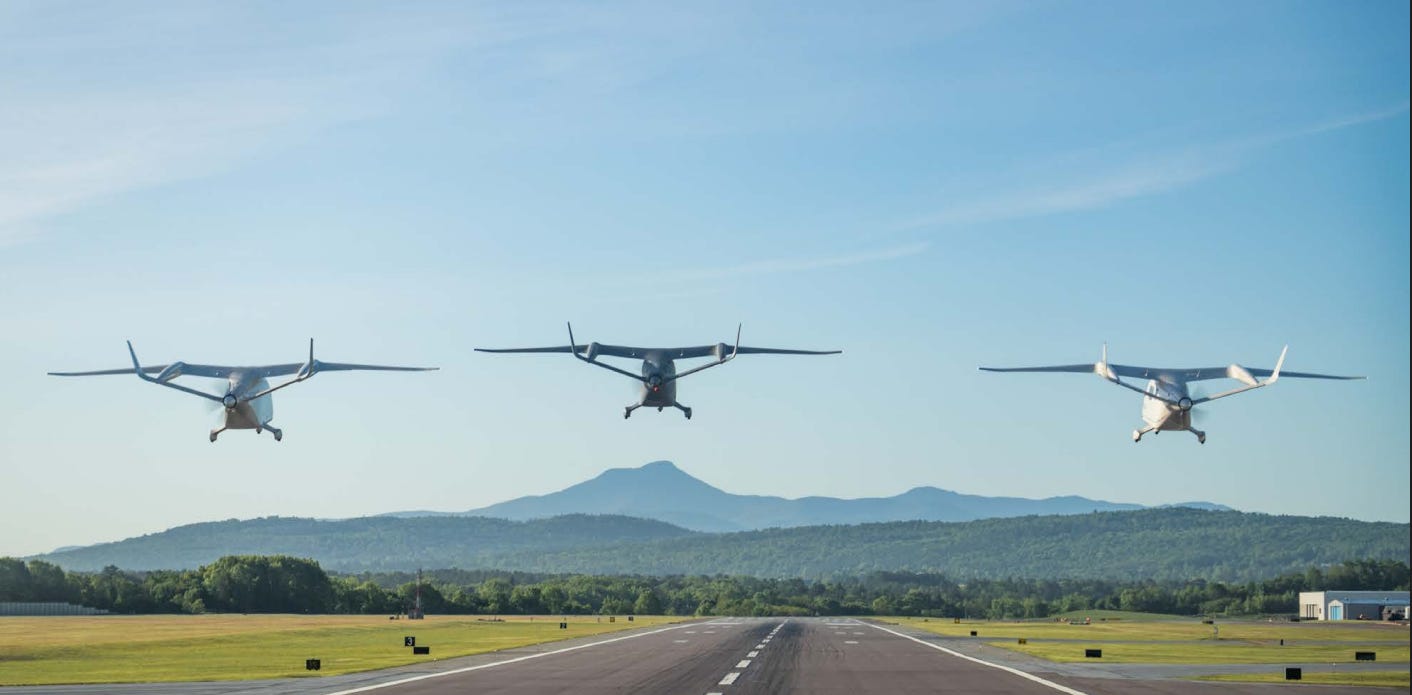
Three weeks after the quarter ended, BETA flew its vertical-takeoff plane, the ALIA A250, across Lake Champlain. On Oct. 16, the FAA gave the A250 a market-survey certificate. That’s a special permit that lets BETA take prospective customers and other business partners along on demonstration flights before the aircraft is fully approved. It is the first such certificate for an electric aircraft that takes off and lands straight up, like a helicopter. On Oct. 20, the A250 flew from Plattsburgh to Burlington in about 20 minutes, BETA told investors.
For Vermont, the bigger news is in the company’s quarterly report to the Securities and Exchange Commission: BETA is spending heavily to get its factory ready to build planes.
The factory is getting ready first
BETA has spent $94 million on buildings, machinery and its charging network so far this year, more than three and a half times the $25.7 million it spent in the first nine months of 2025.
Construction BETA has started but not finished more than tripled in value since the start of the year, to $70.2 million from $20.6 million.
BETA says it began scaling up manufacturing in the third quarter. It now has $26.3 million worth of materials and parts set aside for building aircraft.
On the earnings call, BETA said it is working toward showing its factory can build the equivalent of 4.5 aircraft a month, about 54 a year. It expects the equipment and systems for that pace to be in place by the end of this year, with more production tests continuing into early 2027.
BETA said it is not yet staffing to build at that pace every month, and it will add production workers “at the right time.” For now, the factory’s top job is building the aircraft the FAA will use in its certification testing.
The plant has room to grow. BETA’s 2025 stock-offering filing said its roughly 188,000-square-foot South Burlington factory is designed to build more than 300 aircraft a year at full maturity. Beyond that, BETA’s master plan now before South Burlington’s Development Review Board proposes almost 1.5 million square feet of buildings with room for 5,600 people, counting employees and visitors, VTDigger reported in October.
Hiring is still growing. BETA’s administrative salaries and benefits rose $8.6 million over the same quarter last year “due to increased headcount,” the quarterly report says. Labor costs on the research side, including stock given to employees as pay, rose $17.2 million.
On the Nov. 3 earnings call, BETA founder and CEO Kyle Clark put the company’s workforce at about 1,500. In June, BETA had nearly 1,400 workers and said 85% of the 420 people it hired in the first half of the year were from Vermont, VTDigger reported. Last December, Clark said he expected to add close to 1,000 workers over 18 months, predominantly in Vermont.
BETA has a loan from the Export-Import Bank, a federal agency that lends to companies that sell American-made goods overseas. A proposed $830 million expansion of that financing, which Compass reported in August, is meant to pay for manufacturing growth. BETA said on the call that the financing is still advancing. It is not final yet. The quarterly report lists only BETA’s existing loan from the bank.
What BETA earns money from now
BETA doesn’t sell finished, fully approved airplanes yet. Most of its revenue comes from engineering work for other companies.
Engineering and consulting work (what BETA calls service revenue): $12.5 million, about 7 of every 10 revenue dollars in the quarter, mostly work supporting other companies’ own research. Of that, BETA earned $4.1 million doing engineering work for GE Aerospace, which invested $300 million in BETA last year. So far this year, GE work accounts for about two of every five revenue dollars.
Equipment: $5.2 million in product sales, including $4.3 million in chargers and other ground equipment.
Government work: $355,000, down from $2.7 million a year earlier. BETA completed a set of federal government contracts last year.
BETA’s pitch to future buyers is cost. The company puts the operating cost of its runway plane, the ALIA CX300, at about $450 an hour, compared with $800 to $850 for a Cessna Caravan, a common single-engine cargo plane, AIN reported from the call.
BETA says its order book now totals just over $4 billion for 1,040 aircraft, an average of about $3.85 million a plane. That total includes both firm orders and options, which give customers the right to buy more planes later if they choose.
Before BETA can deliver those planes for regular commercial use, the FAA has to grant type certification, its approval of an aircraft’s design. The market-survey certificate is a step before that. Clark predicted the A250 will be the first electric vertical-takeoff aircraft to win type certification, but he did not give a date, AIN reported.
What it costs to get there
BETA lost $119.1 million in the quarter, about $1.3 million a day. For every dollar it spent running the company, it brought in about 12 cents in revenue, up from about 10 cents a year earlier.
Last year’s third-quarter loss was larger, $437.2 million, but $355.6 million of that was a one-time accounting charge tied to issuing stock to investors. On its day-to-day business alone, BETA’s quarterly loss grew to $127.8 million from $80.6 million as it spent more on development and hiring.
BETA ended September with $1.34 billion in cash, down about $136 million from the end of June and $367 million since the start of the year.
Lake Champlain medical flights
The Oct. 20 flight was a demonstration. It was not the Lake Champlain medical program.
That program is part of a federal test program called the eVTOL Integration Pilot Program, which lets aircraft that haven’t finished FAA approval fly real missions. (eVTOL is short for electric vertical takeoff and landing.) In the Vermont piece, Metro Aviation, which flies UVM Health’s medical helicopter, would use BETA’s planes to carry medical equipment and blood products between Burlington and hospitals in northern New York.
On Sept. 30, BETA told Compass the project had not launched and that it was working with the Port Authority of New York and New Jersey, which leads the project, to set a start date, as Compass reported Oct. 1.
BETA now says six of its seven test programs have launched. The launches BETA and its partners have announced:
Maryland and Virginia, transplant organ deliveries, in July (Compass, Oct. 1)
Louisiana, flights supporting oil and gas work along the Gulf Coast, in late August
North Carolina and Texas, medical and emergency-response supplies, in September (Compass, Oct. 1)
Utah, time-sensitive cancer medicines, in October
Florida, cargo and medical flights, on Oct. 30
The one not on that list is the Port Authority project that includes the Vermont flights. No launch has been announced for it, and BETA’s Nov. 3 earnings release did not mention a start date.
BETA said it will give its 2027 forecast when it reports fourth-quarter results early next year.