


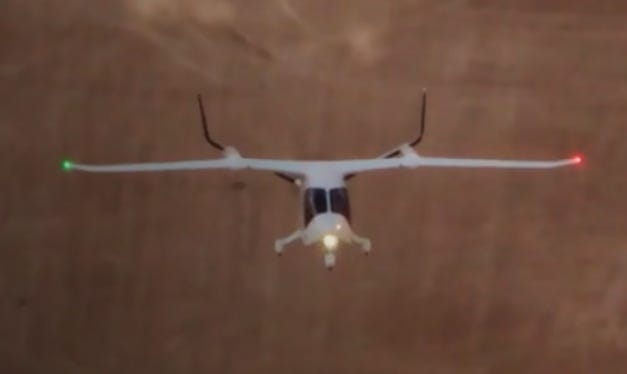
BETA Technologies and the Export-Import Bank of the United States said on Aug. 4 that they intend to expand their lending relationship to as much as $1 billion — roughly $830 million on top of the $169 million the bank approved in 2023 to build BETA’s aircraft production plant in South Burlington.
If it closes, BETA says the money would go toward roughly doubling how much the company can build, bringing more of its aerospace manufacturing in house rather than buying it from suppliers, and scaling up production of the electric motors and propulsion systems it now ships in small numbers. The company puts the employment effect at hundreds of technical and advanced-manufacturing jobs.
BETA had 1,008 employees at the end of 2025, up from 902 six months earlier. Its 188,000-square-foot final assembly plant is built to turn out more than 300 aircraft a year at full rate, and the company holds permits to expand it to over 355,000 square feet. It also runs a battery test facility in St. Albans. The proposed loan is money to fill that capacity out, and it is debt rather than stock, which means BETA gets the capital without selling a larger piece of itself to investors.
Why an export bank is lending to a Vermont factory
EXIM exists to help foreign customers buy American goods. Financing the construction of a plant in Chittenden County is not that.
It happens through a program the bank’s board created in 2022 called Make More in America, which opened EXIM’s long-term lending to domestic factories. BETA’s 2023 loan was only the second deal the program ever approved.
The program’s terms are public, and they are the most useful thing in this story, because they turn a press release into a set of specific things BETA has to deliver:
Some of what the factory makes has to be sold overseas. The required share is 15 percent of output for certain priority industries and 25 percent for everything else.
The size of the loan is tied to jobs. EXIM lends up to about $230,000 for each job supported for one year. A thousand jobs held for five years counts as five thousand job-years.
The bank has to believe it will be paid back. EXIM generally wants at least three years of revenue in the same line of work, a demonstrated ability to service debt, and a loan that isn’t oversized relative to the borrower — as a rule of thumb, no more than 40 percent of the company’s tangible net worth.
The loan has to be money the private market wouldn’t provide. EXIM is meant to fill gaps, not compete with banks.
Missing the targets has consequences. These agreements are supposed to include contractual recourse if a project falls short on exports or jobs.
The jobs formula sets a ceiling on how much EXIM can lend, not a floor under how many people BETA must hire, and it counts jobs supported during construction as well as over the life of the loan. Still, the arithmetic is worth doing: at roughly $230,000 per job-year, a $1 billion facility needs about 4,360 job-years behind it — 400 jobs held for eleven years, say, or a thousand held for four. The “hundreds of jobs” in the announcement is in the same neighborhood as what the formula would require.
The 2023 loan is old enough to check, and it holds up
When EXIM’s board approved the first loan in November 2023, the bank estimated it would support 400 clean energy jobs in Vermont.
BETA reported 1,008 team members at the end of 2025 in its annual report, up from 902 at midyear. By June of this year, the Boston Globe reported the company’s headcount at roughly 1,370, with more than 420 people hired in the first half of 2026 alone — 85 percent of them Vermonters, BETA’s chief information officer told VTDigger. The company has said it expects about 2,000 workers by next summer, which would make it the largest for-profit employer in the state, ahead of the GlobalFoundries plant in Essex Junction.
Vermont has watched a lot of federal announcements arrive with job numbers attached and never checked the receipt. This is one where the receipt is better than the projection.
One difference between then and now: the 2023 announcement counted Vermont jobs specifically. The Aug. 4 announcement counts American ones. BETA’s manufacturing is centered in South Burlington, but the commitment as written is national, and the company also runs a flight-test base in Plattsburgh, New York.
Three things have to happen before the money moves
Nothing is signed yet. Both BETA and EXIM say so plainly in the announcement, and the path from here is short and public:
The EXIM board has to vote. Domestic loans require board approval, and staff can only sign off on deals under $25 million. The board needs three members for a quorum and currently has exactly three — chairman John Jovanovic, acting vice chairman James Burrows and director Spencer Bachus — with two director seats vacant.
Congress and the public get notice. Domestic loans above $50 million go to Congress in advance. Anything above $100 million is also published in the Federal Register with at least a 25-day window for public comment — the one moment when a Vermonter can put something on the record about this.
The clock runs out on Dec. 31. EXIM’s charter expires at the end of this year, and without reauthorization the bank can’t approve new business. Financing meant to arrive in what the announcement calls “one or more tranches” over the next several years runs straight into that date. Sens. Kevin Cramer and Mark Warner introduced a ten-year reauthorization bill, S. 3772, in February; a House draft circulated in March would extend the charter five years instead.
The numbers that will decide it
A $1 billion loan to a company still building toward its first certified aircraft is a real bet, and the pieces EXIM’s underwriters weigh are all in BETA’s public filings.
Exports. This is the condition the whole arrangement rests on, and BETA’s first-quarter report puts a number on where it starts. Of the $10.1 million the company took in from January through March, $559,000 came from customers outside the United States — about five and a half cents of every revenue dollar. A year earlier it was zero. The rule asks for 15 or 25 cents. The standard counts output expected to be exported, not only what has already shipped, and BETA’s aircraft aren’t certified yet, so most of those sales are still ahead of it: the company holds a contract to supply up to $1 billion of pusher motors to EVE Air Mobility, the Embraer-backed manufacturer, and has aircraft customers in New Zealand and the United Kingdom. But international revenue appears in every quarterly report, which makes this the easiest promise in the deal for anyone to follow.
Earnings. BETA expects $39 million to $43 million in revenue this year and a loss, before certain accounting items, of $355 million to $445 million. The proposed loan is about 25 times a full year of revenue. The company has $1.59 billion in the bank from its November IPO and earlier fundraising, and it went through roughly $121 million of it in the first quarter — about $1.3 million a day.
Size. EXIM’s rule of thumb puts a loan at no more than 40 percent of the borrower’s tangible net worth. BETA’s net worth was $1.725 billion at the end of March, down from $1.818 billion at the start of the year, with no goodwill or other intangibles propping it up. Forty percent of that is about $690 million. The proposal is $1 billion, and the gap grows with every quarter of losses. EXIM treats the 40 percent figure as a general standard rather than a hard cap, large project financings are judged differently, and companies can raise more equity — but this is the number to keep an eye on.
Orders. BETA’s aircraft backlog has grown from about $1 billion at the time of the first EXIM loan to $3.9 billion across 991 aircraft, and that is the strongest argument for the whole expansion. The backlog combines firm orders with options, which is standard in aviation: at the end of 2025, the last date the company broke it out, 891 aircraft were on the books, 289 of them firm orders and 602 of them options. The pattern held into this year — the Surf Air Mobility deal signed in March, the biggest single addition of the quarter, is 25 aircraft firm and up to 75 more optional. The narrower measure, the revenue BETA is contractually locked into and hasn’t yet delivered, was $25.1 million at the end of March. All of these numbers are accurate. They answer different questions.
What to watch
A Federal Register notice on the transaction, which starts the public comment clock.
An EXIM board vote, and whether the loan comes through all at once or in a smaller first piece.
BETA’s second-quarter results on Aug. 12, which refresh the cash, net worth and export figures the underwriting rests on.
Which export threshold applies, 15 percent or 25 percent, and how fast international sales climb toward it.
EXIM reauthorization before the charter expires, and how Vermont’s delegation votes on it.
Compass has covered BETA’s federal pilot-program selections, the ACES charging consortium, the Loganair term sheet and the company’s first-quarter results. This is the largest figure attached to any of them.
Compass Vermont is independent and reader-supported.