


At the bottom: where to read Traverse’s plan and every change made to it, the mayor’s own plan, Monday’s council agenda, and how to reach your city councilor before Dec. 7.
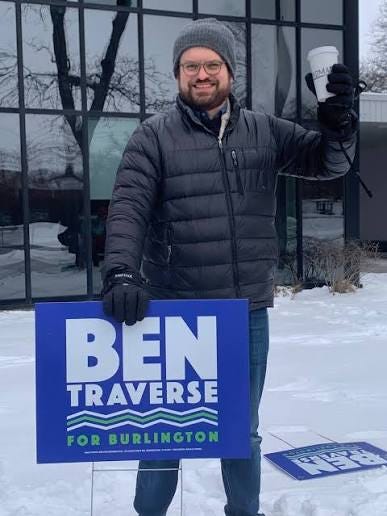
Burlington City Council President Ben Traverse announced Friday at Battery Park that he is running for mayor on Town Meeting Day in March. He said he wants Burlington’s children to inherit “a city that is safer, more affordable, more compassionate, more joyful.”
Traverse, a Democrat who represents Ward 5, led the drafting of Burlington Forward, the public safety plan council Democrats unveiled in July with his declaration that “enough is enough.” Burlington Forward is a council resolution, not a campaign platform. But it is the most detailed public record of what Traverse wants the city to do downtown, and it is still unresolved.
Compass first covered Burlington Forward in July, when a national magazine article featured Burlington as a city that wouldn’t change course on drug policy.
The mayor and the council’s Progressives have fought Burlington Forward from the start. They nicknamed it “Burlington Backwards” and called it an attempt to further criminalize homelessness, Seven Days reported, and the mayor has promised to oppose any version that keeps new needle exchanges or the planned overdose prevention center from opening downtown.
What the Plan Would Change Downtown
The revised draft of Burlington Forward, dated Oct. 26, asks the city to:
Put more public safety staff where people can see them in downtown trouble spots — police officers, plus civilian staff such as community service officers and park rangers — while the police department rebuilds.
Act faster on encampments where camping is banned, generally giving notice within 24 hours of finding one, with reasonable efforts to offer accessible alternatives and to store people’s belongings.
Make drug dealing and violent crime enforcement priorities, and press the Legislature to look at how state law handles repeat low-level drug sales.
Keep an overdose prevention center out of the Downtown Improvement District, a downtown area whose boundaries are set in the city charter. An overdose prevention center is a supervised site where people use drugs with staff on hand to reverse overdoses. State law passed in 2024 allows Burlington to open one, and the city is still working toward it.
Stop the city from buying or using license plate reader cameras, which photograph and log the plates of passing cars, including Flock Safety systems and access through a third party.
Study a stabilization and diversion center, a supervised place where police and medics could bring someone who is intoxicated or in crisis instead of jail or the emergency room.
Most of these are requests. A resolution states what the council wants. Carrying it out depends on the mayor’s administration, the city budget and state law.
What Changed During Review
In August the council voted 7-5 to send Burlington Forward to four committees rather than adopt it. The revised draft that came back differs from the original in ways that matter. Councilor Mark Barlow, a supporter, posts a line-by-line comparison on a site he created and maintains. It is not an official city website.
What was taken out or softened:
A request that the mayor set a maximum number of people Burlington can serve at one time through shelters, city-approved camping sites, outreach and treatment.
Language opposing needle exchanges operating or opening downtown. The draft still takes the position that these programs are not a permitted use under city zoning without the council’s express approval, and asks the Vermont Department of Health to consult the city before opening or moving one.
The overdose prevention center section. The original declared that any proposal should go forward only by amending the zoning ordinance. The revision recommends aligning with the zoning ordinance after public notice, a hearing and council action, and says the council stands by its earlier acknowledgment that an overdose prevention center may serve people facing serious health disparities and may reduce public drug use.
What was added:
Enforcement must focus on unlawful conduct and actual harm, not on a person’s housing status, disability or health condition.
Training for public safety staff in de-escalation, racial equity and civil rights.
The license plate reader ban and the diversion center study.
Where the Two Sides Agree, and Where They Don’t
They overlap more than the nicknames suggest:
Both want a rebuilt police department and visible patrols. The mayor’s community safety plan says downtown foot patrols are at their highest level since 2020, and the city is offering sign-on bonuses to recruit experienced officers.
Both want more from the state. In August the council unanimously asked the governor for help with shelter, treatment and law enforcement, a request the mayor’s office says it worked on with the council. The revised Burlington Forward reaffirms it.
They split on:
Where an overdose prevention center can go. The plan says not downtown. The mayor has promised to oppose that.
Whether the city’s current approach is working. The plan says neither the current nor earlier approaches have achieved what they were meant to. The mayor says the plan calls her framework ineffective without offering data.
Whether the plan can be done. At the Oct. 26 meeting, the mayor told the council that “the proposed strategies don’t reflect evidence and best practices,” that they are naive about operational and legal realities, and that they don’t reflect what is possible with finite city staff, money and resources. Traverse answered that the original draft drew on public safety experts and social service leaders, that he hears week after week from businesses leaving downtown and families staying away, and that dropping the plan without offering a path other than the status quo would mean abandoning the council’s responsibility to the community.
The mayor also holds the veto. Under the city charter, overriding a mayoral veto takes eight of the 12 councilors, and Democrats hold seven seats. That is one reason a negotiated version matters. Traverse made both formal motions to slow the plan down, the August committee referral and the October postponement, and in October he said forcing a final vote would only draw a veto.
What Comes Next
Monday, Nov. 9: a vote on a new police chief. Mulvaney-Stanak has nominated Anthony Geraci, a former police chief in Newburgh and Watervliet, N.Y., and the council votes on the appointment Monday evening. If confirmed, he starts Tuesday.
Monday, Dec. 7: Burlington Forward comes back. On Oct. 26 the council voted 10-2 to postpone the revised plan to its Dec. 7 meeting, according to the meeting minutes. In a separate 9-3 vote, it asked the mayor to form a committee of the mayor, Traverse and the leaders of the council’s Democratic and Progressive members, with a progress report due Dec. 7. Progressive Councilor Gene Bergman made that motion, and Traverse voted for it. A progress report is a checkpoint, not a finished agreement, and the council is not required to vote on Burlington Forward that night.
Decide for Yourself
The plan is long and the arguments about it are loud. Here is where to find the documents so you can judge them on your own.
Read Traverse’s plan: Burlington Forward, Oct. 26 draft (PDF), posted on Councilor Mark Barlow’s site. It is not an official city website.
See exactly what changed: the line-by-line comparison shows every addition and deletion since August.
Read the mayor’s approach: the city’s Community Safety page lays out her plan.
Find Monday’s agenda and meeting documents: the city posts them on its CivicClerk portal.
Watch the recording: council meetings air on Town Meeting TV the Wednesday after each meeting.
Reach your councilor: contact information is on the City Council page. Council meetings also include a public forum where residents can speak.
Compass Vermont is built on giving you the information and the next step so you can decide for yourself. If you find that useful, a paid subscription is the best way to support it, and it’s greatly appreciated.