


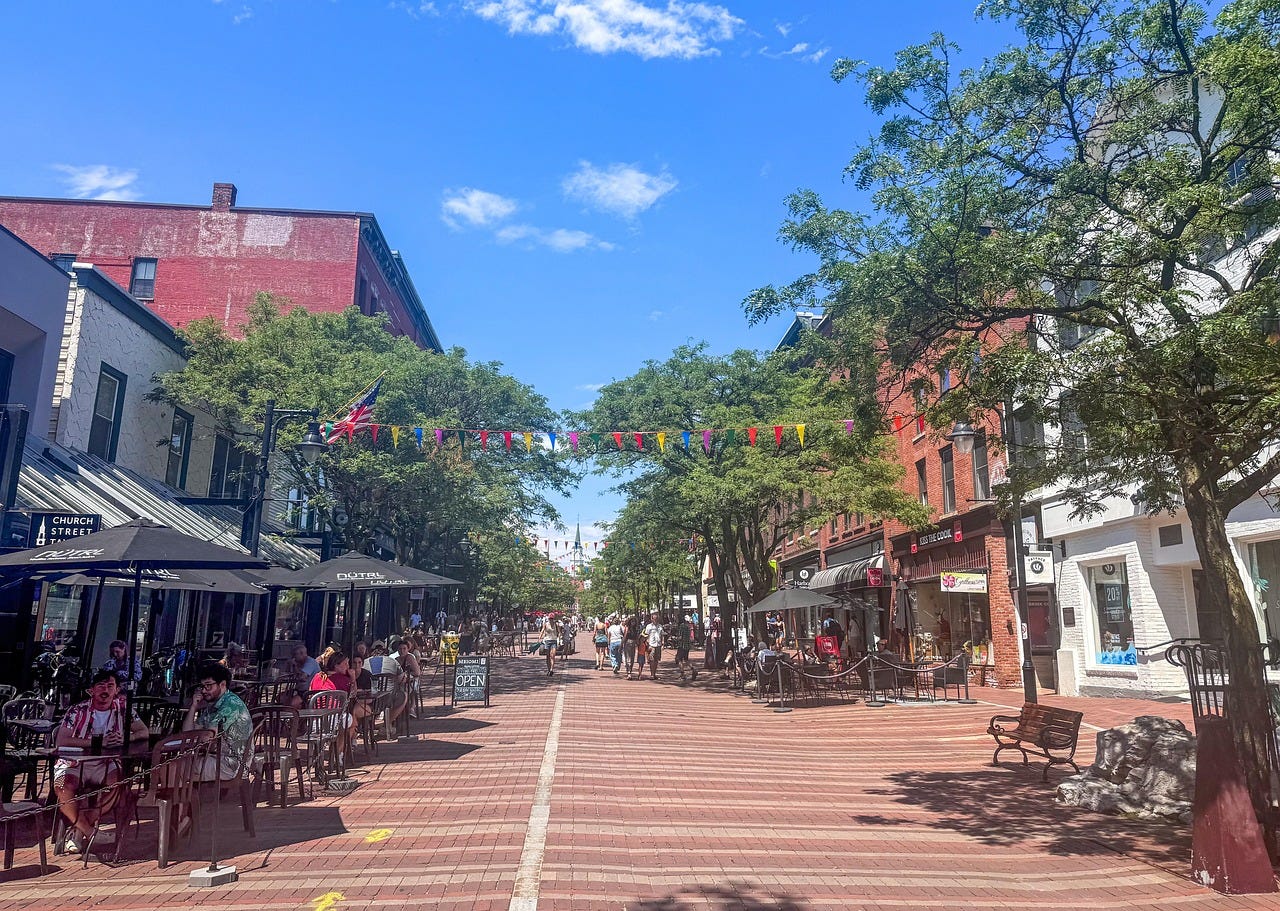
A new article in The Atlantic, published this morning, argues that a radical form of harm reduction has failed the American cities that adopted it. It’s called “The Cities That Said Yes to Drugs,” it’s by Michael Powell, and it runs as the magazine’s September cover story. It uses two cities to make its case. One is Seattle. The other is Burlington.
Burlington is the one the article presents as unmoved.
Compass checked the Vermont figures in the piece against the state’s own records. The ones that can be checked hold up. Vermont recorded 170 overdose deaths in 2025, a 37 percent decline from the 2022 peak of 269 — exact, per the Health Department’s 2025 Fatal Overdose Report, and the same figure Governor Phil Scott’s office used in its own May press release.
Twenty-eight people died of overdoses in Burlington in 2024, out of 64 in Chittenden County — also exact, from the Health Department’s January 2026 report to the Legislature on the overdose prevention center pilot. One number we could not reproduce from public records: the article’s count of 585 overdoses in Burlington that year, which may derive from a police incident category that the same report defines as any encounter with an officer, including a logged foot patrol.
None of that changes the picture. Burlington’s overdose rate is high. The conditions Powell describes — the needles, the tents, the park — are not in dispute here.
But the numbers aren’t what the article is actually arguing.
The argument is about direction
The piece opens on the street in Seattle: an open-air drug market at 12th and Jackson, a fenced playground in Little Saigon, a park pavilion on Beacon Hill taken over by people smoking fentanyl. It traces the philosophy back to the addict unions of 1970s Rotterdam, forward through Vancouver’s 2003 supervised injection site, and out into British Columbia’s “safer supply” program, which Powell argues fed a black market and widened the circle of addiction.
Then it turns to the retreat, and the retreat is the point.
British Columbia now requires supervised consumption of prescribed narcotics, and its decriminalization program has expired. San Francisco’s mayor has ordered crackdowns on dealers and tent cities. Philadelphia has stood up a treatment court. Boston’s mayor, once an enthusiast, has dropped all mention of injection centers from her plans, the article reports. Seattle’s new mayor — a democratic socialist with no prior elected experience — is authorizing encampment sweeps.
One city after another, in Powell’s telling, has looked at what it built and started taking it apart.
And then there is Burlington, where the article finds officials still insisting that harm reduction is the most effective and moral answer available. The mayor calls it humane and essential. The state’s attorney says the people using drugs downtown are rarely dangerous and that City Hall Park is still a very safe place to be. The city is planning an overdose prevention center — authorized by the Legislature in 2024 over the governor’s veto — and citing Vancouver, the model everyone else is walking away from, as its evidence.
That’s the architecture. Burlington isn’t in the piece because its numbers are the worst. It’s in the piece because it’s the one that wouldn’t reconsider.
July 24
On Friday, July 24 — six days before the article published — most of the Burlington City Council’s Democratic caucus held a press conference on Bank Street to announce a draft resolution called Burlington Forward: A Comprehensive Framework for Safe Public Spaces and a Stronger Community.
The Democrats hold a majority on the council. The draft calls for a stronger public safety presence downtown, moving homeless people out of public spaces, more police staffing, security cameras, encampment and graffiti removal, and demands that neighboring towns and the state carry more of the load. It takes direct aim at the needle exchange recently relocated to Bank Street, in the heart of downtown, arguing that facilities like it should go through formal zoning and public review and should not sit in the downtown core. The caucus said it plans to introduce the resolution at the council’s August meeting. (WCAX; Seven Days)
The councilor who called that press conference was Ben Traverse, the council president. “We are here now because, from our perspective, enough is enough,” he said. Neither the needle exchange nor a future overdose prevention center, in his view, belongs downtown.
Traverse is quoted in The Atlantic. Powell describes him as “a liberal Democrat who has grown uncomfortable with Burlington’s direction,” and notes near the end of the Burlington section that “Traverse and other Democrats on the city council have begun to challenge the mayor on harm reduction.”
That sentence is accurate, and this piece isn’t built on the claim that Powell missed something. It’s built on the size of what those six words now contain: the council’s majority caucus, a named framework, a public rollout, a planned August introduction, and the council president saying enough is enough out loud.
What hasn’t happened matters too. The resolution has not been adopted, referred to committee, or scheduled for a vote. It does not reject harm reduction wholesale — it goes after enforcement, encampments, and where these facilities sit, not the philosophy entire. Mayor Emma Mulvaney-Stanak responded the same day, saying the draft does little to set a tone of collaboration and contains ideas that move Burlington away from its values by suggesting the city remove people and legislate restrictions that contradict what public health data shows works. Progressive Councilor Gene Bergman asked that it go through committee rather than get rammed through.
So Burlington is having a version of the argument the article says the other cities already had. It hasn’t finished having it. But it is no longer the city that isn’t having it.
It didn’t start last week either
Pressure has been building for the better part of a year, much of it applied from outside the city.
In October 2025, Governor Scott announced a 14-point action plan for Burlington: a special prosecutor for defendants carrying five or more open cases, state law enforcement on foot patrols, Health Department help with syringe disposal. The mayor didn’t fight it. She said the plan would help ensure cases are resolved and victims supported.
State troopers deployed downtown that November. They came back this week and will stay through mid-August.
In May, an effort to partially defund the overdose prevention center reached the Senate floor. It failed, and the Senate approved more than $1 million to continue the work — but the vote happened at all, and some of the project’s original supporters were publicly undecided going in.
And the center itself still has no site two years on. A location fell through in February and the city declined to say where. A May assessment narrowed the search to three areas of the city rather than to addresses.
None of that is a reversal of city policy, and Compass isn’t calling it one. It’s a record of a policy under sustained outside pressure and growing internal disagreement — in a place where the governing majority on the council has now put a name and a date on its objection.
What none of this settles
The article argues that harm reduction made things worse in Burlington. Burlington Forward assumes the same thing. Neither claim is settled by any Vermont data we can find.
Overdose deaths fell across Vermont and across much of the country in 2024 and 2025. Burlington’s own fell 20 percent while its police-recorded drug incidents rose. Chittenden County didn’t decline at all — 63 deaths became 64 — even as the state’s total fell 12 percent. Nothing in the public record separates the effect of a needle exchange from a changed drug supply, a naloxone campaign, or an enforcement surge. Broad declines across many places don’t tell you which local policy caused them.
But the argument in Burlington was never going to be decided by data, and it isn’t being decided by data now.
What changed on July 24 is that a group of elected officials stopped waiting for the evidence to resolve. The people who live and work downtown had already stopped. So had the merchants who wrote to the mayor last year, and the parents Powell interviewed, and — on the evidence of two trooper deployments and a 14-point plan — the governor.
That’s the thing The Atlantic documented and the thing the article couldn’t quite show, because it went to press six days too early: not a city that said yes to drugs and meant it, but a city that has run out of patience with its own answer and hasn’t yet agreed on a new one.
What to watch
August. Burlington Forward goes to the council for introduction. Whether it moves to committee or toward a floor vote will tell you how hard the Democratic majority intends to push, and whether the mayor and the Progressive minority can slow it.
August 11. State’s Attorney Sarah George, quoted in the article saying people who use drugs are “rarely dangerous,” faces a contested Democratic primary. Compass published its analysis of eight years of Chittenden County court data this week.
Mid-August. The state police deployment ends. Public Safety Commissioner Jennifer Morrison has said the state was already staffing up for a New England governors and eastern Canadian premiers meeting in early August and extended the deployment on both ends. Compass has asked the Vermont State Police to confirm that rationale, along with hours, cost, and end date — and for the same figures from the November 2025 deployment, which was announced with a start date and no public record of how it finished.
A note on timing: Powell reported this piece over roughly a year, and the Burlington section references visits last September and this April. Magazine production schedules are long, and nothing here is a claim about what any reporter could have caught. The observation is narrower: a story about whether a city would change course reached print the same week that city’s council majority made its case for changing it.
Compass Vermont is independent and reader-supported. Sources are linked throughout.
Unless votors use their head and vote out every incumbent it won't get better.
Liberal democrats have done so much damage to this state in recent decades, it'll take years to fix.
Part of the blame falls on the voters who keep putting them there.