


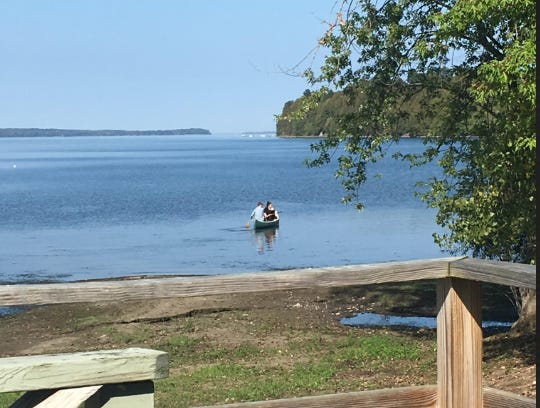
Two recent Compass pieces have looked at the largest sources of phosphorus pollution entering Vermont’s lakes — agricultural runoff at 41% of Vermont’s load to Lake Champlain, and municipal wastewater systems at 4%. Compass readers responded with a third question: what about all the camps on the water?
What about the thousands of older lakeside structures with their own private septic systems, many of them built generations ago, sitting at the edge of lakes Vermonters care about?
It’s a fair question, and one with an honest answer that’s more complicated than the question. The order of magnitude is small. The data shadow is large. The law itself was written in a way that mostly leaves these camps alone. And the work that is starting to happen at the camp level is happening through a workaround that the state itself helped design.
The size of the problem on paper
Vermont has approximately 51,474 seasonal and vacation homes, according to the 2025–2029 Vermont Housing Needs Assessment. That’s roughly 15% of the state’s housing stock — the second-highest share of any state in the country, behind only Maine. A meaningful but unknown share of those structures sit on or near Vermont’s roughly 800 lakes and ponds, particularly in the older lakeside development tracts that emerged during the cottage-era boom of the 1950s and 1960s.
How many specifically are lakeside camps with private septic systems is one of the things Vermont does not officially count. The state has property tax classifications for seasonal residences. It does not maintain a public inventory of which lakeside structures have what kind of wastewater system, when those systems were installed, or whether any of them have been inspected.
What can be calculated is a worst-case ceiling. Using EPA’s per-capita phosphorus generation figure of roughly 2.7 grams per person per day, and assuming an aggressive 17,000 lakeside camps occupied at typical seasonal levels, the theoretical phosphorus contribution if every camp were directly discharging would total roughly 10 metric tons per year. Against the 921 metric tons of phosphorus delivered to Lake Champlain annually, that’s approximately 1% of the total load. The math is sensitive to the camp count assumption, but the order of magnitude holds across reasonable inputs.
Camps are not the principal source of Lake Champlain’s basin-wide phosphorus problem.
Where small numbers still matter
A 4% phosphorus contribution from municipal wastewater — the subject of the prior Compass piece — translates into beach closures and public health concerns that the percentage alone doesn’t capture. The same is true for camps, only more so. What matters at the camp level is not basin-wide phosphorus accounting. It is the localized impact: a failing system 75 feet from the water’s edge, on a small bay where a dozen other camps share the same shoreline and the same hydrology, with sandy soils that don’t bind phosphorus the way the regulations assume they will.
The U.S. Environmental Protection Agency notes that conventional septic systems are typically very effective at removing phosphorus, but that “certain soil conditions combined with close proximity to sensitive surface waters can result in phosphorus pollutant loading” — the lakeside camp scenario almost exactly. Climate change is making this worse: Vermont’s wetter springs are raising water tables, shrinking the unsaturated soil column that older leach fields were designed around.
EPA estimates that 10 to 20 percent of septic systems fail at some point in their operational lifetimes. For systems built before modern standards — the systems most lakeside camps still run on — that risk is likely higher, particularly where soils, setbacks, water tables, or maintenance histories are poor.
Vermont DEC has documented over 600 reported septic failures annually in recent years, up from a historical baseline of 400 to 500. Since 2017, more than 3,200 systems have been formally reported as failed and replaced. Reported failures have been climbing — though that increase reflects multiple factors, including aging infrastructure, more property sales triggering inspection, expanded American Rescue Plan Act assistance for replacement, and the slow accumulation of systems that have simply outlasted their design life.
A failure in this context doesn’t always mean sewage backing up into a kitchen sink. A failure can also mean a system that is “short-circuiting” — sending nutrients and bacteria into groundwater or surface water without the soil treatment the design assumed. From the camp owner’s perspective, the system appears to be working. The lake knows otherwise.
The Clean Slate
The reason most lakeside camps are not subject to modern wastewater standards is a single line of Vermont law. Under 10 V.S.A. § 1974, buildings, campgrounds, and their associated wastewater systems and potable water supplies that were substantially completed before January 1, 2007 are exempt from the state’s Wastewater System and Potable Water Supply permitting requirements. The exemption is known as the “Clean Slate.”
The Clean Slate holds for as long as the property’s use does not change in a way that would otherwise trigger a permit. DEC guidance identifies events such as adding bedrooms, converting from seasonal to year-round use, or replacing a failed system as triggers that may require a permit. The statute also provides a specific shield from administrative or civil penalties for owners of pre-2007 single-family residences whose systems may have failed — but only when the owner conducts or contracts for an inspection, notifies the Secretary of the results, and has not taken any other permit-triggering action. The exemption is from the permitting framework specifically; older systems remain subject to nuisance, health, and failure-replacement obligations even when they fall under Clean Slate.
What the exemption does mean, in practice, is that many older Vermont lakeside camps — the ones with the oldest infrastructure and the highest probability of a problem — operate outside the modern permitting regime. The state knows they’re there. The state has decided, for reasons of practical impossibility and political reality, not to require them to prove they’re working.
There is one important secondary enforcement mechanism. In Hunter Broadcasting, Inc. v. City of Burlington (1995), the Vermont Supreme Court held that the failure to obtain a required state wastewater or subdivision permit constitutes an encumbrance on title. While the Vermont legislature has since narrowed how related principles apply to local zoning permits, the title encumbrance for state wastewater permit violations remains good law. In practical terms: when a lakeside camp changes hands, the buyer’s attorney and the lender typically require a wastewater inspection before closing. Systems that are failing, or that lack required permits for past work, often must be brought into compliance before the property can transfer. The real estate market does the enforcement that the regulatory system does not.
This means the camps that change hands eventually get caught up to the law. The camps that stay in the family for generations — and there are many — never do. And for owners who would otherwise convert older seasonal camps to year-round use, the permit trigger and required wastewater upgrade — often an Innovative/Alternative system at a cost that can represent a substantial share of a modest camp property’s value — is enough to keep many camps seasonal on paper, regardless of how they’re actually being used.
What Vermont does measure
Vermont is not blind to what’s happening at the lake edge. It just measures it from two indirect angles, neither of which connects cleanly back to specific camps.
First, the Lay Monitoring Program — a citizen-volunteer effort dating to 1979 — has expanded in recent years to test lake water for caffeine alongside phosphorus, chlorophyll-a, and water clarity. Caffeine in lake water is a wastewater-specific marker; humans are essentially the only source. Elevated caffeine indicates seepage from failing or outdated septic systems somewhere in the watershed. Vermont monitors roughly 40 stations on Lake Champlain and over 100 inland lakes through the program, with results publicly accessible. After the lab refined its reporting limit downward in 2024, detection counts climbed substantially — and as of the 2025 monitoring season, a meaningful share of monitored Vermont lakes had recorded at least one caffeine detection above the reporting limit. In other words: human wastewater is being measured at the lake level across a significant portion of the state’s monitored waters. The data does not identify which camps are the source. It does establish that camps, collectively, are contributing.
Second, Vermont’s Illicit Discharge Detection and Elimination program, or IDDE, has been mapping municipal and private stormwater systems for roughly two decades and testing them for the presence of wastewater. The IDDE process is methodical: inspectors visit stormwater outfalls during dry weather, sample any flow they find, test for E. coli, phosphorus, ammonia, and optical brighteners — chemical markers found in laundry detergent. When contamination shows up, source-tracking teams use smoke testing, dye testing, and robotic cameras to find the specific property responsible. According to Vermont DEC, the program has reduced phosphorus loading to Lake Champlain by an estimated 275 kilograms per year by eliminating wastewater discharges. Stone Environmental, the engineering firm that has conducted much of the IDDE fieldwork, reports having worked in 145 Vermont communities since 2006 and identified more than 200 wastewater or other inappropriate discharges.
The state is finding the worst direct-discharge cases. It is just doing it slowly and largely outside public attention. And IDDE finds discharges that flow into formal stormwater infrastructure — not failing leach fields on private camp properties at the end of dirt roads.
What neither program does is connect specific lakeside properties to specific impacts on specific bays. Vermont knows the lake is receiving wastewater. Vermont can find the worst direct-discharge cases through IDDE if they’re piped to a stormwater system. What Vermont has not built is the property-level inspection regime that would convert all that indirect knowledge into preventive action.
The Lake Parker workaround
There is one place in Vermont where the indirect data is now being translated into property-level action. It is happening through a workaround that says something important about the structural problem.
After the Lay Monitoring Program detected elevated caffeine in Lake Parker in Glover during the 2023, 2024, and 2025 monitoring seasons, the Orleans County Natural Resources Conservation District launched a Septic Assistance Pilot Program. The program offers financial support for camera inspections and pumping of lakeside camps with septic systems older than 20 years. It is voluntary. It is limited — the pilot’s first round accepts only eight applicants. And it includes a specific, deliberate guarantee from OCNRCD: the conservation district has no regulatory authority, will not share inspection results with the State of Vermont, and will not share results with any third party without the participant’s written permission.
That confidentiality guarantee is the program’s enabling condition. Camp owners who participate do so knowing the state will never see what the inspection finds. If a problem is identified, OCNRCD helps connect the owner with funding programs — ARPA assistance, USDA Rural Development loans, the Vermont On-site Loan Program for low-income homeowners, the state’s Healthy Homes Program. The owner can choose to repair or upgrade. The owner can also choose not to. Either way, the regulatory system never enters the picture.
This is the structural workaround. Vermont has the data — caffeine readings tell DEC there is wastewater in Lake Parker. Vermont has funding programs to help homeowners fix systems. What Vermont does not have is a way to compel inspection of pre-2007 camps under the Clean Slate exemption, or to act on inspection results if it had them. The conservation district, a non-regulatory entity, can ask camp owners to do what the state cannot require — but only by promising the state will never find out.
It is a creative response to a real problem. It is also a vivid illustration of how far Vermont’s enforcement architecture has retreated from the lake edge.
The smell test
In the absence of inspection, the actual monitoring system at the lake edge is the human nose.
Camps are private. Septic is private. What happens belowground stays belowground.
Until it doesn’t. Until the smell becomes undeniable, until someone’s failure becomes everyone’s problem, until the air quality on a hot July afternoon makes it impossible to ignore. That is the threshold at which neighbors complain. The complaint goes to the town health officer or to DEC. The state investigates. If the system has visibly failed, a permit for replacement is required. The Clean Slate exemption ends.
This is not a hypothetical. It is how the system works, and how the people who live with it understand it. Below dairy farms, the manure odor on the right kind of summer day can mask a failing septic system entirely — Vermonters who have spent time on rural lakes know the difficulty of distinguishing one source of olfactory complaint from another. Camps generally do not use lake water for drinking. A pipe is often run out into the lake to draw water for heating, washing, and bathing, with the understanding that the water is not potable. That is a tacit acknowledgment, generations old, that the lake water at the shoreline is not what anyone would want to put in their mouth.
The reasons are not all wastewater-related. Algae, agricultural runoff, sediment, and natural lake processes all contribute. But the practice itself — drawing non-potable water from a lake one swims in, while having no required inspection of one’s own contribution to that lake’s condition — is a quiet illustration of how the regulatory system actually functions.
The honest reckoning
The Compass answer to the camp question, then, has several parts.
The order of magnitude is small. Lakeside camps are not the principal cause of Vermont’s lake pollution.
The localized impact is real. A failing camp septic system on a small bay can cause exactly the kind of nuisance and health concern Vermonters have been complaining about. The fact that the basin-wide percentage is small does not mean any individual lake bay is not being affected.
The regulatory architecture is built to leave most of these systems alone. The Clean Slate exemption is the law. The honest Vermonter who wants to do everything by the book — get the permit, hire the licensed designer, install the modern Innovative/Alternative system — goes through a rigorous and expensive process. The neighbor whose 1962 system has been quietly failing for years faces no proactive scrutiny at all unless something visible or olfactory triggers a complaint, the property changes hands, or a non-regulatory program like Lake Parker’s offers help under a confidentiality guarantee. The structure can create an uneven incentive: owners who voluntarily upgrade face a rigorous and expensive process, while older systems may remain unexamined unless a triggering event occurs.
That is not the camp owners’ fault. Most camp owners are not engineers, and most have no way to know whether their grandfather-era system is functioning properly without paying for an inspection that the state does not require. The fault, if there is one, is in the structure: a permitting system that is rigorous on the front end and largely absent on the back end, with a Clean Slate exemption that ensures most existing systems will never come under the modern regime unless they fail, change hands, or the owner volunteers.
Vermont knows it has a question worth asking. The lake water is telling them. The IDDE program is finding it. The reported failure data is climbing. The Lake Parker pilot is starting to do the property-level work — through a non-regulatory entity, with a confidentiality guarantee that proves the rule by being its exception.
In the meantime, the lake quietly sorts the conscientious from the unconcerned. The smell on a still July afternoon is the only audit most camps will ever face.
If you found this piece valuable, please consider subscribing to Compass Vermont.