


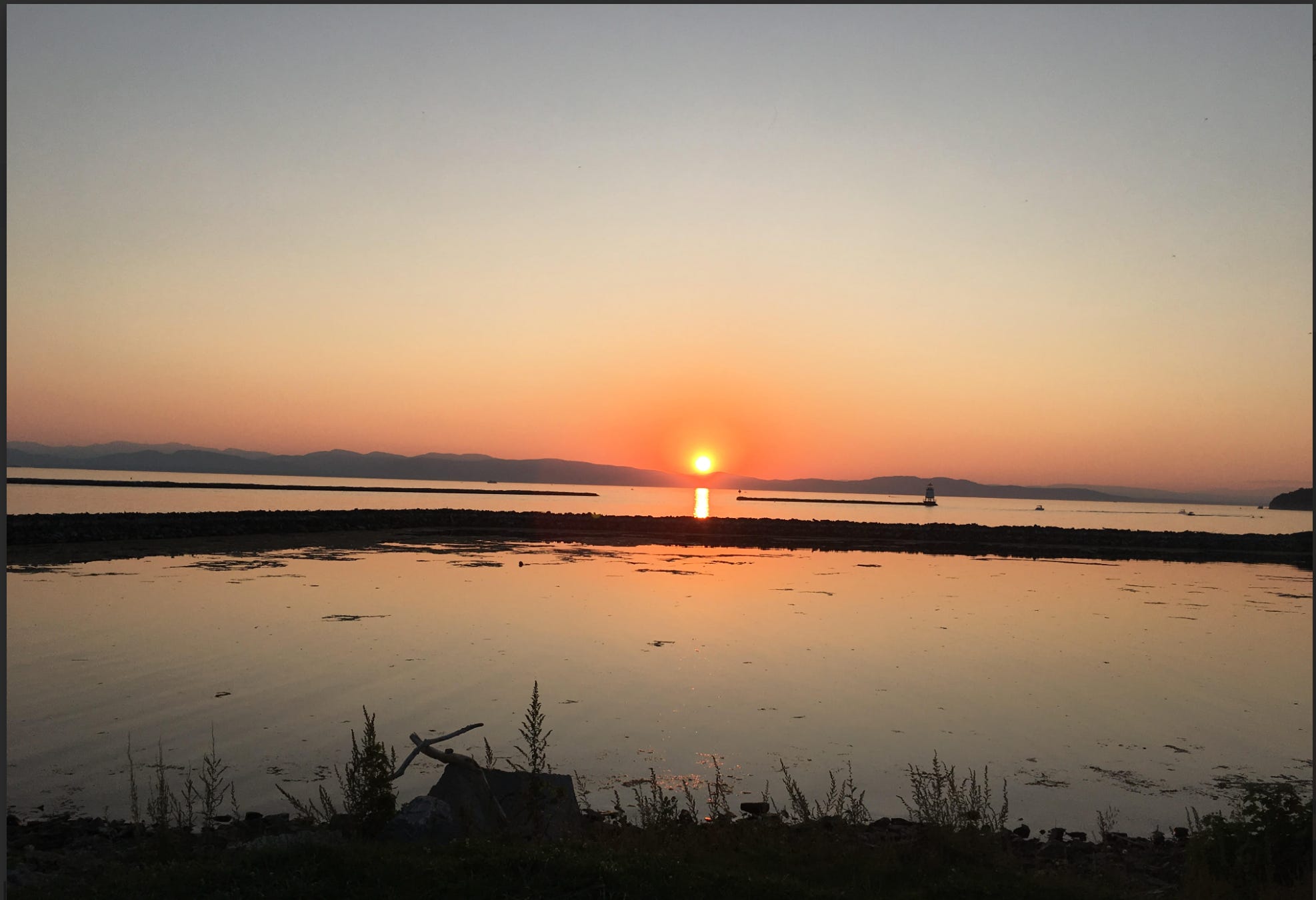
Sixty years ago, a Vermont child could wade into Lake Champlain at the Sand Bar or in Keeler Bay until the water closed over their head, look down through twenty feet of clear water, and count the clams scattered across the sandy bottom. The lake was readable. The bottom was reachable, even where it couldn’t be touched.
Today the same wade ends in a thick green-brown muck. Swimming through it takes some effort and a measure of faith that one won’t be sick afterward.
What changed is partly visible from a road that no longer exists in quite the same way. Before the interstate pulled travelers inland, the route to the lake ran past dairy farms, and on a summer day with the wind blowing the wrong direction and the windows down — air conditioning in cars wasn’t standard until the 1970s — the smell would catch a passenger in the eyes. Heifer dust, families called it. It was the smell of Vermont through every season but winter.
Out on the water, every farm Vermonters passed by boat had its outflow. Small streams. Larger brooks. Each carrying runoff from thousands of cows doing what cows do — chewing grass, producing milk, leaving their contributions for the rain to dissolve and escort downstream. Children watching from the deck didn’t know what they were seeing. The trickle was a cocktail of future pollution.
The change came slowly. The first algae blooms gathered in the corners and bays, away from the open lake. By the time anyone outside the science was alarmed, decades of phosphorus had already settled into the soil and sediment of the basin. Farmers were the backbone of Vermont’s economy and one of the most powerful blocs in the legislature, and the science of what their fields were sending downstream was not yet sharp enough to make the case that would eventually need to be made.
A generation of Vermonters grew up watching the algae grow with them. They grew up together.
Now the science is sharp. And what it shows is that the lake of those Sand Bar afternoons is not coming back in the lifetime of anyone old enough to remember it.
The 41% number
Roughly 41% of Vermont’s phosphorus load to Lake Champlain comes from agricultural production. The figure is from Claire Benning, a University of Vermont Extension water quality research specialist and Ph.D. student, speaking in a recent webinar and quoted in an April 24 piece by Elodie Reed for UVM Extension. The number sits inside a federal pollution budget — the Lake Champlain Total Maximum Daily Load, or TMDL — that has governed Vermont’s cleanup obligations since 2016. The framework is phased over 20 years, with staggered basin-specific implementation and EPA accountability reviews on five-year cycles.
Phosphorus is what feeds the algae. When it accumulates in lake water, it fuels cyanobacteria — the blooms that close beaches, taint drinking water intakes, and produce toxins that have killed dogs that drank from contaminated shorelines. The Lake Champlain Basin Program documented two such Vermont dog deaths in the 1999–2000 period. According to the 2024 State of the Lake report, more than 164,000 people in the basin rely on Lake Champlain for drinking water — about a quarter of the basin’s population. Vermonters who use the lake know what summer brings now. They have known for decades.
Discovery Acres
In St. Albans Bay, on a single undulating field divided by topography into four small watersheds, UVM Extension is running an experiment designed to last a long time. The site is called Discovery Acres. Each of its four watersheds is testing a different combination of management practices — tile drainage versus none, tillage versus none, manure injected into the soil versus broadcast across the surface — while water monitoring stations measure what runs off and what stays.
The project belongs to the national Discovery Farms Network, a farmer-led research program operating in multiple states. The Vermont site exists because Vermont farmers asked for it. UVM Extension agronomic and soils specialist Heather Darby told Reed that the Farmers Watershed Alliance “has driven the work at Discovery Acres, and really has driven accessing funding and the ability for us to do this work.”
That fact reframes a story that gets told a different way most of the time. Vermont’s water quality conversation tends to cast farmers as the source of the problem and the regulators as the solution. At Discovery Acres, the farmers are funding the research into how to reduce their own runoff. They are not subjects of the experiment. They are co-investigators.
Why it will take decades
Joshua Faulkner, the interim director of UVM’s Center for Sustainable Agriculture who helps oversee Discovery Acres, told Reed something most researchers don’t say out loud:
“It’s a big ship to turn, right? We’ve been farming in this basin for a long time. It’s not necessarily going to benefit to our generation, but probably generations that come after us and generations after them.”
He is describing what the science calls legacy phosphorus.
Phosphorus applied to a field doesn’t all get used by the crops growing there. The excess builds up in the soil. In Vermont’s heavy clay basin soils, which drain poorly, phosphorus accumulates over years and decades — bound to soil particles, dissolved in the water moving through the ground. Even on a farm that stopped applying any new manure tomorrow, the phosphorus already in the soil would continue to leach into nearby waterways for decades. Possibly longer.
“Legacy phosphorus is a primary driver of phosphorus loss in poorly-drained soils with subsurface drainage, especially here in Vermont,” Benning said in the same webinar.
Vermont’s regulatory framework reaches the legacy phosphorus problem indirectly. The state’s Required Agricultural Practices compel farms to maintain Nutrient Management Plans that account for existing soil phosphorus when calculating how much manure or fertilizer can be applied. A field with very high phosphorus levels triggers a higher rating on Vermont’s Phosphorus Index, which restricts further applications. The framework, in other words, manages around the legacy. It does not mandate its removal. The phosphorus already in the ground is something the basin has to wait out, while the science figures out how to slow its movement through soil and water.
Climate is reshaping and accelerating the problem
The challenge is also changing shape underneath the regulatory framework that was built to address it.
Vermont’s growing seasons are getting wetter. More farmers are installing tile drainage — perforated pipes buried below the soil surface that move water off fields faster — to keep their land workable. But tile drain water carries dissolved phosphorus, too. A practice that helps farms adapt to a wetter climate creates a different pathway for the same pollutant.
There is also a feedback loop the original framework didn’t anticipate. The Lake Champlain Committee, drawing on the 2024 State of the Lake report, notes that warmer water in the lake itself triggers the release of legacy phosphorus that has already settled into the sediment. As Lake Champlain warms, it doesn’t just receive new phosphorus from runoff. It releases stored phosphorus from its own bottom. Climate change is not just adding to the problem. It is amplifying the problem already in place.
Benning, in the webinar: “Due to shifting climates, we are seeing periodic snowmelt in winter, as well as rain-on-snow events, and shifting freeze-thaw cycles, which are increasing likelihood of nutrient losses during winter and early spring.”
Faulkner is the principal investigator on a parallel experiment in Addison County testing whether filter systems installed at the outlet of a tile drainage system can capture phosphorus before it reaches a waterway. The Discovery Acres work, by contrast, is testing what happens at the surface of the soil — whether different ways of applying manure and managing tillage can reduce the amount of phosphorus that ever moves below the surface in the first place.
Both experiments are looking, at different points in the same problem, for ways to bend a generational curve.
Two clocks
Vermont set its Lake Champlain phosphorus reduction targets in 2016, with a 20-year phased timeline running through roughly 2036. As Compass Vermont reported in October 2025, the state has invested more than $603 million through the Clean Water Initiative since the TMDL took effect — money drawn from a patchwork of state and federal sources, including temporary American Rescue Plan Act funds. The work has produced real reductions: pollution-prevention projects on more than 456,000 acres of agricultural land, more than 1,000 upgraded municipal road culverts, treatment of stormwater runoff from over 3,360 acres of pavement, and upgrades to more than 100 wastewater treatment systems. According to the state’s 2024 Performance Report, this work has reduced annual phosphorus pollution by an estimated 120,593 pounds — about 26% of the Lake Champlain reduction target.
What the research at Discovery Acres is now telling Vermonters, in the careful language of researchers who don’t overpromise, is that the regulatory clock and the chemistry clock are not the same clock. The targets can be hit. The lake will improve. But the version of Lake Champlain that older Vermonters remember — the clear water at the Sand Bar, the visible sandy bottom in Keeler Bay — was the product of a basin that hadn’t yet absorbed sixty years of accumulated phosphorus. Returning to it requires not just stopping the flow but waiting out what has already arrived. And in the meantime, the warming lake is slowly giving back some of what it once took in.
That is what Faulkner means when he talks about generations after ours.
The honest measure
Faulkner closed his interview with Reed on a note worth holding onto: “It’s a finite resource. We need to keep it on the landscape and use it to grow food instead of running off into our waterways.”
The research at Discovery Acres has merit. So does the parallel work in Addison County, and the broader Discovery Farms Network it belongs to. None of it makes the present condition of Lake Champlain any less regrettable. The lake of the Sand Bar afternoons is not coming back. The science being done now is being done for Vermonters not yet born.
If you found this piece valuable, please consider subscribing to Compass Vermont.
Topography is a huge part of the problem,besides over population/urbanization. Just look at Chittenden county! Half of Vermont shares the "Champlain Valley" with NY and the Adirondack Mts.. ALL precipitation in the "Valley" flows towards the lake. It's called Gravity. And there are many Farms on the western side of the Green Mts.. So of course everything is flowing/moving towards the lake. This narrative has been going on for along time and nothing has really changed,except more contamination/pollution. If anyone really cared,things/policy would not be as they are today....