


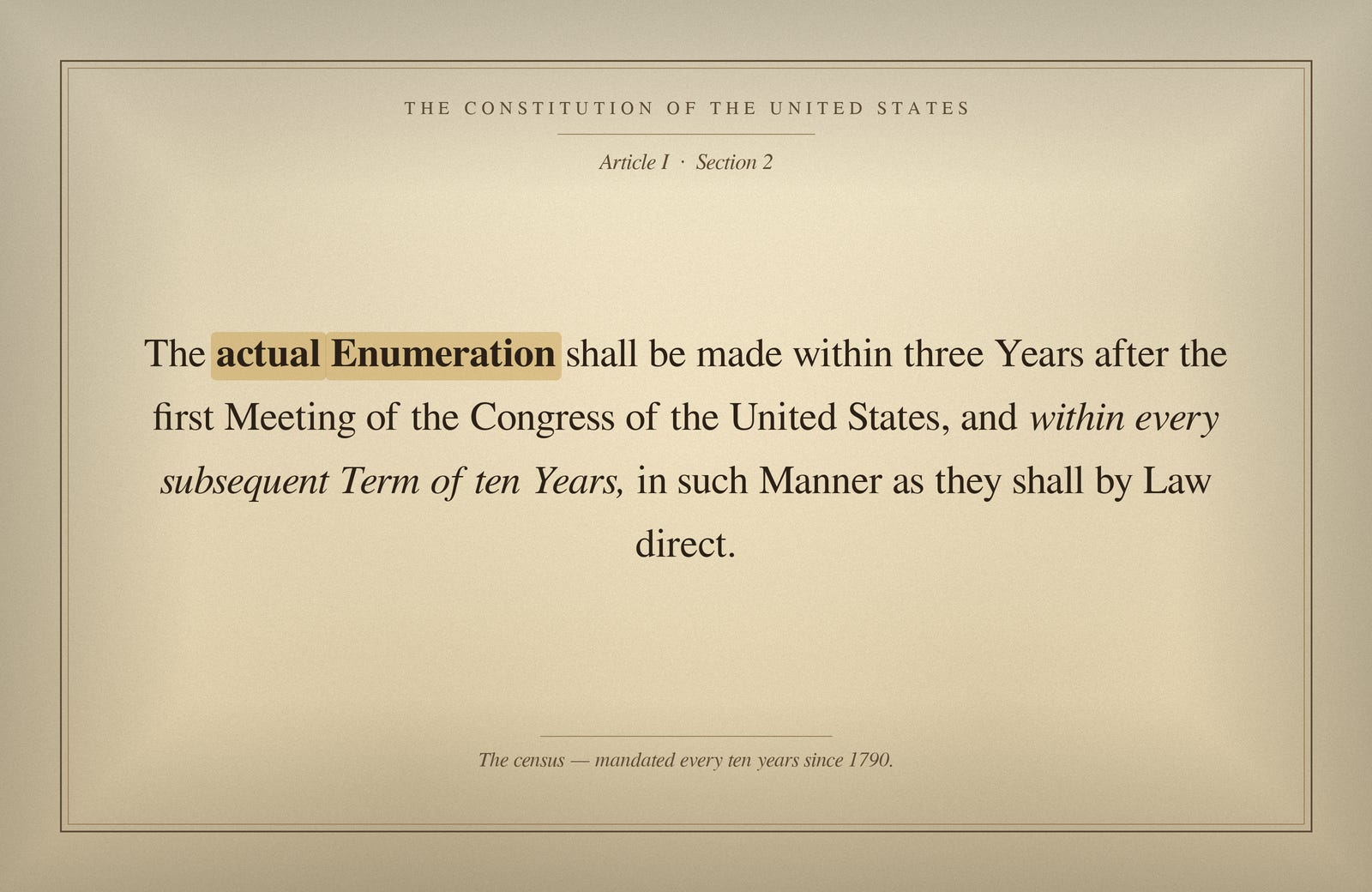
This week the country marked 250 years, and USA Facts used the moment to make a point that’s easy to miss: the founders treated data as foundational. Barely 200 words into the Constitution — before it establishes a president, before it raises an army — Article I orders the government to count every person, every ten years, forever. The first census, run by Thomas Jefferson’s office in 1790, found 3,929,214 people. Vermont was among the places counted.
And counting was only the start of the instinct. A census enumerates people; a working government has to measure things too — what it owes, what it produces, what its people earn. Within a generation the same impulse was surveying manufacturing and tallying the national debt. Counting and measuring are one civic act: fixing a number to reality before deciding what to do about it.
The founders didn’t collect all this to admire it. They measured in order to act — to apportion the House, set the tax base, stand up a government. The data came first so the decision could follow.
Somewhere we drifted
The modern temptation runs the other way. It’s to settle on the conclusion first and reach for the numbers only if they happen to agree — or to order one more study rather than decide on the one already in hand. Both are ways of not acting. At any statehouse — or any newsroom, for that matter — it’s worth asking whether accurate information still guides the conclusion, or whether inconvenient facts get ignored the moment they stop serving the point.
That isn’t ours to answer for you — but you can’t ask it at all unless someone keeps the data in front of you.
And that’s getting harder. Even USA Facts, whose whole purpose is making public numbers usable, now runs a campaign it calls “Data we depend on” — because public data is under strain: slower to obtain, more contested, in places harder to trust. At the state and town level, that rarely looks dramatic. It looks like a number that exists but won’t surface on its own — a records request no one filed, a 263-page report no one summarized.
Surfacing those numbers is the whole job. Every week, Compass Vermont does at the Vermont and town level what the founders wrote into Article I: we count, we verify, we link the source, and we put the figures in front of you — so you can judge for yourself whether the people who represent you are representing you. We provide the data. You make the decisions.
The records requests and the long reading are what your support pays for. As the country marks 250 years of a republic that began by counting, the fitting way to honor it is to help keep the counting going — close to home, where it decides your taxes, your town meeting, and your road.
If Compass Vermont has helped you see this state more clearly, please become a paid subscriber.
Source: “Analyst Notes: Government data and America’s founding,” USAFacts, June 25, 2026.
........"We Assume.".........and this.... "Somewhere we drifted"...... Well said Compass and more.... In my view, the Constitution is in the shredder and it's been turned on.... Our Government is out of control... Voting has consequences.....