


ANALYSIS
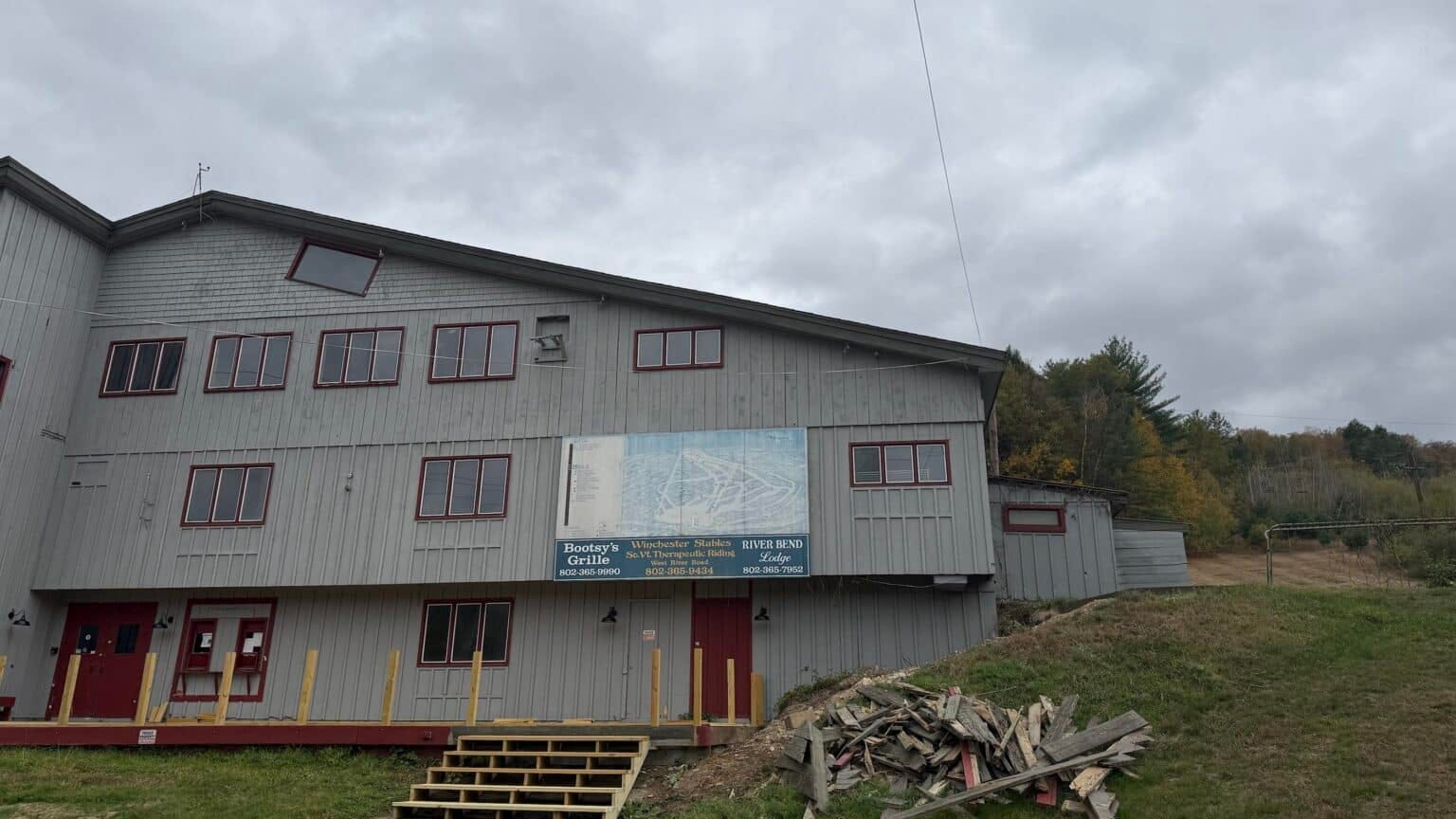
In May 2018, a Connecticut lawyer paid $745,000 for a dead Vermont ski area. Maple Valley, on Route 30 in Dummerston, was built by Terry Tyler in 1963 and ran until the 1999-2000 season — sixteen trails, two double chairlifts and a T-bar, a thousand feet of vertical drop — and then went dark. The 16,000-square-foot base lodge came with the sale. So did the old lifts, the snowmaking equipment, and the diesel generators. The town had the property assessed at $1,477,300. It sold for half that.
Keane Aures and his group, Sugar Mountain Holdings LLC, wanted to turn the base lodge into a brewery, a distillery, and a place people could hold a wedding.
Eight years later, the lodge may pour its first beer this fall.
Four of those eight years went to a single state permit. Sugar Mountain filed its Act 250 application in February 2020 and did not have a final, unappealable permit until December 14, 2023 — 46 months, or more than 1,400 days.
Act 250 is Vermont’s land use law, passed in 1970. It requires state review of development above a certain size, on top of whatever review the town already does. Nine district commissions — three-member panels of citizen volunteers — decide whether a project meets ten criteria covering things like water quality, traffic, soils, and aesthetics.
Here is what filled the 46 months.
February 2020 — Sugar Mountain files its Act 250 application: a brewery and distillery in the old base lodge, a 30-seat tasting room, and an event space for gatherings of up to 150 people, with 24 large events a year.
December 2021 — the Dummerston Development Review Board holds a preliminary site visit. About thirty people attend, most of them asking for party status so they can weigh in at future hearings.
November 2022 — nearly three years after the application, the District 2 Environmental Commission grants the permit but strikes two things: outdoor amplified music, and use of the old skier parking lot near the West River as overflow parking.
June 2023 — Sugar Mountain appeals the conditions. After several days of hearings, the Environmental Division of Vermont Superior Court issues the permit.
July 20, 2023 — Judge Thomas G. Walsh dismisses the last objection, a neighbor’s complaint about noise.
December 14, 2023 — the neighbor appeals to the Vermont Supreme Court. A three-member panel declines to disturb the ruling.
Notice where the time actually went. The appeals took thirteen months. The initial review — one district commission, one application, no appeal yet filed — took thirty-three.
The Supreme Court’s answer was procedural and short. The neighbor had not argued that the lower court got its facts wrong, only that the evidence should have been weighed differently, and “that is not the role of this Court on appeal.”
Nobody ever said no, they just took a long time
The project was never rejected. The district commission approved it. The Environmental Division approved it. The Supreme Court let it stand. What Act 250 did to Maple Valley was not refusal. It was four years.
That distinction is the whole argument about this law, and it is why the state’s own headline number is so slippery. The Land Use Review Board, which administers Act 250, says district commissions receive roughly 400 applications a year and approve more than 99 percent of them. On average, one application a year is denied outright. More than 90 percent never require a public hearing at all.
Read one way, that is a permitting system that almost never says no. Read another way, it is a system whose central cost is not denial but delay — and delay does not appear in the statistic. Compass reported this in April, talking to two Vermont farmers and a Vergennes developer who built nine apartments instead of ten specifically to stay under the Act 250 threshold. The approval rate counts the people who finished. It cannot count the people who never started, and it does not count the calendar.
The calendar is what nearly killed Maple Valley. When the Environmental Division cleared the project in July 2023, Aures did not celebrate. He told the Brattleboro Reformer his group had begun requoting equipment and construction costs, and that “we need to determine if we still have a viable project.” He had said earlier that inflation since 2018 had wrecked the original budget, and that he had stopped putting dates on the thing years ago.
He kept going. In 2024 he bought Whetstone Beer Co. in Brattleboro, giving him a working production facility while the lodge sat unfinished, and started demolition on the lodge deck and interior late that year. The brewery brand — North Chair — is named for one of the ski area’s lifts.
What the objections were about
Two things held the permit up, and they were not the same kind of thing.
The riverside parking lot was a question of hydrology. The lot sits in a floodplain along the West River. Sugar Mountain proposed a 50-foot riparian buffer — a vegetated strip that filters runoff before it reaches the water — which would have allowed parking there twice a month. The Vermont Fish and Wildlife Department recommended 100 feet. The district commission agreed, and at 100 feet there was no room left for cars. That objection was substantive, and it stuck.
The other was about music, and it is the one that consumed the last three and a half years. The district commission barred outdoor amplified music at the lodge. Sugar Mountain appealed, and the Environmental Division heard evidence on how loud the music would actually be.
A sound engineer testified that music would reach roughly 45 decibels at the neighbor’s house, which the Bennington Banner reported the court likening to a refrigerator three feet away. For scale, OSHA’s reference chart puts a normal conversation at three feet at 60 decibels, and an ordinary urban residence at 50. Because the decibel scale is logarithmic, that conversation carries roughly thirty times the sound energy of the music at issue.
The court found no written community standard was violated, and that occasional music was not uncharacteristic for that stretch of Route 30 — a road that carried a lit ski area with night operations for thirty-seven years. Hearing the band, the court held, was not fatal to the project.
The neighbor appealed and lost. What he asked the state to protect, in his filing, was that “Dummerston is quiet, peaceful, beautiful, private and even remote.” Nobody disputed that it is. The question Act 250 put to three levels of review over thirteen months was whether it had to stay that way.
The doubled process
Vermont is one of a very small number of states that runs a statewide development review on top of municipal review. Most states stop at the town. In Dummerston, Sugar Mountain went before the town’s Development Review Board and the state’s district commission, presenting the same project twice to two sets of citizen volunteers applying two sets of standards.
The state has since tried to shorten the path. Act 181 of 2024 — the most substantial rewrite of Act 250 since 1970 — replaced the old acreage triggers with a three-tier map system and swapped the Natural Resources Board for a professional Land Use Review Board. Whether that changes anything for a project like Maple Valley is not yet knowable. The maps that would answer it are still being drawn, and the tier that would cover a former ski area in a rural town does not take effect until the end of this year.
What is not in dispute is the arithmetic. A building sat empty in Dummerston for 26 years. The permit to fix it took four of them, and it was granted.