


Canada is trying to make its economy less dependent on the United States, and few states have more riding on that relationship than Vermont.
Canada is Vermont’s largest trading partner, accounting for 56 percent of the state’s total goods trade in 2024. About one of every four kilowatt-hours Vermonters use comes from Hydro-Québec, Quebec’s government-owned utility, under a contract that runs through 2038. The company that owns Green Mountain Power and Vermont Gas Systems is controlled by Quebec’s public pension fund. And as of Oct. 5, Quebec is governed by a party that wants the province to leave Canada.
The Wall Street Journal’s chief economics commentator, Greg Ip, argued Oct. 16 that President Trump’s tariffs and annexation talk may push Canada to do what it has struggled to do for generations: build pipelines, power projects and trade routes that run east-west across Canada instead of south into the U.S. Prime Minister Mark Carney’s government has set a goal of doubling Canada’s exports to countries other than the U.S. within a decade.
Here is what that shift could mean for Vermont, and where it doesn’t fit the “Canada is pulling away” story.
Will Trump’s Actions to Save Maine’s Susan Collins Help Vermont?
On Oct. 23, the Trump administration lifted its 50 percent tariff on some Canadian goods, a move The Wall Street Journal reported was aimed at helping Maine Sen. Susan Collins. Collins, a Republican in a close re-election race in a state that depends heavily on trade with Canada, had asked for the relief.
Here is what changes on Oct. 30:
The 50 percent tariff comes off some Canadian products used in agriculture, including certain machinery, refrigeration products, packaging and plywood.
A new 50 percent tariff goes on Canadian carpet, certain valves and waste products.
The relief isn’t limited to Maine. Tariffs are charged at the border no matter which state the goods are headed to. Vermont businesses that bring in the exempted products from Canada will no longer owe the tariff on them, and those that bring in the newly tariffed products will.
The total barely moves. The swap leaves roughly $20 billion in Canadian goods under the 50 percent tariff, about 5 cents of every dollar Canada sells to the U.S., the Journal reported. What changes is the list. This is the second time since the tariffs took effect in August that the administration has pulled some products off and put others on. It has also threatened to double tariffs on Canadian vehicles in January if the two countries don’t reach an agreement, and a New Jersey food importer has sued, arguing the administration is overstepping its legal authority.
For a Vermont business that buys from or sells to Canada, what gets taxed at the border can change from one month to the next.
What Vermont Sells and Buys
Canada bought $635 million in Vermont goods in 2025, about 31 cents of every dollar of goods Vermont sells abroad, according to the U.S. Trade Representative.
That figure is less than half of what it was. Vermont’s exports to Canada were $1.43 billion in 2019, according to the Eastern Border Transportation Coalition, then:
$919 million in 2020
$645 million in 2024
$631 million in 2025 (the U.S. Trade Representative puts 2025 at $635 million)
Most of the drop came before Trump’s tariffs. The 2025 tariff fight, which Compass tracked as it hit Vermont, took off about $14 million more. The U.S. Supreme Court later threw out the emergency tariffs at the center of that fight.
The flow running the other way is much larger. Vermont imported $2.78 billion in Canadian goods in 2025, more than four times what it sold north, and up from $2.37 billion in 2024. Total trade between Vermont and Canada went up last year, not down.
The Power Contract
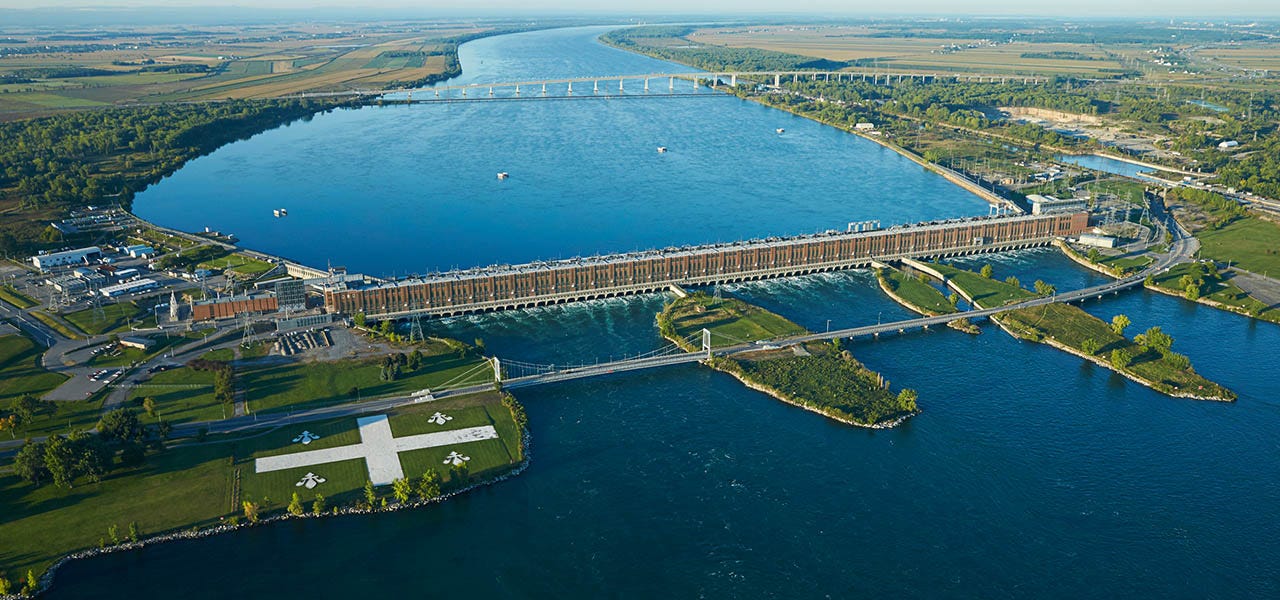
The Hydro-Québec contract covers up to 225 megawatts, about 1.3 billion kilowatt-hours a year, which Hydro-Québec says is equivalent to about 25 percent of Vermont’s annual electricity needs. Green Mountain Power, Vermont Electric Cooperative, the Vermont Public Power Supply Authority, Stowe Electric and Burlington Electric are all parties to it, according to a 2026 Hydro-Québec filing with the U.S. Securities and Exchange Commission.
The contract runs 12 more years. When Vermont negotiates what comes next, it will be dealing with a utility that needs more power at home. Hydro-Québec expects Quebec’s own electricity demand to roughly double by 2050 as homes, cars and industry switch from fossil fuels.
Quebec has also shown it is willing to use electricity in a trade fight. During the 2025 tariff dispute, the previous Quebec government considered stopping the power it sells on the U.S. spot market, which is short-term power sold day to day rather than under contract. It also said it was looking at whether it could legally break contracts for future power deliveries signed with two U.S. states. That March, Hydro-Québec stopped selling into New England’s wholesale market for a stretch, which the company said was driven by prices. Vermont’s power comes under a long-term contract already in effect, not the spot market.
Questions sent Oct. 19 to the governor’s office for the Department of Public Service, asking whether the state has begun planning for the contract’s end, had not been answered by publication.
Who Owns Vermont’s Utilities
Green Mountain Power and Vermont Gas Systems are owned by Énergir, a Montreal company. Énergir is controlled by the Caisse de dépôt et placement du Québec, which manages Quebec’s public pension funds. The Caisse took full control of Énergir in 2021, describing it as Vermont’s primary electricity distributor and its only natural gas distributor.
Vermont Gas also depends on Canada for its fuel. Nearly all of its supply comes from Canada, the company has said.
Ownership is not control over rates or service. Both utilities answer to the Vermont Public Utility Commission, which sets their rates and must approve major decisions.
Quebec’s New Government
The Parti Québécois, which wants Quebec to become an independent country, won 59 of 127 seats on Oct. 5, five short of a majority. Leader Paul St-Pierre Plamondon has promised a third referendum on leaving Canada, but not until Trump leaves office in January 2029. Quebec voters rejected independence in 1980 and 1995. A recent poll put support for leaving at 31 percent, and the two main opposition parties have pledged to block a referendum.
Two weeks later, Alberta voters rejected starting the process toward a separation vote, with about 76 percent choosing to remain in Canada, according to unofficial results.
The Trade Agreement Clock
Beyond the month-to-month changes, the trade agreement itself is on a timer. On July 1, the U.S. declined to renew the U.S.-Mexico-Canada Agreement, the 2020 pact that replaced NAFTA and lets most goods cross the border duty-free. The agreement stays in force, but the three countries now review it every year. If they don’t agree to extend it, it expires in July 2036, two years before the Hydro-Québec contract ends.
Canada Isn’t Turning Away From U.S. Customers
The evidence that Canada is cutting off the U.S. is thinner than the rhetoric.
Canada’s new energy deal sends power south. The August agreement among Canada, Quebec and Newfoundland and Labrador to expand the Churchill Falls power station and build a new hydroelectric station at Gull Island guarantees Newfoundland 985 megawatts of transmission to outside markets, including 200 megawatts into New England and up to 240 megawatts into New York. The PQ, which once called an earlier version of the deal humiliating, has said it will review the agreement rather than scrap it.
Most of Canada’s new trade is gold and oil. The U.S. share of Canada’s goods exports fell from 75.9 percent in 2024 to 71.7 percent in 2025, driven largely by gold and energy. Vermont doesn’t compete in either.
Canadian visitors are coming back. Canadian credit card spending in Vermont was up 18 percent through August compared with last year. That is still well below 2024: spending fell 47 percent in 2025.