


Part 2 of a two-part series on Vermont’s drug trafficking pipeline.
In Part 1 of this series, we examined why out-of-state drug traffickers treat Vermont as a high-profit, low-consequence destination — and why mandatory minimum sentences target the wrong point in the pipeline. Opponents of tougher sentencing frequently point to “Housing First” as a more effective alternative: give people stable housing as the foundation for recovery from addiction, and you reduce both homelessness and the low-level crime that comes with it.
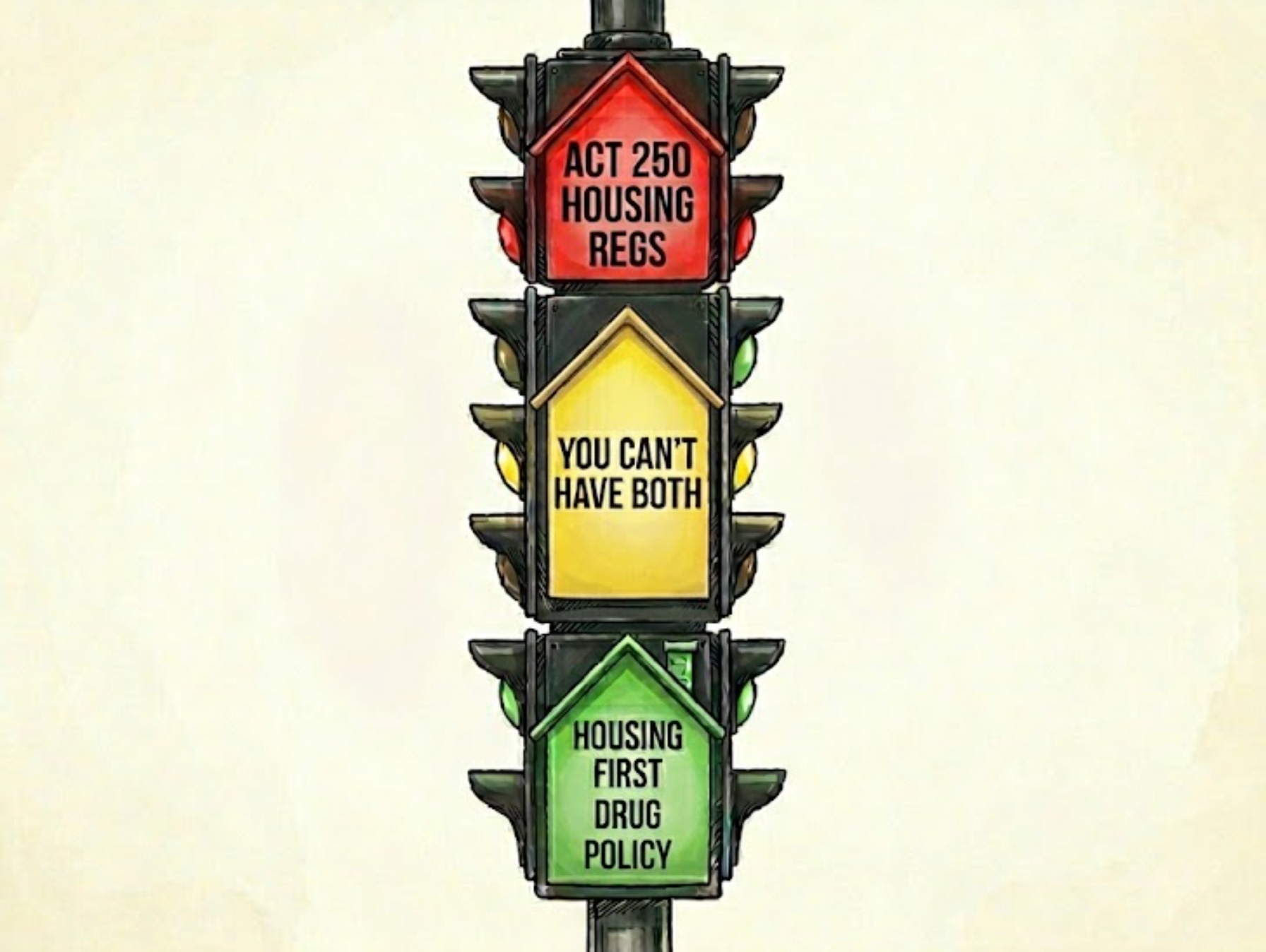
The evidence for Housing First is strong. The logic is sound. And in Vermont, it is an answer without a delivery mechanism — because the state has spent 55 years making it structurally impossible to build the housing it requires.
The Scale of What’s Missing
Vermont needs at least 24,000 additional year-round homes by 2029. That includes 16,000 to 20,000 rental units. The state is currently building just 27% of what it needs each year to meet its 2030 targets. Vermont has the second-highest per capita homelessness rate in the nation. The median home sale price rose 43% between 2019 and 2023. Thirty-six thousand households — renters and owners — are paying more than half their income toward housing.
The cost of building is staggering. A single apartment in a subsidized multifamily building now runs about $500,000 to develop — up roughly 50% since 2020, according to the Vermont Housing Finance Agency. Building a modest single-family home costs $250 to $400 per square foot, meaning a 1,500-square-foot house runs $375,000 to $600,000 before land, permits, or utilities. Construction costs are up roughly 20% since 2020 due to labor shortages and supply chain disruptions.
Now do the math on Housing First. If Vermont needs 24,000 units and each costs $500,000 to develop, the price tag is $12 billion — in a state whose entire housing development budget dropped from $73.9 million in 2024 to $39.9 million in 2025. At current spending levels, it would take decades to close the gap. And that’s before dedicating a single unit to people in addiction recovery, which is supposed to be the whole point of the Housing First argument.
How Vermont Got Here: 55 Years of Act 250
Multiple factors created the housing shortage — pandemic migration, low birth rates, short-term rentals, aging housing stock. But the single most consequential is Act 250, the landmark 1970 land use law that subjected housing construction to state-level environmental review based on a project’s size rather than its location.
For more than five decades, Act 250 worked essentially the same way. A developer building more than nine units within a five-mile radius over five years triggered full state review — whether the project was in downtown Burlington or on a country road. The process added time, expense, and uncertainty that builders describe as the single biggest barrier to housing production.
The chilling effect went beyond the projects that actually went through review. Developer Peter Kahn told VTDigger he initially planned to build only 9 apartments at a Vergennes site specifically to avoid triggering Act 250. A South Burlington development was abandoned entirely when the developers faced the prospect of a lengthy Act 250 fight with neighbors. Evernorth, the state’s largest nonprofit affordable housing developer, navigated a years-long legal battle over an affordable project in Putney that was launched by just two neighbors — adding tens of thousands in legal fees and construction cost increases.
An attorney who represented builders in Act 250 proceedings told Vermont Public that organized opposition can stall projects for years, destroying all predictability for developers. The result: builders either downsize, relocate, or walk away. Each abandoned or reduced project is housing that Vermonters needed and didn’t get.
Act 250’s defenders credit it with keeping Vermont looking like Vermont — compact towns surrounded by working landscapes. That’s a fair point. But it comes with a cost that its defenders have been slow to acknowledge: a state that looks like Vermont but where working Vermonters increasingly cannot afford to live in it.
The Reforms — and Their Limits
The Legislature has begun to address this. The HOME Act of 2023 required municipalities to allow at least five units per acre in water-and-sewer districts, and duplexes in single-family zones. Act 181 of 2024 overhauled Act 250’s structure, replacing the old size-based trigger with a tiered, location-based system. In Tier 1 areas — designated growth centers — housing projects of 50 units or fewer would be exempt from Act 250. Tier 2 would continue roughly as before. Tier 3 areas — classified as “critical natural resources” — would see tighter restrictions.
It’s an improvement. Developers have already used interim exemptions to build projects across the state — about a dozen since the law took effect, including a nursing home conversion in Hartford and new senior housing in St. Johnsbury. Kahn, the Vergennes developer, expanded his project from 9 to 24 apartments once Act 250 no longer applied.
But the reforms have three significant problems.
Towns can opt out. Municipalities that qualify for Tier 1B status can simply choose not to participate. In Chittenden County — Vermont’s population center — a third of eligible towns have declined, including Colchester and Essex. The Land Use Review Board has in some cases pushed regional planning commissions to shrink proposed Tier 1B areas, including in Rutland County towns like Castleton, Fair Haven, Killington, and Poultney. The director of the Rutland Regional Planning Commission has estimated that only 2% to 2.5% of the state’s land will end up in Tier 1 — less than what currently falls under the temporary exemptions. The permanent system may be more restrictive than the interim one.
Tier 3 threatens rural housing. The new “critical natural resources” designations cover rare natural communities, headwater streams, and habitat connectors along roads. Rural municipal officials have pushed back hard. Karen Horn, chair of Moretown’s planning commission, wrote to the Land Use Review Board that the Tier 3 maps “disproportionately disadvantage Moretown’s potential for housing development in some of the few areas best suited to housing growth.” She called the prospect of additional state review on land where housing is encouraged locally “beyond demoralizing.” Tier 3 is slated to take effect at the end of 2026.
The interim exemptions are temporary. Most require construction to begin by 2027 or 2028. If the Legislature doesn’t make them permanent, the window closes. Governor Scott has pushed for exactly that — and has called Act 181 “a conservation bill” that doesn’t go far enough for housing. He vetoed it. The Legislature overrode the veto 107-38 in the House and 21-8 in the Senate.
The Coalition That Wants It Both Ways
Here is where the drug policy debate and the housing debate collide — and where the contradiction becomes impossible to ignore.
When Governor Scott issued an executive order in 2025 directing state agencies to streamline housing regulations — including reducing wetland buffer setbacks and rolling back some energy code requirements — a coalition of organizations issued a joint letter calling it “illegal overreach.” The signatories: the Vermont Natural Resources Council, the Conservation Law Foundation, Sierra Club Vermont, Vermont Conservation Voters, the Vermont Public Interest Research Group — and the ACLU of Vermont.
The ACLU of Vermont is also one of the most prominent voices opposing mandatory minimum sentencing for drug traffickers, citing the failed war on drugs and racial disparities in enforcement. Their alternative: invest in treatment, harm reduction, and housing.
The VNRC, for its part, has been Act 250’s most vigorous institutional defender for over five decades — filing briefs to prevent weakening of the law, celebrating the veto override of Governor Scott’s objections, and cautioning against housing reforms that it argued went too far. In 2023, VNRC recommended the Legislature wait another year before making jurisdictional changes to Act 250 — during an acute housing crisis.
To be clear: these are organizations with legitimate missions. Environmental protection matters. Civil liberties matter. The positions they hold on individual issues are defensible in isolation.
But they are not operating in isolation. They are operating in a state with a 24,000-unit housing deficit, the second-highest homelessness rate in America, and a drug trafficking pipeline that feeds on the instability both of those conditions create. When the same organizations that oppose tougher drug enforcement also oppose the regulatory changes needed to build the housing they propose as an alternative, the result is a policy environment where neither approach can work. Tougher sentences fail because the pipeline’s command structure sits in another state. Housing First fails because there is no housing. And the communities bearing the cost of both failures — East Barre, Brattleboro, St. Johnsbury — are left with nothing.
The Math That Nobody Wants to Do
Housing First is not free. It is, in fact, enormously expensive — and in Vermont, the expense is compounded by the very regulatory structure its advocates defend.
A Corporation for Supportive Housing analysis commissioned by the state recommended strengthening Vermont’s housing-and-services system. The 2025 Vermont Housing Needs Assessment documented that developing a single affordable apartment now costs roughly $500,000. The state’s combined housing development budget — state, federal, and private equity — peaked at $200 million in 2022 during pandemic-era investment and fell to $82.3 million in 2025.
At $500,000 per unit and $82 million in annual investment, Vermont can produce roughly 164 new affordable units per year. The state needs 24,000 to 36,000. At that rate, closing the gap would take 146 to 220 years — assuming no units are lost to flooding, deterioration, or conversion to short-term rentals in the meantime.
These numbers are not an argument against Housing First. They are an argument that Housing First is meaningless without a construction revolution — and that a construction revolution is impossible under the current regulatory framework, no matter how many exemptions are carved out at the margins.
Governor Scott has argued for making the Act 250 exemptions the default — so towns would be in Tier 1B unless they opted out, rather than the reverse. Senate President Pro Tempore Phil Baruth pushed back, arguing that Act 250 has been “demonized” and should be given time to work. That’s a reasonable position if the timeline is measured in decades. It is not reasonable if Vermont’s drug-affected communities need housing now.
What Honesty Looks Like
Vermont’s drug trafficking problem cannot be separated from its housing problem. The pipeline runs on instability — on people without stable housing, without treatment access, without options. Every person living in a car, cycling through emergency shelters, or crashing in an apartment that a Springfield dealer has commandeered is both a potential customer for the pipeline and a potential beneficiary of Housing First.
But offering Housing First as a policy alternative while defending the regulatory framework that prevents housing from being built is not a policy position. It is a contradiction. And it has consequences. The communities at the sharp end of the trafficking pipeline — the families in East Barre, the small-town police chiefs with no backup, the emergency room nurses reviving the same person for the fifth time — cannot wait for a 146-year construction timeline.
An honest drug policy conversation in Vermont would require several things that are currently not on the table.
It would require the environmental advocacy community to acknowledge that 55 years of Act 250 contributed to a housing crisis that now undermines the very alternatives to incarceration they champion. Protecting Vermont’s landscape is important. So is making sure Vermonters have somewhere to live.
It would require the Legislature to make the Act 250 housing exemptions permanent, stop allowing towns to opt out of Tier 1B status in the middle of a housing emergency, and reconsider whether Tier 3 designations are pulling too much buildable land off the market in rural communities that desperately need housing.
It would require the same federal investment in enforcement partnerships that Part 1 of this series described — because even with adequate housing, the pipeline’s 300-500% profit margin will continue to attract out-of-state traffickers until the people running the operation face consequences that reach beyond Vermont’s borders.
And it would require everyone involved to stop pretending their half of the answer is the whole answer.
The tougher-sentencing advocates are right that the current consequence level is too low to give law enforcement any leverage over the pipeline. But mandatory minimums for replaceable runners won’t fix that.
The Housing First advocates are right that stable housing is essential to breaking the cycle of addiction. But you can’t house people in units that don’t exist and won’t be built under the regulatory framework you’re defending.
Vermont doesn’t need to choose between enforcement and treatment, between conservation and construction, between public safety and civil liberties. It needs all of them — and it needs the people advocating for each one to stop blocking the others.
This is Part 2 of a two-part series. Read Part 1: Why Drug Dealers Keep Coming Back to Vermont — and Why Nobody’s Solution Is Working
Compass Vermont is independently reported and edited by its Vermont-based publisher. Questions about any story are welcome at tom@compassvermont.com
You have hit the nail on the head. What if houses could be built for $200k and banks provided affordable financing backed by the state?