


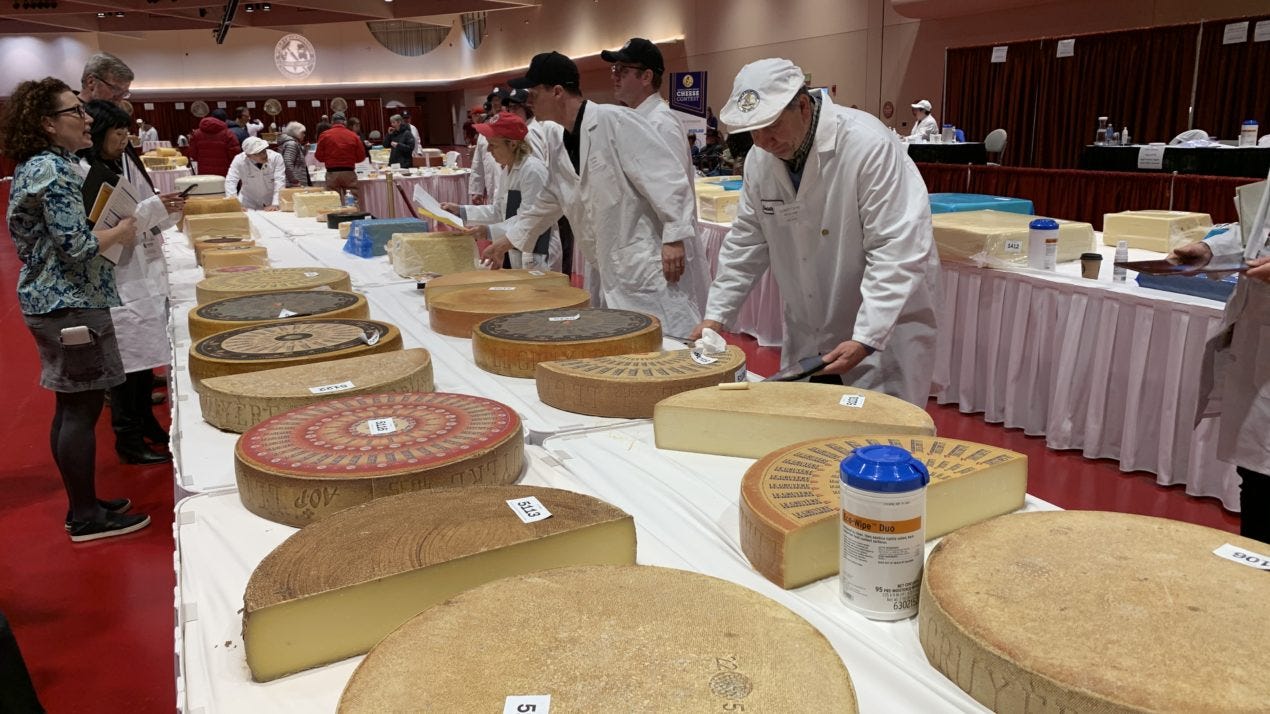
The world’s premier cheese competition is about to unfold in Madison, Wisconsin, and Vermont—despite its outsized reputation for award-winning artisanal cheese—will have just one representative among the 56 experts judging the event.
The disparity has sparked discussion within Vermont’s dairy community about whether the state’s cheesemaking excellence is adequately represented in the evaluation process.
Record-Breaking Entries and Global Participation
The 36th World Championship Cheese Contest will take place March 3-5, 2026, at Madison’s Monona Terrace Community and Convention Center. The competition has attracted 3,375 entries from 24 countries and 33 U.S. states—a notable increase from 3,302 entries in 2024 and 2,978 in 2022. Hosted by the Wisconsin Cheese Makers Association since 1957, the contest evaluates cheese, butter, yogurt, and dry dairy ingredients across 150 distinct classes.
The competition carries substantial commercial weight. The “Gold Medal Seal” serves as a powerful marketing tool that influences consumer purchasing decisions and can propel small creameries into national distribution networks.
The Judging Panel Breakdown
The 2026 judging panel comprises 56 experts including cheese graders, buyers, dairy science professors, and researchers from 22 countries and 12 U.S. states. The international contingent includes representatives from major dairy regions such as Italy, the Netherlands, Switzerland, Germany, Denmark, and France, as well as Brazil, Japan, Ukraine, and Ecuador.
Among U.S. states, Wisconsin dominates the panel with approximately 18 judges—roughly 32% of the total. Other represented states include Oregon (2-3 judges), California (2), and New Jersey (2), along with single representatives from Idaho, South Dakota, Texas, Illinois, Washington, Missouri, Utah, and Pennsylvania.
Vermont’s sole representative is Ted Brown of Cabot Creamery Cooperative, a senior quality professional with extensive experience in high-volume cheddar production.
Vermont’s Award-Winning Track Record
Vermont’s minimal representation contrasts sharply with the state’s competitive success. In 2023 alone, Vermont cheeses captured 142 domestic and international awards, with high concentrations of wins at the American Cheese Society awards and the Guild of Fine Foods’ World Cheese Awards.
Vermont creameries have consistently excelled at the World Championship itself. Jasper Hill Farm’s Harbison won Best in Class at the 2024 contest, while Willoughby placed in the Top 20 World Finalists. Vermont Creamery and Cabot Creamery have also secured Best in Class honors in previous years, and Jasper Hill Farm’s Whitney won Best of Show at the 2022 American Cheese Society competition.
The state’s producers specialize in artisanal techniques—raw milk production, cave-aging, and non-traditional approaches like Harbison’s spruce-bark wrapping—that have earned international recognition despite Vermont’s relatively small production volume.
The Wisconsin Advantage
The concentration of Wisconsin judges reflects fundamental differences in scale and infrastructure. Wisconsin produces approximately 3.6 billion pounds of cheese annually—about 25% of all U.S. cheese—compared to Vermont’s estimated 13.2 million pounds. If Wisconsin were a country, it would rank as the world’s fourth-largest cheese producer behind only the United States, Germany, and France.
Wisconsin is also the only state requiring a professional cheese license for commercial production and maintains the nation’s only state-sponsored Master Cheesemaker program. The Center for Dairy Research at the University of Wisconsin-Madison provides continuous training for judges and technical experts, creating a deep pool of certified graders that naturally populates much of the domestic judging panel.
Wisconsin has over 1,200 licensed cheesemakers compared to Vermont’s estimated 50-60, giving the host state a significantly larger base of qualified technical judges.
How the Technical Scoring System Works
The contest’s integrity rests on its rigorous, science-based evaluation methodology. Unlike subjective consumer awards, the World Championship uses a 100-point deduction system where each entry starts with a perfect score and loses points for specific technical defects.
A pair of judges evaluates each sample for defects in flavor, body and texture, salt, color, finish, and packaging. Common flavor defects include “acid,” “bitter,” “feed,” “flat,” or “oxidized,” while body and texture issues might involve “corky,” “crumbly,” “mealy,” “pasty,” or “weak” characteristics. This dual-oversight approach ensures consistency in scoring.
The Championship Round involves all 56 judges, with the 20 highest-scoring gold medalists advancing to a final evaluation where individual scores are averaged to determine the World Champion. This statistical averaging significantly dilutes the potential influence of any single judge or regional bias.
Evidence of System Objectivity
Historical results suggest the technical evaluation system recognizes excellence regardless of regional judicial representation. In 2024, Michael Spycher of Switzerland won the World Championship with “Hornbacher,” achieving a near-perfect score of 98.98 out of 100. Spycher also won in 2022 with “Gourmino Le Gruyère,” scoring 98.423 points—despite the Wisconsin-heavy judging panel.
In 2022, no Wisconsin cheese was named World Champion despite most finalists coming from the state. A 2016 World Championship was won by a Vermont-Wisconsin collaboration: Cabot Clothbound, made by the Cellars at Jasper Hill Farm in partnership with Cabot Creamery.
These outcomes demonstrate that when Swiss or Vermont cheeses achieve technical excellence according to the deduction-based criteria, the judging panel—regardless of its regional composition—recognizes that quality.
The Case for Increased Representation
Vermont dairy industry advocates argue that the state’s distinctive cheesemaking approaches deserve greater recognition on the judging panel. Vermont’s focus on terroir-based techniques, raw milk production, and innovative aging methods represents a different philosophy from the larger-scale production more common in the Midwest.
Without more judges familiar with these artisanal nuances, proponents suggest, there’s a risk that innovative but technically divergent cheeses could be unfairly penalized for characteristics that are actually intentional style features rather than defects.
The reduction from previous years—when Vermont had additional representatives like Craig Gile—may result from several factors: routine panel rotation to incorporate fresh international perspectives, increased allocation of seats to judges from countries like Greece, Austria, and New Zealand, or the contest’s prioritization of experts with formal ties to Wisconsin-based training institutions.
Managing Conflicts of Interest
The contest addresses potential conflicts through its dual-judge system and scoring protocols. Judges employed by major dairy manufacturers with entries in the competition would typically be recused from evaluating entries in specific classes where their employers have submitted products.
The recruitment process follows a merit selection philosophy requiring judges to be competent in technical duties, free from undue influence, and possess extensive scholarship and professional achievement in dairy science. The inclusion of international judges from 22 countries provides an additional check on domestic regionalism, as experts from Denmark’s dairy industry or Croatia’s universities are unlikely to favor either Wisconsin or Vermont in regional disputes.
What Happens Next
The 2026 World Championship Cheese Contest will proceed March 3-5 with its current 56-member panel evaluating 3,375 entries across 150 classes. Vermont’s single judge, Ted Brown, will participate in evaluations alongside the international cohort and his Wisconsin counterparts.
For Vermont to secure additional representation in future competitions, the state would likely need to strengthen institutional ties to formal dairy science and grading certification programs. While Vermont has numerous master cheesemakers in the artisanal sense, it lacks a state-sponsored Master Cheesemaker certification program like Wisconsin’s, which provides a pipeline of judges who meet the contest’s technical requirements.
The contest results themselves will offer the most definitive assessment of system fairness. If Vermont creameries continue securing Best in Class and Top 20 finishes—as they have consistently for decades—it will demonstrate that technical excellence in cheesemaking can overcome disparities in judicial representation. The ultimate test is whether Vermont’s Harbison, Bayley Hazen Blue, and other award-winning cheeses can once again earn recognition from a global panel of experts, regardless of how many judges call the Green Mountain State home.