


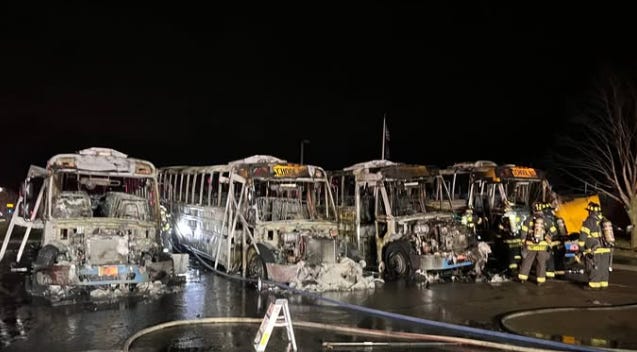
After a long pause, a voice in the room spoke up. She had a quiet question for Gary Marckres, the Chief Operating Officer of Champlain Valley School District, who had just finished a detailed account of the fire that destroyed four electric school buses in a Williston parking lot.
She’d heard the recently approved bond was for more electric buses. Was that right?
Marckres corrected her. “They were not for more electric buses. Just more buses.” He paused. “Two used buses — well, two used diesel buses, sorry.”
“Yes,” she replied. “I and others were misinformed, but good. Good. Thank you.”
It was a small moment in a school board meeting that mostly dealt with other business. But it said something larger about where things stand — not just in Champlain Valley, but in school districts across Vermont and the country — when it comes to the promise of electric school buses.
The Fire
On the night of March 11, a custodian at Allen Brook School in Williston noticed a glow outside and called 911. Williston Fire responded within minutes. A fire that started in a single electric bus had spread in heavy southeast winds to three others — all total losses — and bubbled the paint on a fifth.
The buses were Thomas Built models, a subsidiary of Freightliner, leased from Massachusetts-based Highland Electric Fleets. They had been parked and plugged in. Under the lease agreement, Highland holds liability when buses are in that status. The district had begun operating the six buses in September 2025, purchased by Highland with funding from the EPA’s Clean School Bus Program.
No evidence has emerged that the high-voltage batteries caught fire. According to Marckres’ account to the board, the damage was primarily seats, foam, vinyl, and fiberglass. The Vermont State Police Fire and Explosion Investigation Unit and the state fire marshal are investigating the cause, alongside independent investigators from Highland, Thomas Built, and the district’s insurer, Church Mutual.
The district immediately grounded its two remaining electric buses. Highland arranged six replacement diesel buses from Lamoille Valley Transportation at its own expense. School was canceled for Williston students on March 12 and 13 while the parking lot was secured for the investigation and an environmental cleanup of the playground, sidewalk, and nearby modular classrooms was completed.
The Buses That Were Already Dead
The Allen Brook fire wasn’t Champlain Valley’s first problem with electric school buses. It wasn’t even the first problem with a different company’s electric school buses.
In 2021, Vermont became one of the first states to put electric school buses on the road. The Agency of Natural Resources launched a pilot program funded by the federal Volkswagen Environmental Mitigation Trust — roughly $4 million from VW’s emissions cheating settlement, administered by the Vermont Energy Investment Corporation. Three school districts participated: Champlain Valley School District and the Barre Unified Union School District selected Lion Electric, a Quebec-based manufacturer, while Franklin West Supervisory Union chose Blue Bird. Each district received two buses.
The results were mixed from the start. A VEIC pilot report tracked performance across all six buses and found wide variation. At Champlain Valley, one Lion bus achieved a 100% in-service rate; the other managed 73%. At Barre, the two Lion buses came in at 60% and 86%. Franklin West’s Blue Bird buses performed worst of all, with in-service rates of just 57% and 29%. Cold weather was the biggest factor: at zero degrees, Lion buses lost 30–40% of their advertised range, and Blue Bird buses lost closer to 80%. The report’s summary was blunt: some brands performed well in winter, and some “failed to perform at all.”
Even before the buses arrived, there were complications. Champlain Valley experienced delivery delays with its Lion buses that disrupted driver training schedules. Lion provided two demonstration buses as a stopgap — but they weren’t compatible with the DC chargers the district had ordered, requiring temporary Level 2 chargers to be installed until the permanent buses showed up.
Today, Champlain Valley’s Lion buses are out of service. According to a CVU communications office spokesperson, at least one has been out of commission for an extended period. The district has no path to getting it repaired: Lion has voided all U.S. warranties. Barre Unified Union School District, which also received two Lion buses through the same pilot, faces the same voided warranties and the same absence of manufacturer support.
That’s because Lion Electric — once valued at $4.2 billion — went bankrupt in late 2024 and has since voided every warranty on every bus it sold in the United States.
What Happened to Lion Electric
Lion Electric had been a high-profile player in the electric vehicle space. The company was publicly traded on both the NYSE and TSX, employed 1,400 people at its peak, and in 2023 opened a 900,000-square-foot manufacturing facility in Joliet, Illinois, designed to produce 20,000 buses a year.
Between October 2022 and May 2024, the Biden administration awarded Lion approximately $160 million through the EPA’s Clean School Bus Program — a $5 billion initiative created by the Bipartisan Infrastructure Law. Lion was the program’s third-largest recipient. That is the same federal program that funded Champlain Valley’s Highland buses — the ones that burned at Allen Brook.
According to the Washington Free Beacon, the EPA sent the money upfront rather than tying payments to production milestones. Less than two weeks before the first $82.7 million was awarded, Lion had reported $17.2 million in quarterly losses. Since 2020, its cumulative net losses totaled $301.6 million.
But demand for electric commercial vehicles slowed nationwide. Reliability problems mounted. Multiple school districts reported power steering failures. A former Lion technician warned federal and state officials that the buses were “more like a science project than a validated, road-legal vehicle.” Lion’s stock price fell from $33.48 to $0.08 per share. The company’s president resigned in November 2024. In December, Lion filed for creditor protection in Canada and Chapter 15 bankruptcy in the United States.
In May 2025, a group of Quebec investors purchased Lion’s remains for a reported $6 million CAD — a company that had owed more than $244 million to creditors. The Joliet factory was permanently closed. The company, rebranded as “LION,” announced it would focus exclusively on the Quebec market.
In July 2025, the court-appointed bankruptcy monitor sent a letter to every U.S. customer: all warranties and purchase orders outside Quebec were null and void. All U.S. obligations had been transferred to a shell entity created to be wound up through bankruptcy proceedings.
Nearly 2,000 Lion Electric school buses in the United States — including at least four in Vermont — lost their manufacturer warranties overnight.
Vermont Isn’t Alone
The pattern is the same across the country: buses that broke down, a manufacturer that couldn’t or wouldn’t fix them, a bankruptcy that erased every warranty, and districts quietly returning to diesel.
In Winthrop, Maine, four Lion buses were pulled from service after repeated mechanical failures. “All four Lion buses that we own are currently parked and not being used,” the district’s interim transportation director told Clean Trucking. In Herscher, Illinois, Lion buses made up half the district’s fleet of 50, and six of the 25 needed repair with no one to fix them. In Kansas, a rural superintendent described his Lion buses as “paperweights in the lot.” By September 2025, the rebranded LION issued inspection bulletins for a heating system wiring issue after a bus caught fire in Montreal.
The EPA has referred the matter to the Department of Justice, citing possible “pending litigation.” The DOJ has said it “can neither confirm nor deny the existence of an investigation.” Shareholders have filed a class-action lawsuit alleging Lion misrepresented its finances. In Canada, Quebec’s auditor general is investigating the provincial subsidies given to Lion, with a report expected by spring 2026. Whether any of the $160 million will be recovered remains an open question.
This story has circulated on social media as a partisan talking point — framed as “textbook money laundering” with demands that “people need to go to prison.” That characterization, added by a social media account and not by Zeldin himself, strips out the complexity. Lion was a publicly traded company that built a real factory, employed real people, and delivered some buses before collapsing under slowing demand, mechanical failures, and years of mounting losses. Investors were wiped out. Employees lost their jobs. That is a story about serious oversight failure — but not the same thing as a cash handoff to a shell company.
Are the Buses Ready?
In February 2026, the EPA announced a restructuring of the entire Clean School Bus Program, canceling the 2024 rebate round and opening a public consultation that now includes alternative fuel options like propane, compressed natural gas, and hydrogen. The agency specifically cited Lion Electric’s bankruptcy as context for the changes. About 90 percent of the program’s $2.7 billion in awards to date had gone to electric buses.
The broader electric school bus sector is still growing — there are now more than 5,100 electric school buses on U.S. roads, up from 415 in 2020, and financially sound manufacturers like Blue Bird have reported record profits. Lion’s collapse was not the industry’s failure. But Lion was the third-largest recipient of federal clean bus funding, it is the company whose buses Vermont put on the road first, and its bankruptcy has left school districts from Maine to Kansas to Vermont holding buses with no warranty and no manufacturer support.
The Allen Brook fire is a separate event — different buses, different manufacturer, different program — and its cause remains under investigation. But it has landed in a district that was already dealing with dead Lion buses, and at a moment when the entire federal program that funds these purchases is being reworked. For school boards weighing whether to invest in electric buses, the timing is hard to ignore.
Two federal funding streams converged in Champlain Valley. The Volkswagen settlement money bought the Lion buses that are now out of commission. The Clean School Bus Program funded the Highland buses that burned. Different manufacturers, different programs, different failures. But for a district trying to get kids to school safely, the result is the same: six diesel buses from Lamoille Valley are running the routes.
The question that board member was really asking — and the one school boards across Vermont will be weighing — isn’t about Lion Electric or federal grant oversight. It’s simpler than that.
Are we sure these buses are ready?
......."Are we sure these buses are ready?"........here's another, what are they going to do with all the Bus's that are dead/burned with their Battery's???