


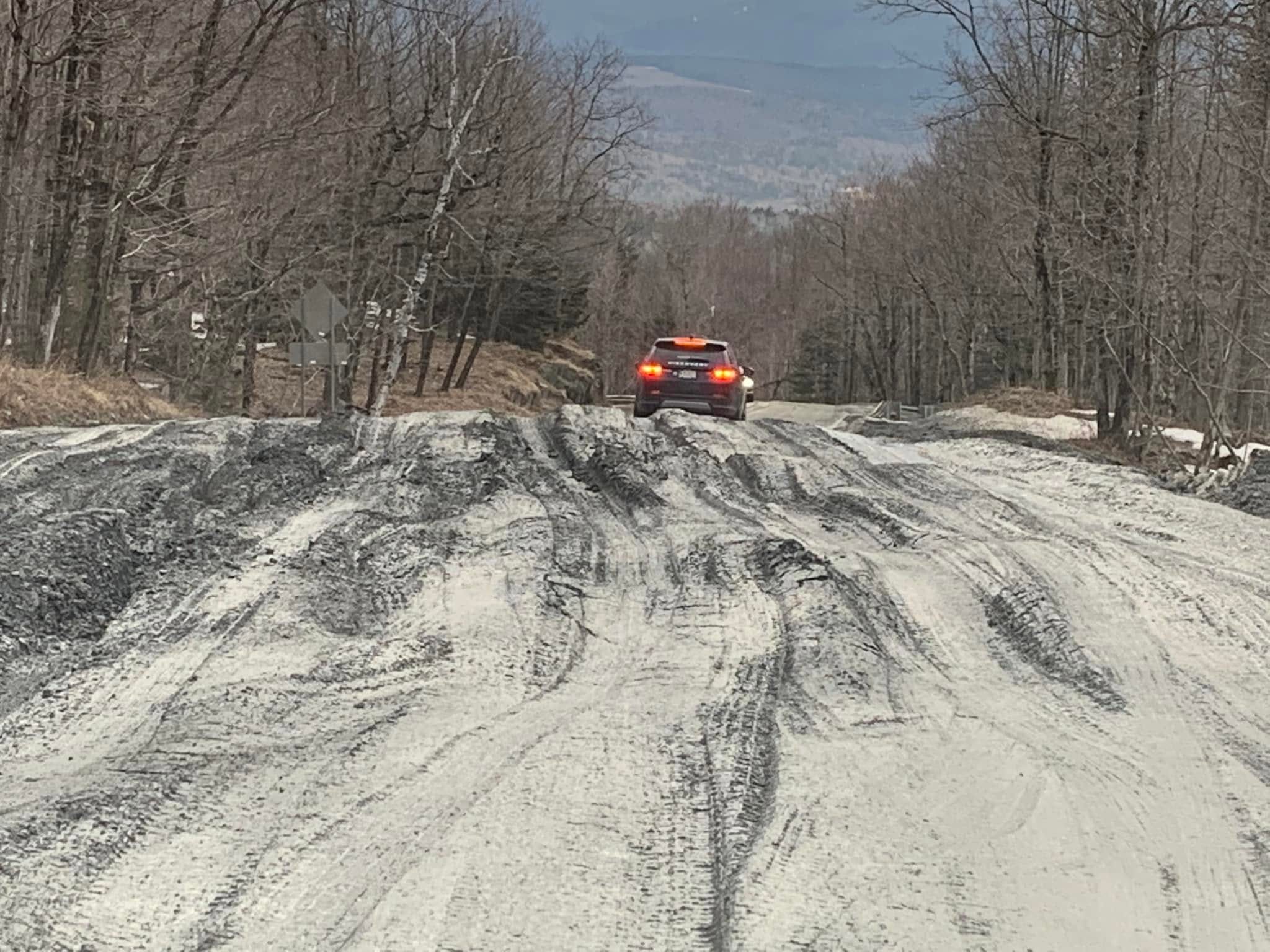
Every winter, vehicles come off Interstate 89 in Northfield and take the shortcut over the mountain into the Mad River Valley. Nobody counts them. There is no traffic counter on the Roxbury Gap.
What there is instead is GapStat, a Facebook page where drivers post real-time reports on whether the road is passable: ice, ruts, mud, or clear. It has 6,600 followers as of September 2026. The town the road runs through has 678 residents. The page exists because the answer changes.
They pass through Roxbury on what can be an extremely difficult road, depending on the weather conditions. The pavement out of Roxbury village just beyond the Northfield Road intersection and quits there.
After that it is dirt, and it is steep: rutted by late summer, washboarded by fall, soft enough in April that drivers who don’t know it get stuck. In a bad season it means frost heaves in February, the lumps that form when ice lenses lift the road bed from underneath, and frost boils in April, when the frozen ground thaws from the top down, traps the water beneath the surface, and saturated soil pumps up through the road.
If they are fortunate enough to reach the top with all of their body parts intact, and with their car car accessories still attached, they are greeted by a beautifully smooth, paved road that will take them all the way to Warren and ultimately to their destination. It carries them down in long curves past hillside houses and openings that look back across the Valley, well ditched and well shouldered, the kind of Vermont road people photograph.
The road does not change mountains at the top. It changes towns.
This month, Warren’s road crew is repaving its side. The Roxbury side stays dirt.
This is not a back road
Both towns call it TH-1, each town’s first road. Each names it for the place it takes you. Drive west out of Roxbury and you’re on the Warren Mountain Road. Drive east out of Warren and you’re on the Roxbury Mountain Road. Everyone else calls the whole thing the Roxbury Gap.
Roxbury’s stretch carries the town’s class 2 designation, its highest ranking for a road it maintains — the town won two Class 2 Roadway grants on it in 2022. Roxbury has 3.08 miles of class 2 road in the entire town.
It earns that ranking. The Gap puts a driver in the Mad River Valley — Sugarbush, Mad River Glen, the inns and the rentals — roughly 20 minutes faster than going around through Middlesex or Waitsfield. In clear conditions. That qualifier is the whole story. On a February Saturday the traffic is out-of-state plates.
It is also how emergency vehicles reach the people who live up there. Loren Bent, who was Roxbury’s road foreman for 24 years, put it plainly in a 2022 interview quoted in Compass’s earlier reporting: if somebody has a house fire or needs an ambulance, and there are elderly people living out there, it’s concerning.
A road that two towns rank first, that carries interstate traffic to a ski economy, and that an ambulance has to climb in mud season is not a road anyone would design as dirt. Roxbury’s crew keeps it as well as a dirt road can be kept, and that is a real achievement, not a consolation. But grading is what you do to a surface that will need grading again in three weeks.
So the question isn’t whether the Roxbury side should be paved. It’s why one side of a mountain got asphalt and the other got a grader — and the answer has nothing to do with the road.
Vermont pays by the mile, and only by the mile
Every year the Legislature appropriates money for town highways and splits it three ways under 19 V.S.A. § 306: 6 percent to class 1 roads, 44 percent to class 2, and 50 percent to class 3. Each town’s share is its share of the state’s mileage in that class.
The classes are Vermont’s ranking of its own roads. Class 1 roads are town-maintained stretches of state highway. Class 2 roads are the ones a town designates as its most important, and reclassifying one requires the state’s sign-off. Class 3 roads are everything else that has to stay passable year-round. Class 4 roads are the leftovers, and the town decides how much, if anything, to do with them.
Here is what the state sent each town this year, dated July 15, 2026:
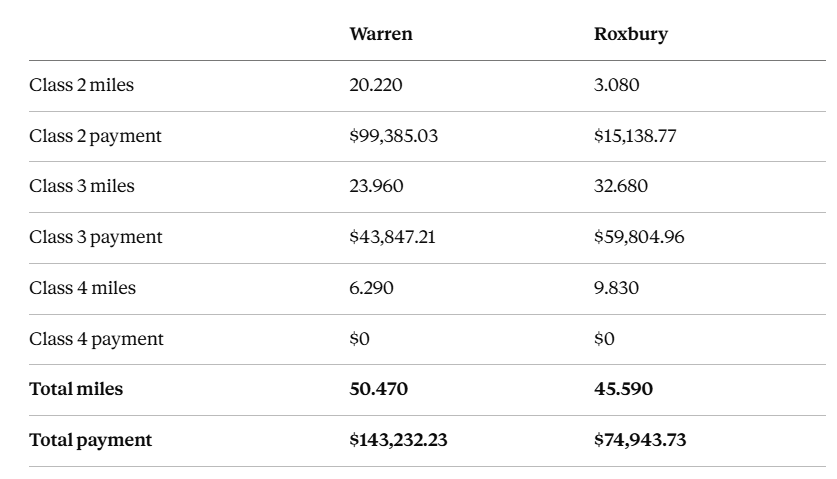
Divide it out and both towns are paid at the same rate: $4,915.18 for every mile of class 2 road, identical to the penny, and about $1,830 for every mile of class 3. Nobody is shortchanging Roxbury.
Warren has 11 percent more road than Roxbury. Warren receives 91 percent more money.
The gap is the mix. A class 2 mile pays 2.7 times what a class 3 mile pays, and a class 4 mile pays nothing. Forty percent of Warren’s network is class 2. Seven percent of Roxbury’s is. Roxbury also carries 9.83 miles of class 4 road that draw no state aid at all — three and a half more unpaid miles than Warren has.
The formula does not ask which road is steeper. It does not ask which one carries ski traffic on a February Saturday. It does not ask what a town can afford to spend on the rest.
More Data Here
Want to know what the state sends your own town for roads? VTrans publishes every town’s annual allotment and its full grant history at this address. Pick your town from the dropdown. The figures that matter are the total allotment and the class breakdown that produces it — a town heavy in class 3 and class 4 road is a town the formula pays less.
Driving the Gap this fall or winter? Check the Roxbury GapStat Facebook page before you go. Conditions change fast in mud season and after storms, and the Roxbury side is unpaved.
The grants go to the towns that can match them
State aid is not where the paving money is. The paving money is in two competitive grant programs, and both require the town to put up cash it raises locally.
Town Highway Class 2 Roadway — $8,832,200 statewide this year. Maximum award $200,000. The town covers 30 percent, or 20 percent if it has adopted road and bridge standards.
Town Highway Structures — $7,394,400 statewide, for culverts, bridges and retaining walls. Maximum award $200,000. The town covers 20 percent, or 10 percent with standards adopted.
Demand runs about three times supply. In fiscal 2026 the structures program awarded $7.3 million against $19.3 million in applications — 37 percent funded. The two prior years ran 35 and 33 percent.
VTrans District 6’s call letter to towns says awards turn on whether a town has had recent grants, the condition of the road, and “the completeness of the submittal.”
Roxbury lost its road foreman of 24 years in 2025, and Compass reported at the time that the road commissioner’s seat sat vacant. A town in that position still has to write a complete submittal.
What $370,815 buys, and what it doesn’t
On April 6 of this year, Roxbury’s road commissioner brought quotes to the selectboard. The number was $370,815, and the minutes are specific about what it covers: “all the paved portion.”
That is the cost of resurfacing the asphalt Roxbury already has, from the village up to the Northfield Road. It is not the cost of paving the dirt. Doing half of it as a mill and fill — grinding off the old surface and laying new pavement over it — would fit under a grant cap.
The board chair, Jeremy Reed, said it was unlikely the town would get the grants.
They voted to apply anyway.
Set $370,815 against what Roxbury has. The town’s entire class 2 allotment from the state is $15,138.77 a year. Resurfacing that road is 24 years of every class 2 road dollar Vermont sends Roxbury. Measured against the town’s whole allotment, all classes together, it is five years of everything.
And winning would not close it. The Class 2 Roadway program caps any single grant at $200,000. A town that took the largest award Vermont gives would still have to find $170,815 — more than eleven times its annual class 2 allotment, and more than twice everything the state sends it for roads in a year.
Which is the part worth sitting with. The dirt stretch over the top of the Gap — the one 6,600 people check the weather on — is not in that estimate. It is not in Roxbury’s budget, or in a grant application, or in a five-year plan. Laying new pavement up a mountain grade is a job that runs into the millions, and Roxbury cannot afford to resurface the asphalt it already has. Paving the rest has never been a proposal.
(The April 6 minutes describe a $220,000 cap with a 10 percent match. The published terms for the Class 2 Roadway program are a $200,000 cap and a 20 to 30 percent match, while the 10 percent figure belongs to the structures program. Which program the quote refers to could not be determined at the time of publication.)
In 2022, both towns used the same program
Roxbury does win these grants. That is what makes the pattern clear.
In fiscal 2022, state records show, Roxbury took two Class 2 Roadway awards on the Warren Mountain Road: $137,444 on a project costing $171,805, and $48,588.75 on a project costing $53,987.50. Two small bites, about $226,000 in total project cost.
The same year, Warren took $175,000 — the full cap at the time — on a $344,055 project on the Sugarbush Access Road.
The award is capped. The match is not. A town can only apply for a project it can pay the tail on, so Roxbury’s projects are sized to Roxbury’s wallet and Warren’s are sized to Warren’s. Roxbury gets its road in fragments. That is what the road looks like.
The savings account
Warren keeps a Road Paving capital fund. On December 31, 2025, its balance was $467,738. The 2026 budget adds $440,000 more.
Warren has more money sitting unspent in its paving fund than Roxbury’s entire estimate for resurfacing the asphalt it already has.
Across all its capital reserves, Warren held $3,794,992 at the end of 2025. Roxbury’s reserved funds, all of them — highway equipment, fire truck, cemetery, library, reappraisal — came to $591,700 at the close of its 2022 fiscal year.
The reason is the grand list, the total value of taxable property a town can levy against. Warren’s municipal grand list stood at $8,010,301.76 in 2025, representing about $801 million in property. Roxbury’s was $900,241 in 2022, about $90 million. And that comparison flatters Roxbury: Warren’s listers report their properties are currently listed at 47 percent of market value, while Roxbury reappraised in 2022 and came out at nearly 98 percent. Corrected for that, the real gap is closer to eighteen to one.
So Warren taxes at 0.4515 and raises $3.6 million.
Roxbury splits its municipal rate into two lines, and the second one is the argument in a single number. In its most recent published rate setting, Roxbury charged 0.2493 for general government and 0.5784 for roads — a total municipal rate of 0.8277, nearly double Warren’s.
Roxbury charges its residents more just for roads than Warren charges its residents for everything.
Roads are 72 percent of what Roxbury spends. In Warren, with more miles of road and more than twice as many dollars going into them, roads are 31 percent.
None of which makes Warren the villain of this story. Warren has 27 miles of dirt road of its own and its own mud seasons. Its crew placed 7,530 cubic yards of gravel across town last year and resurfaced seven roads. Warren’s dirt roads are simply better built, and Warren’s budget is the reason why. Warren’s voters approved that spending. They were able to.
Two towns, one garage problem
In 2022, Roxbury’s road commissioner wrote that the town garage was in very poor condition — trucks barely fit inside, no office space, limited bathroom, no storage, poor insulation, and it fails current workplace codes. The town, he wrote, was studying the costs of a new one. On November 4, 2025, Warren’s voters approved a $9.7 million bond for a new 12,100-square-foot town garage, replacing a building that was 56 years old. The vote was 324 to 211, on the highest turnout in the Valley. Construction starts this spring.
Warren’s debt service on that garage in 2026 is $367,638 — within a few thousand dollars of Roxbury’s entire estimate for resurfacing its side of the Gap, and more than half of everything Roxbury spends on roads in a year.
Two towns. Same problem. Same years. One bonded. One is studying.
Vermont has already had this argument once
In 1997 the Vermont Supreme Court decided Brigham v. State and held that funding schools out of local property wealth was unconstitutional, because what a town’s grand list happened to be determined what its children got. Act 60 followed. Roxbury’s schools were equalized. The town’s students now attend the Montpelier Roxbury district, and what Roxbury can raise no longer sets what they receive.
Brigham turned on the education clause of the Vermont Constitution, which makes schooling a state obligation. There is no roads clause. Nothing in Vermont law says a town is owed an equal road, and nobody has argued otherwise in court.
What the Gap shows is narrower and harder to answer. Vermont looked directly at this problem, decided in 1997 that it could not stand for schools, and left it in place for everything else a town does. Same town. Same grand list. Two systems, and the seam between them runs right over the top of the mountain.
Roxbury carries the traffic. Warren collects the lodging, the meals, the rooms and meals tax, and the second homes on its grand list. Roxbury gets the ruts.
Compass Vermont is a reader-supported publication.
Great article!
Reminds me of Joe Sherman's book "Fast Lane on a Dirt Road"