


The Collision of Celebration and Conscience
On the afternoon of January 25, 2026, the cultural and commercial attention of New England was singularly focused on the AFC Championship game. As the New England Patriots secured their victory over the Denver Broncos and punched their ticket to Super Bowl 60, millions of fans across the region were glued to their screens. This broadcast event served as the penultimate contest of the NFL season and represents one of the most valuable aggregations of viewer attention in the modern media landscape.
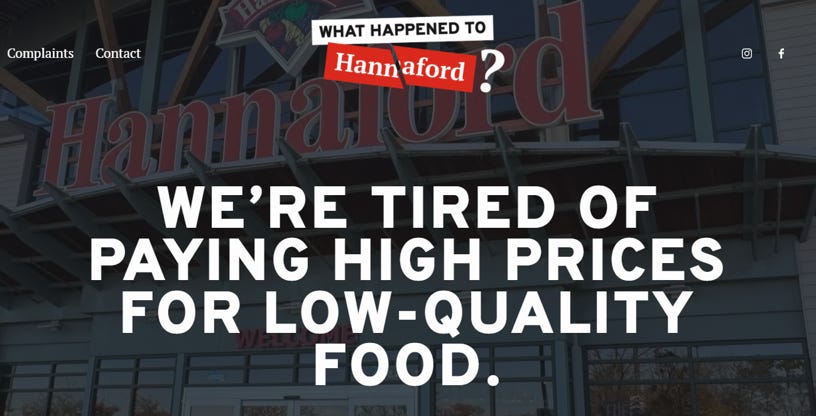
It was within this high-stakes environment—amidst the pageantry of a conference title win—that viewers across Vermont and the broader New England region were confronted with a jarring disruption to the standard cavalcade of automotive and beverage advertisements. Instead of lighthearted marketing, they witnessed a high-production commercial spot aggressively protesting Hannaford Supermarkets.
For many Vermonters, the question wasn’t just about the content of the ad, but the sheer cost of it. The placement of such a message during a broadcast of this magnitude—now solidified as a historic win for the Patriots—signals a departure from traditional grassroots activism, suggesting the presence of significant institutional capital. This campaign serves as a flashpoint for a conflict involving the Dutch retail giant Ahold Delhaize, the parent company of Hannaford, and two distinct pressure campaigns that have besieged the grocery chain.
The Economics of Attention
To appreciate the significance of what aired during yesterday’s game, one must understand the financial realities of “Championship Sunday.” The cost of entry for such an advertisement is a strategic signal of capability.
Live sports remain the last bastion of the “mass monoculture”—a singular time where millions of consumers are reachable simultaneously. While national spots for the upcoming Super Bowl 60 have reached record highs of approximately $8 million, the advertisement in question was likely a “spot market” buy on local affiliates like WCAX or WPTZ.
However, a “local” buy during a Patriots championship victory is not cheap. Broadcasters in New England leverage intense regional loyalty to drive rates up significantly. A typical prime-time spot in the Burlington area might cost a few thousand dollars, but the scarcity and viewership density of yesterday’s game likely pushed the rate to between $8,000 and $15,000 for a single 30-second airing. If the campaign targeted the broader region, including Portland and Boston, the total expenditure for this single day could easily reach hundreds of thousands of dollars.
This financial footprint confirms that the entity behind the ad—the New England Consumer Alliance—is capitalized at a level consistent with major lobbying firms rather than local community groups.
The “Air War”: The New England Consumer Alliance
The advertisement is the flagship weapon of the “What Happened to Hannaford?” campaign, operated by the New England Consumer Alliance (NECA). While the group presents itself as a regional watchdog, investigative analysis reveals a complex structure.
The timing of the ad coincided with the release of a report alleging a “Hannaford Poverty Tax.” The group claims that Hannaford engages in discriminatory pricing, charging significantly higher prices in lower-income, rural communities compared to affluent suburbs. Their researchers allege a price disparity of over 25% for the same basket of goods between wealthy and struggling towns.
Beyond pricing, the campaign attacks the brand on safety and security, highlighting data breaches and product recalls. The narrative frequently emphasizes Ahold Delhaize, the Dutch parent company, framing the “local grocer” as a foreign entity disconnected from New England values.
However, NECA is not a standalone grassroots entity. It is a project of the Center for Responsible Food Business (CRFB), a nonprofit based in Pennsylvania. Tax filings and reports suggest this organization receives funding from major philanthropic foundations associated with animal welfare, utilizing consumer protection issues as a lever to negotiate broader corporate policies.
The “Ground War”: Migrant Justice and Milk with Dignity
While the slick TV ads dominated the airwaves during the game, a separate, visceral conflict is playing out on the ground in Vermont. This is the campaign led by Migrant Justice, a Vermont-based organization representing immigrant dairy workers.
Unlike the external “air war,” this is a local movement born from the need to address labor conditions on dairy farms. Migrant Justice is pushing Hannaford to sign the Milk with Dignity agreement. This legally binding program would require worker-defined standards for wages and housing, monitored by an independent council.
The grievances here are specific and harrowing. Workers have reported substandard housing conditions and workplace hazards. The campaign has intensified recently, with mass pickets at Hannaford locations in Morrisville, South Burlington, and Middlebury involving hundreds of community members and students.
Why It Matters in Vermont
Vermont is uniquely susceptible to this dual-pressure campaign. Dairy is the backbone of the state’s agricultural identity, and many Vermont towns are “food deserts” where Hannaford is the primary source of nutrition.
The “Milk with Dignity” campaign has become a primary outlet for activism, drawing support from students at Middlebury College and UVM. When Vermont Way Foods signed onto the program in late 2025, it isolated Hannaford as a primary holdout in the region.
For the average viewer celebrating the Patriots’ win, the distinction between the Pennsylvania-based non-profit buying TV ads and the local farmworkers staging protests may blur. The result is a “pincer movement” where the grocer is attacked simultaneously on pricing, safety, and human rights.
Hannaford’s Response
Hannaford has largely rejected the demands to join the Milk with Dignity program, preferring its own internal standards. The company pushes back against the activists, citing its requirement for suppliers to participate in the industry-standard FARM (Farmers Assuring Responsible Management) program.
In response to the protests, the company has deployed private security and coordinated with local law enforcement to maintain access for customers. They have also commissioned independent investigations into supply chain conditions, though activists have criticized these measures as insufficient.
What Happens Next
The advertisement viewed during the Patriots’ AFC Championship victory was likely just the opening salvo of a broader offensive leading up to Super Bowl 60 on February 8. With the “What Happened to Hannaford?” campaign demonstrating the financial capacity to buy premium airtime during a regional victory lap, Vermont viewers can expect the “air war” to continue alongside the “ground war” of protests.
As the region prepares for the Super Bowl, Hannaford finds itself in a precarious position. The grocery aisles of Vermont have effectively become a voting booth, where every purchase is increasingly framed as a referendum on the ethics of the local food system.
Comparing Hannaford and Shaw's, we find that, while Shaw's produce tends to be a cut higher in quality and selection than Hannaford, overall prices are consistently less at Hannaford. I imagine if prices are higher at some Hannaford locations than others it is likely due to higher cost of doing business and an unwillingness to spread losses at some stores across other, more profitable locations. Seeing the same faces at the market over many years indicates they are treating people well enough for them to stay. When I see nonprofits competing for attention, I wonder if multiple organizations are really necessary or if they exist primarily for the benefit of their paid staff.