


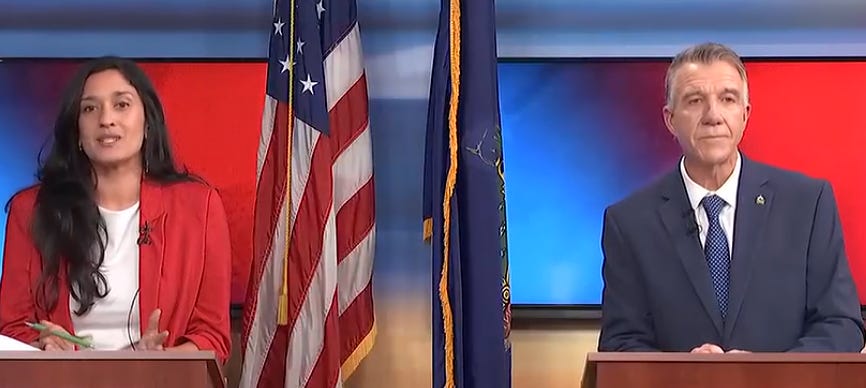
Gov. Phil Scott and Amanda Janoo, the Democratic and Progressive nominee, met Wednesday night on WCAX for their last debate before Tuesday’s election. Both made specific claims about schools, taxes and the economy that can be checked against public records. Here is what holds up, what doesn’t, and why it matters to you.
Has Mississippi Passed Vermont? In Fourth Grade, Yes. In Eighth Grade, No.
What Scott said: “Mississippi is eating our lunch.” A moderator went further, saying Mississippi had “turned theirs around” and “passed us.”
What the record shows: Mississippi’s turnaround is real. Its fourth graders ranked 49th in reading and 50th in math in 2013. By 2024 they led the nation in gains since then on the National Assessment of Educational Progress, the national test given the same way in every state.
But making big gains isn’t the same as passing Vermont. Here’s the share of students scoring proficient or better in 2024:
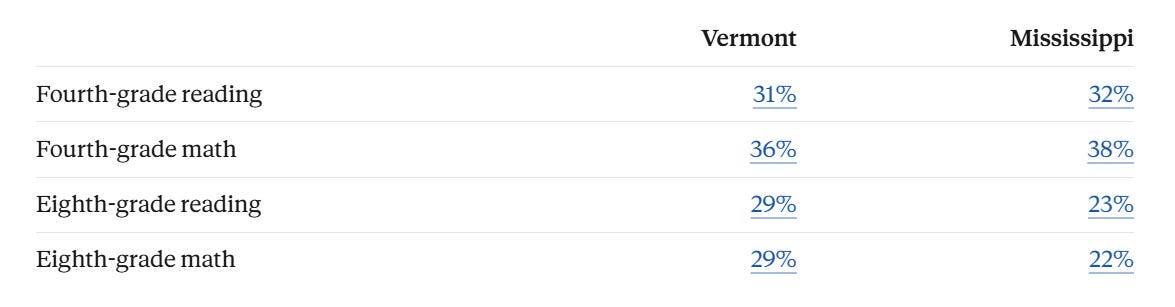
In fourth grade, Mississippi’s scores are one to two points higher than Vermont’s. In eighth grade, Vermont is six to seven points ahead.
Vermont Spends More Than Twice What Mississippi Does Per Student — for Similar Fourth-Grade Scores
What Scott said: Vermont is “the top spender in the country per pupil.”
What the record shows: Close, but not quite. Census Bureau figures for the 2024 school year rank Vermont third, behind New York and the District of Columbia. That’s second among the 50 states.
Vermont: $28,818 per student
National average: $17,619
Mississippi: $12,324
Why it matters: Vermont spends more than twice as much per student as Mississippi and gets roughly the same fourth-grade results. Vermont’s education property tax pays for much of that spending, which is why school costs sat at the center of both candidates’ pitches.
Janoo Is Right That Vermont Keeps Changing Its Tests, But The Mississippi Comparison Doesn’t Use Them.
What Janoo said: Schools told her “the testing methodology has changed four times over the last 10 years,” so it’s hard to know where Vermont stands. Asked to back that up, her campaign said “the State of Vermont has used at least four different testing methodologies in the last 10 years.”
What the record shows: Her count holds up. Counting the main test, the science test and the separate test for students with significant cognitive disabilities, Vermont has changed its state tests at least four times since 2015:
2015: Smarter Balanced replaced NECAP for English and math.
2019: The Vermont Science Assessment replaced NECAP science.
2023: VTCAP replaced both.
2023: Vermont moved its alternate test, taken by about 1 percent of students, to a multistate exam after several earlier changes.
But: None of those changes touch the comparison with Mississippi. That comparison uses NAEP, which is designed to stay comparable from year to year. NAEP shows Vermont eighth graders’ reading proficiency falling from 40 percent in 2019 to 29 percent in 2024, the steepest drop of any state, according to the education think tank FutureEd.
Why it matters: The changes to Vermont’s own tests make it harder to track a school from year to year. They don’t explain away Vermont’s slide on the national test.
Scott Misspoke on Millionaires, but His Count of High Earners Mostly Holds
What Scott said: Vermont has too few high earners to pay for Janoo’s plans. He said 13 filers make more than $1 million and 16,000 make more than $250,000, counting a married couple as one return. His campaign said the figures came from the Tax Department’s 2024 income tax statistics.
What the record shows:
Millionaires: The table shows 1,325 resident returns over $1 million, about 1 in every 250 returns. Scott’s other figures are consistent with the same table, so “13” was almost certainly a slip for “thirteen hundred,” not a misreading of the data.
Over $250,000: The table doesn’t break at $250,000, but its count of returns above that line falls between about 12,000 and 26,700. Scott’s 16,000 fits within that range.
One-time income: Scott said half of the millionaire returns, and a third of those over $250,000, came from one-time events such as selling a business or a farm, leaving about 11,000 households to carry a new tax. The table doesn’t track one-time income, and the campaign gave no source for those shares.
One billionaire: The table’s top category is “$1 million and up,” so it can’t confirm Scott’s statement that Vermont has one filer making $1 billion.
Why it matters: The number of high earners decides how much a tax on them could raise, and that’s the question behind whether Janoo’s plans can be paid for. The same table shows that returns over $200,000, about 8 percent of the total, already paid 60 percent of Vermont’s income tax from residents in 2024. Supporters of the Fair Share proposal Janoo backs argue that once sales and property taxes are counted, the highest earners pay a smaller share of their income in state and local taxes than other Vermonters.
Essex Said No to Amazon First. Act 250 Came Second.
What Scott said: Amazon “couldn’t get that done with our Act 250 and the PUC” when it tried to build a distribution center in a Chittenden County industrial park.
What the record shows: The first no came from the town. The Essex Development Review Board rejected the Saxon Hill warehouse in July 2025, and Amazon appealed to the environmental division of Vermont Superior Court. In April 2026, an Act 250 commission denied a road and subdivision that would have led to the site, finding they didn’t conform to Essex’s own town plan.
Why it matters: Scott used Amazon as an example of state permitting driving business away. Act 250 did play a part, but the first decision was made locally, and the Act 250 denial rested on the town’s own plan.
Janoo Can’t Yet Say What Her Second-Home Tax Would Raise — and the State’s Own Version Won’t Start Until 2029
What Janoo said: Asked how much her second-home tax would bring in, she said she couldn’t yet say because “right now we only have two property tax classifications.” The state would first have to create new ones, she said.
What the record shows: She’s right about today. Every property is taxed as either a homestead or a nonhomestead. But the Legislature has already written a second-home class into law. The 2026 education law, Act 170, created a “nonhomestead residential” class: houses that aren’t anyone’s primary home or a long-term rental. It takes effect July 1, 2029, if conditions in the law are met. It doesn’t draw the distinctions Janoo described, such as luxury homes versus family camps or corporate owners versus families.
What Scott said: He opposes raising taxes on anyone, including second-home owners, until the education system is fixed.
Why it matters: Janoo has pitched the second-home tax as a way to lower property taxes for people who live here year-round. Without a revenue estimate, voters can’t tell how much relief it would deliver. The second-home class already in law doesn’t start until July 2029, after the two-year term Tuesday’s winner will serve. If you own a second home or a camp, that’s the timeline to watch.
Can F-35 Pilots Learn in a Simulator? Yes — but They Still Have to Fly
What Janoo said: A governor might help reduce jet noise by influencing the 158th Fighter Wing’s training, for example by shifting more of it to simulators. She also said the governor “isn’t able to determine” national military operations.
What Scott said: “You can’t learn from a simulator. You need real life experience in the cockpit.”
What the record shows: The truth sits between them. Lockheed Martin, which builds the jet, said in 2020 that simulators handle about half of initial training flights. When the 158th’s own pilots learned the jet, Lt. Col. Nathan Graber said in 2019 that they “relied very heavily on these simulators,” while adding that “you don’t get the same sensations as the actual aircraft.”
Why it matters: For people living under the flight path, every training hour moved into a simulator is an hour without jet noise overhead. Pilots do learn a lot in simulators, so Scott’s “can’t learn” goes too far. But they still have to fly the real jet, and Janoo herself said a governor “isn’t able to determine” military operations.
Election Day is Tuesday, Nov. 3.