


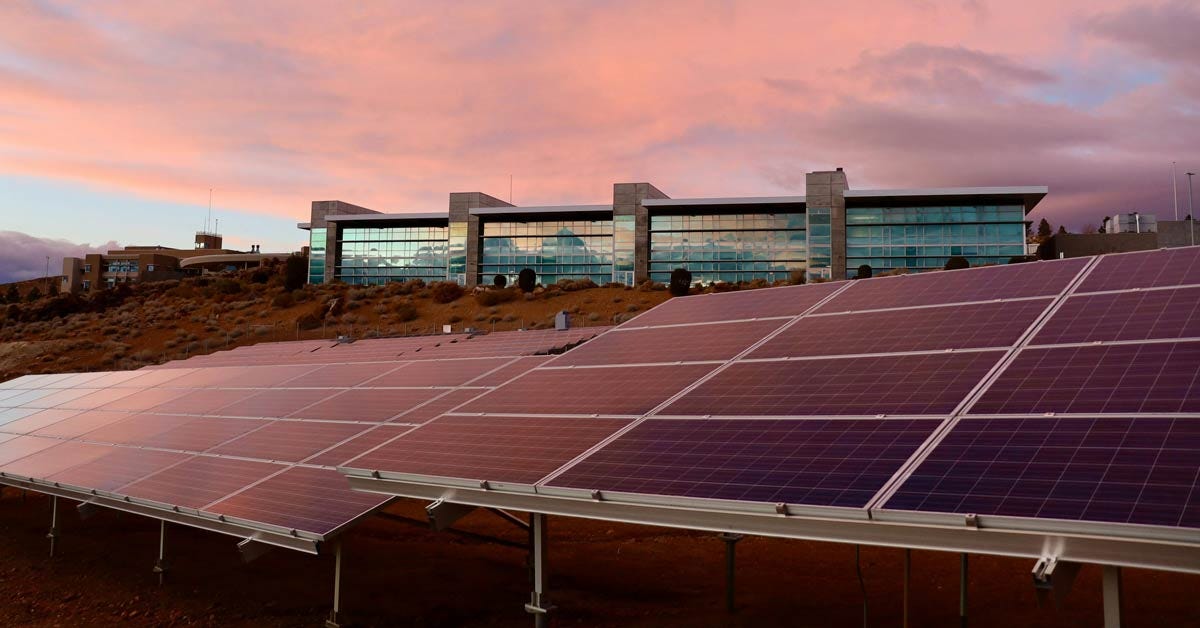
A post circulating on social media makes a striking claim: a solar installation at an Arkansas high school turned the district’s budget from a $250,000 deficit to a $1.8 million surplus in three years, and the district used the savings to give teachers raises. The post has been shared millions of times with the tagline “We have the solutions. Implement them.”
The claim is substantially true — but the viral version leaves out almost everything that matters. And the part it leaves out is the part Vermont taxpayers should care about most: not whether solar can fund teacher raises, but whether comprehensive energy management can reduce the share of school budgets that lands on property tax bills.
In a state where education property taxes drove a historic revolt on Town Meeting Day 2024 — with 31% of school budgets rejected, compared to a typical 2–3% failure rate — that question isn’t abstract.
Here’s what actually happened in Arkansas, how the financial mechanics work, and why Vermont’s sky-high electricity rates make the model more viable here than where it was invented.
What Actually Happened in Batesville
The district in question is Batesville School District in Independence County, Arkansas — a rural district of roughly 3,200 students in a town of about 11,000. By 2017, the district was running a $250,000 annual budget deficit. Superintendent Dr. Michael Hester, hired that year, launched a comprehensive energy and facilities overhaul — not just a solar installation.
After 32 town hall meetings, voters approved a $5.4 million bond that funded:
Approximately 2,200 solar panels across a ground-mounted array and a canopy structure (740 kW combined capacity)
Building consolidation (closing excess campuses)
LED lighting upgrades across 600+ fixtures
HVAC system replacements
Window and insulation improvements
Thermostat and water fixture upgrades
The energy services firm Entegrity documented $362,100 in first-year savings across all measures combined. Monthly utility bills dropped from roughly $17,000 to about $4,000. The solar array generates approximately 990,000 kWh annually — about half the district’s electricity.
The savings are real. But there’s a math problem with the viral version: $362,000 per year in energy savings over three years yields roughly $1.09 million in cumulative savings. The swing from a $250,000 deficit to a $1.8 million surplus represents a total budget shift of about $2.05 million. Building consolidation — fewer facilities to staff, maintain, heat, and insure — almost certainly accounts for the gap, though no independent audit has been published to isolate each factor’s contribution.
The viral framing — “school puts up solar panels, gives teachers $15,000 raises” — commits several specific distortions. It attributes the entire financial turnaround solely to solar panels, when solar was one component of at least eight efficiency measures plus building consolidation. It omits the $5.4 million bond voters had to approve. And it implies easy replicability while ignoring that Arkansas subsequently changed its net metering law in 2023, making future projects less viable.
The bottom line on the fact check: The core story holds up — a comprehensive energy management strategy meaningfully restructured a struggling school district’s budget. The oversimplification — “solar panels fixed everything” — does not. Solar was one piece of a deliberate, multi-pronged overhaul. That distinction matters, because the multi-pronged version is actually more useful as a model.
The Vermont Taxpayer Question: Where Else Can School Money Come From?
Batesville chose to redirect its energy savings toward teacher compensation. That was the right move for a district hemorrhaging families to school choice because of low pay. But the mechanism — freeing up operating dollars by eliminating energy costs — is agnostic about where the savings go.
For Vermont, the more urgent question is whether the same mechanism can reduce what taxpayers owe.
Vermont’s education property taxes are not merely high — they are structurally dominant. The statewide education fund is overwhelmingly financed through property taxes, and the average homeowner feels every incremental increase directly. When school budgets rise, tax bills rise. When voters reject budgets — as 31% did in 2024, the worst rate in at least a decade — it’s not because they oppose education. It’s because the tax mechanism that funds it has become unsustainable for many households.
Act 73 is attempting to overhaul the system with a state-controlled foundation formula beginning in 2028. Federal education funding freezes have compounded the pressure. But regardless of how the funding formula changes, one variable remains within each district’s control: operating costs.
Energy is a significant and largely fixed line item in school budgets. Vermont schools collectively spend millions annually on electricity alone. Every dollar a district doesn’t spend on electricity is a dollar it doesn’t need to raise through property taxes — or a dollar that can absorb rising costs elsewhere without pushing the total budget higher.
That’s the real lesson of Batesville: not “solar panels can pay for teacher raises,” but “eliminating your energy bill creates budget flexibility that can be directed wherever a community’s priorities demand.” In Vermont, the most pressing demand is property tax relief.
How the Financial Mechanics Work
Understanding why school solar generates real savings requires understanding three layers of economics.
Layer 1: Avoided electricity costs. Every kilowatt-hour a school generates is one it doesn’t buy from the utility. Over a 25–30 year system lifespan with essentially fixed costs, savings compound as utility rates rise 3–5% annually while solar costs stay flat. A district that installs solar today locks in its electricity cost for a generation.
Layer 2: Net metering credits. Excess electricity generated during peak production (summer days, weekends when schools are empty) earns credits against future utility bills. Vermont’s net metering program, while declining in generosity over the past seven years, still provides meaningful value — particularly for systems on “preferred sites” like school rooftops and parking lots.
Layer 3: Federal incentives that dramatically reduce upfront costs. Before the Inflation Reduction Act, tax-exempt entities like school districts couldn’t use the federal Investment Tax Credit directly. Schools relied on Power Purchase Agreements, where third-party developers owned the panels, claimed tax credits, and sold electricity to schools at a discount. The IRA’s direct pay provision changed this: school districts can now receive 30% of installation costs as a direct cash payment from the IRS, with stackable bonuses for domestic content (+10%), energy community location (+10%), or low-income service area (+10–20%) that can push the total credit to 40–70%.
Additional funding sources include USDA REAP grants covering up to 50% of costs for rural projects, Vermont’s Bond Bank Energy Efficiency and Renewable Energy Program, and the state’s Clean Energy Development Fund.
Typical payback periods run 7–12 years. After payback, schools get 15–20 years of near-zero marginal electricity costs. For a district paying $150,000 annually in electricity — not unusual for a Vermont supervisory union — that’s the equivalent of permanently removing $150,000 from the budget that needs to be funded through property taxes.
Why the Economics Favor Vermont Over Arkansas
The intuitive assumption — that sunnier states benefit more from solar — turns out to be wrong when electricity rates enter the calculation.
Vermont receives roughly 14–20% less solar energy than Arkansas (approximately 4.0 vs. 4.7 peak sun hours daily). But Vermont’s electricity rates are dramatically higher: residential rates average roughly 22.6¢ per kilowatt-hour versus Arkansas’s approximately 9.8¢. Vermont ranks among the five most expensive states for electricity; Arkansas sits near the bottom ten.
Each kilowatt of installed solar capacity produces fewer kilowatt-hours in Vermont — but each of those kilowatt-hours displaces electricity that costs more than double what it costs in Arkansas. A rough calculation suggests Vermont school solar delivers approximately 85% more savings per kilowatt installed than the same equipment in Arkansas, despite the solar resource disadvantage.
Cold temperatures also improve panel efficiency — solar panels lose 0.3–0.5% output per degree Celsius above 25°C. Vermont’s cool climate partially offsets winter production dips.
Put differently: if the Batesville model could turn a rural Arkansas school district’s budget around in a state with some of the cheapest electricity in America, the same approach should produce larger dollar savings in a state with some of the most expensive.
Vermont Schools Are Already Proving It Works
Vermont is already among the national leaders on school solar. As of 2023, Vermont was one of only five states where more than 20% of school buildings have solar panels. Several districts have demonstrated proof of concept:
Windsor Schools entered a net metering agreement with Norwich Solar at zero upfront cost and are now saving enough to redirect $19,000 annually to other programs, with lifetime savings projected to top $900,000.
Hartford School District deployed 2,160 panels (745 kW) through a similar zero-upfront-cost net metering agreement.
Westminster Center School installed solar covering more than 100% of the district’s electricity needs.
St. Johnsbury voters approved a 25-year agreement to lease vacant school property for a 2,000-panel solar array, generating $98,000 in lease payments to the school.
Starksboro has powered Robinson Elementary School and municipal buildings with solar since 2010.
Crossett Brook Middle School in Duxbury has a solar array that has been documented by VTDigger as part of the state’s broader renewable energy infrastructure.
What these projects share is a common structure: schools either partner with a solar developer through a net metering or power purchase agreement — requiring zero capital outlay from taxpayers — or finance the installation through performance contracts or bonds that pay for themselves from energy savings. In most cases, districts began saving money from day one.
School Sites Sidestep the Solar Siting Problem
Vermont faces genuine tension between its renewable energy targets and organized opposition to solar development on undeveloped land. The proposed 50-megawatt solar array in Panton — which would be the state’s largest — has drawn intense opposition over landscape impacts, agricultural land conversion, and tourism concerns.
School solar largely bypasses this conflict. Under PUC Rule 5.100, school rooftops, parking lots, and previously developed tracts qualify as “preferred sites” — earning better net metering compensation and more streamlined permitting. Projects on non-preferred sites face a roughly $0.04/kWh penalty. Solar installations go through the Section 248 process at the PUC rather than Act 250, offering a more predictable regulatory path.
Solar on school buildings uses no additional land. It generates no landscape conversion controversy. Parking canopies provide dual benefits of energy generation and weather protection. And the community benefit — lower school operating costs, potentially lower property taxes — is visible and direct.
This is worth emphasizing: in a state where solar siting has become a flashpoint, school solar is the rare version almost everyone can support. The panels go on buildings and parking lots that already exist. The savings flow directly to the community. The aesthetics debate that stops large-scale projects in their tracks simply doesn’t apply.
The Barriers Are Real — and the Window Is Closing
The opportunity is genuine, but several headwinds matter.
Net metering compensation keeps declining. Vermont’s Public Utility Commission has reduced net metering incentives seven years running, driving a 62% decline in applications from the program’s 2018 peak. Existing installations are grandfathered at their original rates, but new projects face a diminishing value trajectory.
Virtual group net metering is ending. Act 179 (2024) ended virtual group net metering for applications filed after December 31, 2024, unless the system is on the same or adjacent parcel. This limits flexibility for districts with buildings spread across a municipality. The Department of Public Service has been tasked with recommending a successor program.
The federal incentive window is narrowing fast. The One Big Beautiful Bill Act, signed July 4, 2025, accelerated the phase-out of clean energy tax credits. Projects beginning construction after July 4, 2026 must be placed in service by December 31, 2027 to claim credits. Districts that act within the next 12–18 months lock in today’s incentive structure. Those that wait may face a fundamentally different — and less favorable — financial picture.
Vermont’s Solar for All program has been terminated. The $62.5 million federal grant for low-income solar was terminated by the EPA on August 7, 2025, under language in the One Big Beautiful Bill Act. Governor Scott’s administration has filed an administrative dispute.
Act 73 creates investment uncertainty. Potential school consolidations under the new education finance framework could complicate solar investments on buildings that later close — though Vermont’s state-developed Group Net Metering Agreement Template specifically addresses school closure provisions.
Each of these barriers is real. None of them is fatal. But taken together, they define a window: the economics of school solar in Vermont are strong right now, and they are likely to get weaker — potentially significantly weaker — over the next two years as federal incentives phase out and net metering compensation continues to erode.
The Uncomfortable Bottom Line
The Batesville story, properly understood, offers Vermont a genuine template — but not the one the viral posts describe.
The lesson is not “install solar panels and everything is fixed.” It is that comprehensive energy management — combining efficiency upgrades, facility rationalization, and renewable generation, financed through mechanisms that require zero upfront taxpayer cost — can meaningfully restructure a school district’s operating budget. In Batesville, that restructuring was large enough to transform the district’s competitive position. In Vermont, it could be large enough to bend the property tax curve that is driving voters to reject school budgets at historic rates.
Vermont’s position is in some ways stronger than Arkansas’s. Electricity rates more than double Arkansas’s create a more compelling savings case per dollar invested. Existing state infrastructure — the Bond Bank’s energy loan program, a state-developed group net metering template, Section 248’s streamlined permitting for preferred sites — reduces transaction costs. Multiple districts have already demonstrated proof of concept. And Vermont is already one of the top five states in the country for school solar adoption.
What Vermont hasn’t done is connect these dots into a coherent fiscal strategy. The state has school solar projects. It has an education funding crisis. It has electricity rates that make the economics of school solar more favorable than almost anywhere in the country. It has a closing federal incentive window that creates genuine urgency.
Nobody is putting these pieces together into the obvious question: What would it mean for Vermont property taxpayers if every school district that hasn’t already gone solar did so within the next 18 months — while the federal government is still willing to cover 30–70% of the cost?
That’s not a rhetorical question. It’s a math problem. And someone should be running the numbers.
Compass Vermont publishes data-driven reporting on policy that affects Vermonters’ daily lives. If you found this useful, please consider sharing it or becoming a subscriber.
........"Vermont is already one of the top five states in the country for school solar adoption."........Yet Budgets keep going up. I wonder why??? /s