


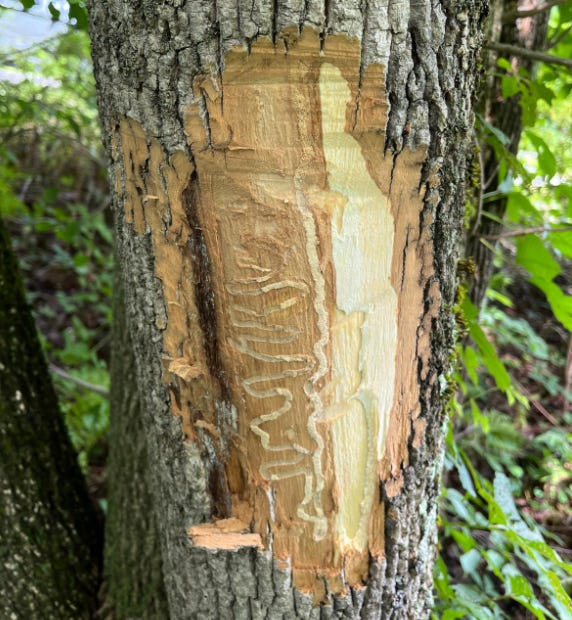
A study published this month by researchers at the University of Vermont found that tree loss from natural causes in the Northeast now outpaces harvest-caused loss by nearly 40% — a reversal that has occurred in just 15 years.
Overall tree loss across the region also increased by nearly 16% during the same period. The study’s co-author, UVM Professor Tony D’Amato, describes what’s happening as “death by a thousand cuts.”
The findings, published in the Canadian Journal of Forest Research by lead author Lucas Harris and D’Amato, compared nearly 324,000 records of tree mortality across 18 states using the federal Forest Inventory and Analysis database. In 2009, timber harvesting was the leading cause of tree biomass loss. By 2024, natural causes — driven by invasive insects, disease, and extreme weather amplified by climate change — had overtaken harvesting by a wide margin, even as harvest levels remained essentially flat.
Emerald ash borer, hemlock woolly adelgid, spongy moth, and beech leaf disease are among the leading culprits. D’Amato notes that states south and west of Vermont — particularly southern New England — are seeing the largest increases, and that Vermont’s own forests are beginning to show the same pressures.
“We were starting to see pretty high rates of mortality,” D’Amato told Compass Vermont. “The amount of harvesting hasn’t really changed — it’s been kind of a flat line. But mortality really has increased dramatically from things other than harvesting.”
The findings raise an urgent policy question: as these threats intensify, how should Vermont manage its forests to respond? That question has placed two fundamentally different philosophies in direct conflict — and the legislature appears to be choosing sides before the science is settled.
What the science says about active management
D’Amato has spent much of his career studying whether active forest management — including silvicultural thinning, species diversification, and adaptive harvesting — can improve forest resilience against invasive pests. His work includes the national Adaptive Silviculture for Climate Change project, a multi-site research partnership with the USDA Forest Service that uses strategic harvesting and planting to build forest resilience in experimental plots across New Hampshire, Minnesota, and other states.
In his interview with Compass Vermont, D’Amato confirmed that the scientific literature supports active management for specific pests — though the effectiveness varies by species.
“There’s definitely some insects and diseases where doing active management can either reduce the level of impact or contain the impact,” D’Amato said.
On hemlock woolly adelgid, he pointed to research showing that thinning hemlock stands to increase sunlight exposure improves tree vigor. “Really increasing the sunlight that understory hemlock is receiving, as well as thinning the canopy — it certainly doesn’t eliminate the woolly adelgid, but the trees are vigorous enough to still survive while being impacted,” he said.
That finding is consistent with a 2023 study by USDA Forest Service researchers Mary Ann Fajvan and Andrea Hille, published in the Canadian Journal of Forest Research, which found that silvicultural thinning on the Allegheny National Forest improved hemlock health, growth, and crown area over a 10-year period compared to untreated stands. The researchers concluded that preemptive thinning “may be a viable strategy to enhance hemlock resilience prior to HWA infestation.”
A separate 2023 review in the Journal of Integrated Pest Management, published by Oxford Academic, analyzed a decade of U.S. forest pest management projects and found that silvicultural strategies were the single most-used approach, accounting for 32% of all pest management projects nationwide — more than chemical (21%), semiochemical (22%), or physical/mechanical (18%) approaches.
D’Amato acknowledged that not all pests respond to silvicultural intervention. With emerald ash borer, he said, “you can’t thin the forest and the ash are more vigorous.” But he described an adaptive approach that goes beyond simply leaving forests alone — managing for replacement species, preserving female seed trees to maintain genetic diversity, and creating the light conditions ash needs to regenerate.
“It’s not like a simple silvicultural solution to emerald ash borer,” D’Amato said. “It’s more like, how do we use good stewardship to still maintain ash as part of our forest?”
He drew a clear distinction between that adaptive approach and the claim that nothing can be done.
“It’s different than saying there’s no silvicultural solution for a given pest,” he said. “There are careful stewardship activities we can do to support the forest for the future, which I think is key.”
What Montpelier is considering
While D’Amato’s research points toward a flexible, tools-in-the-toolbox approach, the Vermont legislature has been moving in a different direction.
In 2023, the legislature passed Act 59, the Vermont Climate Resilience and Biodiversity Protection Act, which codified a goal of managing approximately 10% of the state’s forests to recover old-growth conditions. That same year, Governor Scott signed Act 146, which amended Vermont’s Use Value Appraisal program to create a Reserve Forestland category — one that explicitly states it is “not a ‘do nothing’ enrollment option” and allows for active management including invasive species control.
The most sweeping proposal, however, is H.276 — the Vermont Climate Resilience and State Wildlands Act, introduced by Rep. Amy Sheldon of Middlebury, Chair of the House Committee on the Environment. The bill would designate 268,000 acres of state parks, state forests, and wildlife management areas as “wildlands” and prohibit timber harvesting, vegetation management, and — critically — the removal of diseased or infected trees on those lands.
The bill’s language is explicit: “There shall be no vegetation management, including timber harvesting, pruning, cutting, herbicide application, salvage logging, or removal of diseased or infected trees.”
That language would cover 75% of all state-managed forest in Vermont, increasing the state's wildland designation from less than 4% of Vermont's total land area to approximately 7%.
Compass Vermont sent Rep. Sheldon detailed questions about H.276 — specifically whether the bill accounts for peer-reviewed research supporting active management as a tool for pest resilience, and how it reconciles its blanket prohibition with the adaptive silviculture science produced by UVM’s own researchers. She did not respond.
H.276 is backed by Standing Trees, a Vermont-based advocacy organization that promotes “proforestation” on public lands — a model that argues for leaving forests unmanaged to maximize carbon storage, biodiversity, and resilience. The bill did not cross over this session, and Vermont State Forester Oliver Pierson told Compass Vermont it is unlikely to pass in its current form given the focus on Act 181. But it represents a policy direction that has been gaining momentum in the legislature, and Standing Trees has indicated it will continue to push the proposal.
The State Forester’s assessment
Pierson, who serves as Director and State Forester in the Division of Forests within the Department of Forests, Parks and Recreation, offered a pointed assessment of H.276’s impact on his department’s ability to manage the threats D’Amato’s study identified.
“H.276, if passed, would limit FPR’s ability to respond to pest threats,” Pierson wrote in a response to Compass Vermont. “The bill clearly states that ‘There shall be no vegetation management, including timber harvesting, pruning, cutting, herbicide application, salvage logging, or removal of diseased or infected trees’ in the proposed wildland areas, which significantly limits our toolkit to slow or mitigate the spread of introduced invasive species and forest pests.”
Pierson emphasized that FPR uses both active and passive management on state lands, and that the choice of strategy depends on a wide range of factors including forest ecology, silvicultural science, economic considerations, and the presence of rare or sensitive species.
“The key is to allow experts to make informed decisions based on science, statute, and landowner interest, as opposed to using any ‘one-size fits all’ approach,” he wrote.
Pierson also shared details about active management efforts already underway on the very state lands H.276 would restrict. FPR has identified areas where black ash is present and used insecticide treatments to protect trees at six sites in 2025, with at least six additional sites planned for 2026. The department has released biocontrol species to reduce emerald ash borer density at 12 sites on state lands — five at wildlife management areas, four at state forests, and three in state parks — with at least two more sites planned for 2026. FPR has also been releasing biocontrols for hemlock woolly adelgid at two sites on state lands, with a third planned this year.
Those are precisely the kinds of interventions H.276 would prohibit.
Standing Trees’ position
Zack Porter, Executive Director of Standing Trees, offered a different perspective, arguing that Vermont needs to expand its wildland designations and that the proforestation model is the right approach for the state’s public lands.
“A financial advisor would never tell you to put all of your money in one stock or industry,” Porter wrote to Compass Vermont. “Same goes for managing our forests. We need a balance of wildlands and actively managed woodlands to be ready for an uncertain future.”
Porter emphasized that Standing Trees supports active management on lands not designated as wildlands, and that the organization is not opposed to wood products.
“Standing Trees supports abundant local wood products from well-managed forests, as well as abundant local wildlands. We can have both,” he wrote. “Private lands are where we get most of our wood products, and that shouldn’t change.”
Porter’s position on active pest management within designated wildlands, however, is clear.
“Protected wildlands on state lands are wildlands for a reason — they aren’t open for cutting,” Porter told Compass Vermont. “This is the same as how wildlands on the Green Mountain National Forest are managed, and it’s how wildlands are managed on state lands in the Adirondacks. Outside of designated wildlands, Vermont ANR has more discretion but it must use sound science and public input to make decisions for state lands.”
Porter argued that active intervention against invasive pests is both ineffective and potentially counterproductive.
“There is no amount of logging that is going to get rid of an invasive pest or disease,” he said. “We’re going to cause much more harm to our forests by cutting down trees of a given species than would have happened if we’d allowed the disease or pest to run its course. The best example that we can point to is when we cut down all of our chestnut trees without realizing that we were eliminating the chance for the chestnut to adapt and survive chestnut blight. There were resistant chestnut trees. And today, if we go about this by eliminating all ash trees, for example, we’re not going to find out which ash trees are resistant to ash borer.”
Porter also argued that unmanaged forests are essential as a scientific baseline against which to measure the effectiveness of active management elsewhere.
“Every time we go in and do some kind of active intervention, we’re rolling the dice and seeing what works,” he said. “We’re playing God out there. We need to have something to compare that to, to actually tell if what we’re doing is working — if it’s better than the alternative.”
Porter cited research showing that older, undisturbed forests store more carbon and exhibit greater structural complexity than managed forests. He also pointed to a 2006 study by Foster and Orwig in Conservation Biology that found salvage and preemptive logging after natural disturbances often caused greater ecosystem disruption than the disturbances themselves. “From an ecosystem perspective,” the study concluded, “there are strong arguments against preemptive and salvage logging or the attempt through silvicultural means to improve the resistance or resilience of forests to disturbance and stress.”
That study, however, did not test whether proactive thinning in uninfested stands slows the advance of species-specific invasive pests — the question at the center of the current debate and the one addressed by the Fajvan and Hille hemlock research.
The tension in D’Amato’s own work
The complexity of this debate is perhaps best illustrated by the range of D’Amato’s own published work.
In a 2024 paper he co-authored with Caitlin Littlefield and others — “Beyond the Illusion of Preservation” — D’Amato and his colleagues laid out a vision for New England’s forests that calls for at least 10% of the landscape in passively managed wildlands surrounded by at least 70% in actively, ecologically managed woodlands. The paper explicitly warns against reducing harvesting without addressing consumption, arguing that doing so “is not really proforestation but rather the illusion of proforestation.” The paper specifically references organizations calling for the elimination of harvesting on state and federal lands.
At the same time, D’Amato told Compass Vermont he is “a huge proponent” of reserves.
“I think we need to have lands that aren’t managed, for many reasons,” he said. “I’m an advocate for reserves and wildlands. But we need everything. Including — we use the forest a lot, so we need to own our keep in terms of the wood that we produce and use.”
He described reserves as serving a critical function as scientific controls — places to observe natural processes and compare them to managed landscapes.
“Those areas that we are protecting as reserves — those are important places to observe,” he said. “We’re doing management in other areas where we think we can actually minimize the impacts of beech leaf disease. Let’s take a look over in this area where we aren’t allowing any management to see how that’s changing. And to learn from that.”
But he expressed concern about the specific approach of converting state forest lands to reserves without considering what would be lost.
“Some of the discussion in the state right now is, oh, we just flip state lands into reserves,” D’Amato said. “But that doesn’t really look at a couple things. One — how representative would those reserves be of the region? Do we have certain ecosystems that are not well represented if we just do that? And if we eliminate the opportunity for active stewardship on state lands, what are we losing, both in terms of our ability to practice adaptive and ecological forestry, and our ability to have this public land where we can actually engage in that process as citizens of Vermont?”
D’Amato argued that state lands are uniquely valuable for ecological forestry precisely because they’re not driven primarily by economics.
“State lands have a unique ability to balance multiple goals,” he said. “What’s nice about state lands, as opposed to private lands where there’s financial pressures — a state land actually has a little bit of an ability to manage for multiple uses without being told that they’re not making enough profit. They’re able to do more balanced and nuanced and long-term approaches.”
He described the professional oversight on state lands as something worth preserving: “If you’re a responsible consumer and want to feel good about where your wood comes from, I really feel good about a place where you have five foresters, wildlife biologists, cultural resource specialists, others — really looking at that project and giving it a stamp of approval. That feels a heck of a lot better than just wood being cut from private land where there is less oversight over whether it’s good stewardship or not.”
A comparison across the border
Vermont is not the first state to grapple with these questions. Maine — which has far more forestland and a much larger timber economy — established its Ecological Reserve System by statute in 2000, with a cap of 115,000 acres. But Maine’s approach differs from H.276 in one critical respect: it explicitly allows the use of “pesticides, including herbicides, and sanitation harvests to control insect and disease outbreaks” within ecological reserves when there is a specific threat to native ecosystems, human safety, or adjacent lands.
In other words, Maine protects wildlands while keeping the pest management toolbox open. H.276 would close it.
Dana Doran, Executive Director of the Professional Logging Contractors of the Northeast, pointed to this contrast in testimony before the House Committee on the Environment earlier this year. Doran noted that Maine’s approach — developed through unanimous consensus among state officials, environmental organizations, landowners, loggers, mills, and wildlife officials — never once recommended taking forestland out of production or prohibiting timber harvesting.
“Professional logging isn’t the problem — it’s part of the solution,” Doran wrote in a statement to Compass Vermont. “Active, science-based forest management helps reduce risk, respond to emerging threats, and sustain the environmental and economic values our forests provide. Healthy forests don’t happen by accident. They happen because skilled people make informed decisions on the ground.”
What this means for Vermont
The debate over H.276 is, at its core, a debate about certainty — and whether Vermont’s legislature is prepared to make an irreversible policy decision while the underlying science remains actively contested.
The proforestation model holds that older, undisturbed forests are inherently more resilient, store more carbon, and support greater biodiversity. There is peer-reviewed research supporting those claims. But that research largely measures carbon storage and structural complexity — not whether old forests survive species-specific invasive pests like emerald ash borer, hemlock woolly adelgid, or beech leaf disease any better than managed ones.
The adaptive management model holds that strategic, science-based intervention — thinning, species diversification, biocontrol, and sanitation harvesting — can improve forest resilience against specific threats. There is also peer-reviewed research supporting those claims. Federal data shows silviculture is the most-used pest management strategy in the nation. USDA Forest Service research shows thinning improves hemlock survival against HWA. And Vermont’s own State Forester is actively deploying those tools on state lands right now — insecticide treatments for ash, biocontrol releases for both EAB and HWA — on the very acres H.276 would restrict.
H.276 would foreclose one side of that debate on 268,000 acres of state land — 75% of all state-managed forest in Vermont — permanently. The bill’s sponsor did not respond to questions about how it accounts for the science supporting active management.
D’Amato, whose study set off this conversation, perhaps put it most simply.
“I’m a fan of that 10 percent,” he said, referring to the wildlands goal, “but I’m also a fan of the other part of it, which I think is discussed the least, which is that working landscape and how that landscape is stewarded into the future.”
He added: “It gets so polarized that we forget there’s a lot of middle ground and a lot of evolution. Most modern foresters are fans of reserves. It’s not one or the other. We need both. But oftentimes it gets pitted as one versus the other, which is unfortunate.”
Jamey Fidel, Vice President of Audubon Vermont, was out of the office and unavailable for comment during the reporting period for this story.
Compass Vermont is reader-supported independent journalism covering the policies that shape life in Vermont. If this reporting matters to you, please consider becoming a paid subscriber at compassvermont.substack.com.
You’d think a management plan would encompass the entire region, all the forests of northeastern united states, at least as far as it can be distinguished from, for example, the Ohio river basin, the piedmont and coastal regions, Deep South and so forth, similar the way bird populations are identified. In fact, at least to my mind, bird populations are of primary concern in forest management.
I have also read that they are working on bio-engineering, to produce a tree that is resistant to the Diseases affecting them...