


Vermont’s Statehouse had a rare moment of open rebellion this week.
Rank-and-file House Democrats bucked their own leadership to revive a proposal to add a 3% income surtax on household earnings above $500,000 and an additional 2% on income above $1 million. Leadership tried to kill it.
Unions and advocacy groups flooded lawmakers’ inboxes demanding passage. Bradford Rep. Monique Priestley called it “the single-most popular thing” her constituents had demanded. After hours of closed-door negotiations, leadership reached a compromise: the amendment was pulled from the floor, and the Ways and Means Committee agreed to take it up as standalone legislation later in the session.
The projected revenue? Upward of $110 million annually — money that would go a long way in a state wrestling with a structural budget deficit, crumbling education funding, and property taxes that have become a genuine crisis for working Vermonters.
It’s an appealing idea. It is also aimed at a surprisingly thin slice of Vermont.
A Small Pool
Vermont’s Department of Taxes publishes detailed income data from state filings each year. The 2023 numbers — the most recent available — tell a story that neither side of this debate has centered.
In all of Vermont, 2,625 households filed income tax returns in the $500,000–$999,999 bracket. Another 1,047 households filed returns showing income above $1 million. Combined: roughly 3,672 households statewide — out of approximately 329,000 total Vermont filers — would be subject to the new rate. That is just over 1% of all Vermont income tax filers.
Governor Scott, who attended a press conference earlier this week where Compass Vermont was present, made exactly this point when asked about the proposal: there simply aren’t enough Vermonters with that level of income to generate the revenue supporters are counting on. His broader concern — that high earners will relocate to lower-tax states — is a separate and genuinely contested question. But on the raw arithmetic, he has a point.
The Wealth That Isn’t Filing Here
Here is what the Statehouse debate has largely overlooked: Vermont's most visible concentration of wealth — the multi-million-dollar ski chalets, the waterfront compounds, the Stowe and Quechee and Manchester properties that define the state's luxury real estate market — largely belongs to people who file their income taxes somewhere else.
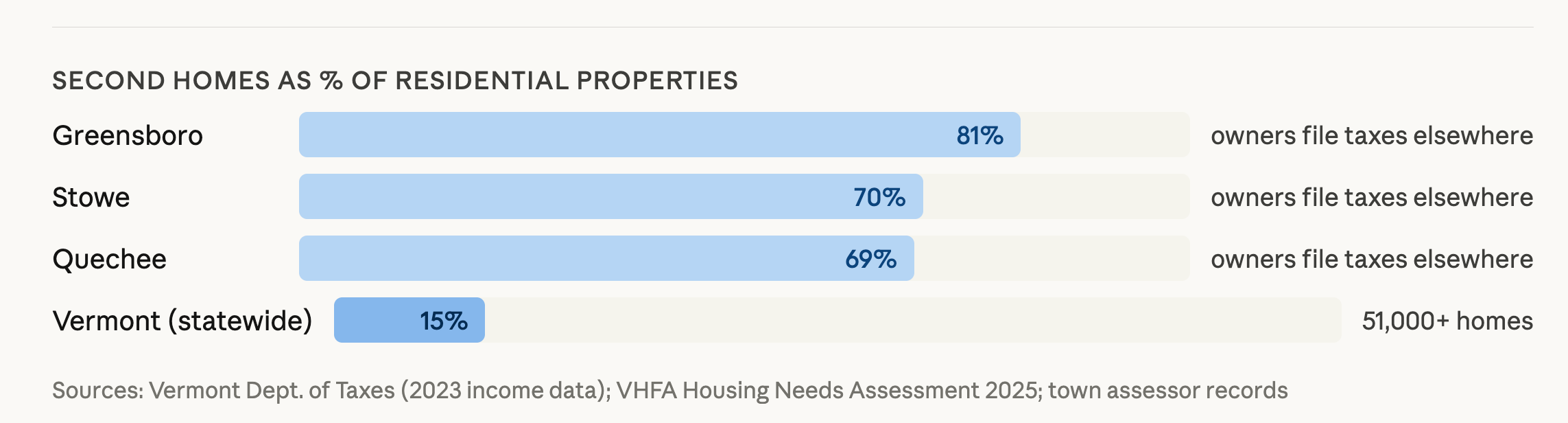
Vermont ranks second in the nation for the percentage of its housing stock classified as seasonal, vacation, or occasional-use homes. By the most recent estimates, more than 51,000 Vermont homes — roughly 15% of the state’s total housing stock — fall into that category. In Stowe, 70% of all residential properties are taxed at the non-homestead rate, meaning the owner’s primary residence is elsewhere. Of Stowe’s 3,304 residential properties, only 1,130 carry homestead declarations. In Greensboro, 81% of homes are second homes. In Quechee, 69%.
Who owns them? The market that once drew heavily from Quebec has, according to real estate professionals, shifted decisively to buyers from Boston, New York, Connecticut, and Washington, D.C. Vermont’s real estate market saw a 25% increase in out-of-state buyers since 2020, driven primarily by high-income households from neighboring states seeking a retreat they can reach in three to five hours.
Those buyers pay Vermont property taxes — at the non-homestead rate, which is typically higher than the rate paid by full-time residents. But their income taxes flow to Massachusetts, New York, or Connecticut. Vermont’s proposed income surtax would not touch them at all.
The Structural Mismatch
This is not an argument against taxing high earners. It is an observation that Vermont’s legislature spent this week in intense, emotional debate over a tax instrument that, by design, cannot reach the largest visible concentration of wealth in the state.
The approximately 3,672 households with Vermont-filed income above $500,000 are real, and their tax contribution is meaningful. But the wealth parked in Vermont’s resort towns — owned by people whose financial lives are anchored elsewhere — sits largely beyond the reach of an income surtax, no matter how high lawmakers set the rate.
Vermont does have tools to reach non-resident property wealth: property taxes, transfer taxes, and potentially new frameworks for taxing second homes differently from commercial properties. Legislators have explored those options in recent sessions but found them technically and politically complex.
For now, the income surtax debate will continue. The Ways and Means Committee has committed to a vote. The Senate, where Finance Chair Ann Cummings has signaled any changes will be revenue-neutral, remains a different conversation.
Vermont’s working families, meanwhile, are paying some of the highest property tax rates in the country — including rates shaped in part by the education funding obligations that second-home owners share but whose income-tax benefits they collect in other states.
The rich, in Vermont, are complicated. So is the question of how to tax them.
Compass Vermont is an independent, reader-supported news outlet covering the issues that matter to Vermonters without bias, so you have the full story to decide on your own.
Editor’s note: An earlier version of this article referred to “lakefront estates” in a passage that included Quechee as an example. A Quechee reader correctly pointed out that the community’s primary water feature is a small man-made pond, not a lake. The article has been updated accordingly.
Not sure how you can describe education funding as "crumbling" when it is growing at 2 to 3 times the rate of inflation every year. The problem isn't that its crumbling it is that it is eating more and more revenue to feed it's never ending appetite for our money.
One other point to consider, the number of $500k filers is small to begin with as the article points out, but many within that small number are one-time filers -- folks who sell an asset such as a business -- not people making that much money every year.
I appreciate the informative facts that are laid out in this article. VT is increasingly at a cost of living crossroads. It's painful to watch the legislature yet again unable to agree on viable solutions to this challenging situation. Hopefully they will read this article and get on the path to at least understanding more of the underlying details. Taxing the rich has assorted limitations as you outline.
Much of this revenue problem is bigger than VT, starting with the high cost of healthcare in the US. Another is corporate America not paying their share of taxes and underpaying their employees who we subsidize. I'm not sure VT can tax it's way out of this cost of living mess.
PS. Quechee is primarily a 2nd home community as you outline. However the so called
Lake Pinneo is actually just a small man made pond, with no homes on this pond.
Best, Tom in Quechee