


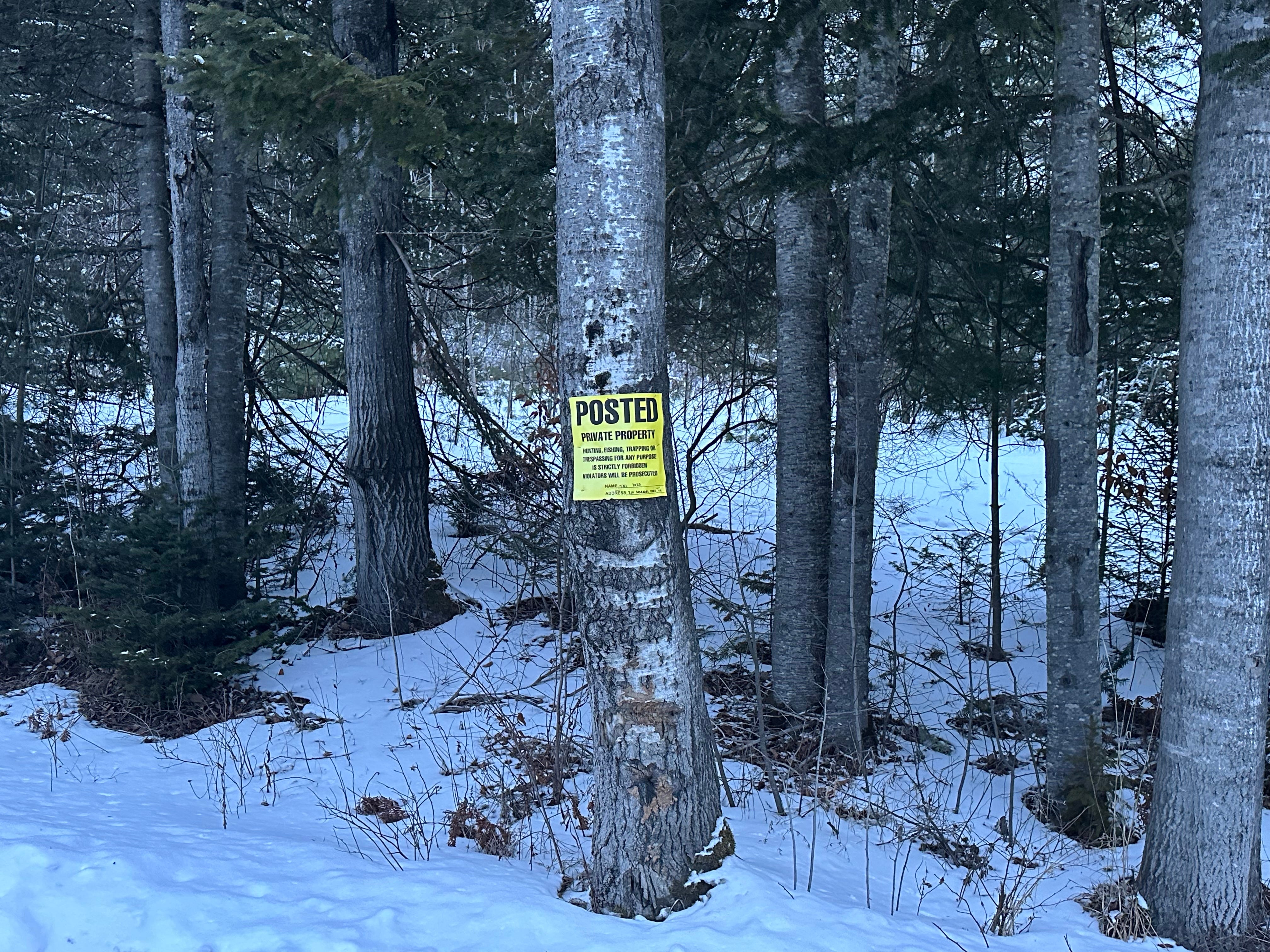
When Vermont’s Chief Warden sent a letter to town clerks last fall, it upended what many thought they knew about a fundamental question: How do you legally keep hunters off your land in Vermont?
The answer turns out to be far more complicated—and confusing—than almost anyone realized. So confusing that even state wardens had been giving contradictory information for years. So contentious that Fish and Wildlife Commissioner Jason Batchelder was called to explain the situation to the Senate Natural Resources and Energy Committee on January 16, with “Land Posting” listed as a standalone agenda item.
The confusion centers on a deceptively simple phrase in Vermont law: signs must be “dated each year.” That seemingly straightforward requirement has sparked a debate about whether postings expire after 12 months or on December 31st—a distinction that creates wildly different outcomes for landowners trying to comply with the law.
Vermont’s Unusual Starting Point
Unlike most states, Vermont doesn’t assume private land is off-limits. The state’s constitution guarantees Vermonters the right to hunt and fish on “lands not inclosed”—making Vermont one of the few states with a constitutional “right to roam” on private property.
This means landowners who want to keep hunters off their property must actively “enclose” it, not with physical fences, but through a legal process called posting. The statute governing this process requires landowners to place signs at every corner of their property and no more than 400 feet apart along boundaries, record their posting annually with the town clerk for a $5 fee, and ensure signs are at least 8.5 x 11 inches with contrasting colors.
The signs must also be “dated each year.” That’s where the trouble starts.
The Calendar Year Bombshell
For years, many landowners and town clerks operated under what seemed like common sense: if you posted your land on September 15th and paid your $5 fee, you were covered for one year—until September 15th of the following year.
This “rolling year” interpretation allowed landowners to post during hunting season when the need was most acute, and gave them a full 12 months of protection for their money.
But last fall, Colonel Justin Stedman, Vermont’s Chief Warden, sent a letter to all town clerks declaring a different interpretation: postings are valid only until December 31st of the year they’re recorded, regardless of when during that year they were made.
Under this “calendar year” interpretation, a landowner who posts on January 2nd gets nearly 364 days of protection. But someone who posts on December 15th—perhaps responding to a poaching incident—gets just 16 days before their land legally reverts to open access on New Year’s Day.
The letter acknowledged that even wardens had been sharing contradictory information with clerks about the requirements.
The January Problem
The calendar year interpretation creates what critics call the “January Paradox.” To maintain continuous protection, landowners would need to re-post immediately after their old posting expires on December 31st.
That means updating date stamps on every sign—potentially dozens or hundreds of them, spaced around the entire property boundary—in the middle of Vermont’s coldest, snowiest month.
“I’ve been telling people about the state’s position, and they are not excited,” East Montpelier Town Clerk Rosie Laquerre told a local news outlet. “It can be hard for landowners to get out in January and post their land.”
The Town of Guilford issued an update emphasizing the strictness of the interpretation: “A sign dated 2025/2026 would not be legal in 2026. The signs would need to be dated in 2025 and 2026 respectively.”
This suggests landowners can’t even pre-date signs for the coming year—they must wait until January 1st to legally mark them with the new year, creating either a gap in protection or requiring winter excursions that may be physically impossible for elderly or disabled landowners.
No Margin for Error
The confusion around the date is just one way Vermont’s posting law can trip up landowners. The statute requires strict compliance across multiple dimensions, and failing any single requirement voids the entire posting.
Signs must be exactly the right size (8.5 x 11 inches minimum)—many generic “No Trespassing” signs sold at hardware stores are too small. The spacing must be precise, with signs at each corner and no gaps exceeding 400 feet. Signs must remain legible at all times, meaning weather damage or vandalism can unknowingly void a posting. And landowners using “Permission Only” signs must include their name and contact information on every sign.
A single fallen sign, a windstorm that creates a gap in coverage, or forgetting to pay the town clerk’s $5 fee renders the land legally open to hunting, even if dozens of other signs remain in place.
Competing Perspectives
The strict requirements reflect competing interests embedded in Vermont law. The constitutional right to hunt on unenclosed land represents a public liberty interest dating to 1793, while property owners have a fundamental right to exclude others from their land.
Fish and Wildlife Department materials promote the posting system while encouraging landowners to consider “Permission Only” signs as a middle ground. However, these signs carry the same rigorous compliance requirements as outright prohibitions, offering no regulatory benefit for landowners willing to allow some access.
Critics argue the system’s complexity serves a purpose: making it difficult to enclose land keeps more territory available for public hunting. They point to former Fish and Wildlife Commissioner Christopher Herrick’s 2024 testimony defending the Fish and Wildlife Board’s hunter-focused composition as evidence of departmental priorities.
Others note that Vermont has declined to adopt alternatives used by neighboring states, such as New Hampshire and Maine’s “purple paint” laws, which allow landowners to mark boundary trees with paint instead of maintaining paper signs. Paint doesn’t require annual dating, doesn’t blow away in storms, and doesn’t need town clerk recording fees.
Some observers, including attorney Vanessa Kranz in a recent commentary, argue the current system is “overly burdensome” and discriminates against elderly, disabled, and out-of-state landowners who cannot maintain winter access to their property boundaries.
What Happens Next
The appearance of Commissioner Batchelder before the Senate Natural Resources Committee suggests legislators are taking the confusion seriously. The committee’s agenda specifically listed “Land Posting” alongside major water quality legislation, indicating the issue has risen to significant policy concern.
Whether this leads to statutory clarification, regulatory changes, or adoption of alternative posting methods remains unclear.
For now, Vermont landowners face a choice: brave January weather to update their signs, accept that their land may be legally open to hunting during the gap, or abandon posting altogether. Town clerks continue fielding questions they’ve answered differently over the years. And hunters navigate a landscape where the legal status of any given parcel may depend on whether a sign’s date survived the winter—or whether anyone agrees on what “each year” actually means.
The law remains the law until the legislature changes it. But rarely has a law left quite so many people—from enforcement officers to municipal officials to the landowners themselves—equally baffled about what it requires.
Ground is frozen and many signs are in pastures that are mowed seasonally. Where's the sense, Vermont? Fix this. It's an easy one, compared to school funding....