


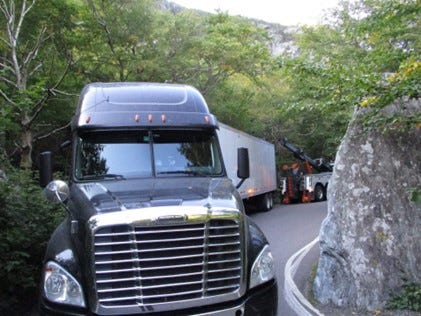
Vermont is on the verge of making it significantly more expensive to get a tractor-trailer stuck in Smuggler’s Notch — and the legislation doing it is smarter than most people realize. Whether it’s smart enough is a different question.
S.326, which passed the Vermont Senate in March and is moving through final House review this week, rewrites the penalty structure for operating a prohibited vehicle on Vermont Route 108 through Smuggler’s Notch. The base fine jumps from $1,000 to $10,000. If the stuck vehicle substantially impedes traffic — which a 48-foot tractor-trailer blocking a mountain pass tends to do — the fine doubles to $20,000. A second offense within three years doubles it again. If signed into law, the new penalties would take effect July 1, 2026.
That alone would be a straightforward deterrent story. But the bill goes further.
Under S.326, when a driver is operating in the scope of employment, the fine doesn’t go to the driver. It goes to the employer — the carrier, the trucking company, the business that dispatched the vehicle. If the driver was on a personal trip, the operator pays. The Vermont Legislature drew a line that most states haven’t bothered to draw.
It’s a meaningful distinction. The problem of trucks getting stuck in the Notch has never been primarily a driver problem. It has been, increasingly, a routing problem — GPS navigation apps and dispatch systems sending commercial vehicles into a mountain pass where there is, as VTrans’s website puts it, “no physical way for large vehicles to fit.” The decision to turn onto Route 108 is often not made by the person sitting behind the wheel. It’s made by an algorithm, confirmed by a dispatcher in another state, and executed by a driver who trusts the route they’ve been given.
Vermont’s new law reaches the employer. That matters.
Except that reaching the employer on paper and reaching the employer in practice are not always the same thing.
Josh Klein, Deputy Communications Director for the Owner-Operator Independent Drivers Association, told Compass Vermont this week that OOIDA sees both the five-point penalty and the $10,000 fine as significant consequences. But on the question of who ultimately bears the cost, Klein was direct: “While the bill language seems well-intended by penalizing the carrier, most fines we’ve seen in other states ultimately are passed along to the driver.”
Employment contracts, lease agreements, and carrier policies have a way of redirecting statutory liability back to the person behind the wheel, regardless of what state law specifies.
And there’s a second consequence in S.326 that no employment contract can redirect.
Alongside the fine structure, the bill adds Smuggler’s Notch violations to Vermont’s point assessment schedule under 23 V.S.A. § 2502 — five points, assessed to the individual operator’s driving record, every time, regardless of whether the employer pays the fine. For most drivers, five points is an inconvenience. For a commercial driver, five points on a CDL is something closer to a career event.
The driver who followed the dispatcher’s GPS route into the Notch — who may not have known the road, may not have had a choice, may have trusted the system that was supposed to know better — takes that hit personally. The employer writes a check. The driver carries the record.
The House Transportation Committee, in its amended version of the bill, added one more provision the Senate hadn’t included: a direct mandate requiring VTrans to update the signage at the Notch entrances to reflect the new penalty amounts. It is a small addition, but it acknowledges something that transportation officials have struggled with for years.
Vermont has tried myriad approaches to the signage problem. Signs in English and French. Pictographs. Physical chicanes installed in 2024 that dropped annual stuckages from five to one. And language that VTrans itself describes in plain terms — that no matter what a GPS says, there is simply no physical way for an over-length vehicle to navigate the Notch.
Todd Sears, who led the Notch management effort for VTrans, told Vermont Public in November 2024 what every sign designer eventually confronts: “Our signage was very clear, saying that you will get stuck. Do not attempt to drive through the Notch, and don’t trust your GPS — but they would try anyway. I mean, it’s a mystery.”
Colorado wrestled with the same mystery on I-70 east of Denver, where CDOT officials interviewed truck drivers about how they experienced a specific stretch of road before writing warning signs in language drawn directly from those conversations. The result cut fatalities in half even as traffic volume grew. The lesson was clear: signs work when they address the specific cognitive moment the driver is in, not when they restate the legal prohibition. Applying the same approach to Independence Pass produced more mixed results — incidents continued despite better language and higher fines.
Physical reality, it turns out, communicates more clearly than any sign. The chicanes proved that. Updating the signs to say $10,000 instead of $1,000 may reinforce it.
S.326 is in its final days at the Statehouse. When the next truck turns onto Route 108 — and based on recent history, one eventually will — Vermont will have a sharper set of tools than it has ever had before. A $10,000 fine. Employer liability on paper. Five points on a CDL regardless of who pays. Updated signs at the entrance.
What Vermont still won’t have is a way to reach the dispatcher who chose the route, or the routing platform that recommended it, or the carrier policy that didn’t flag the restriction before the truck left the yard.
The law is smarter. The gap it can’t close is structural.
Written responses from sources are on file. S.326 statutory text and legislative history reviewed in full by Compass Vermont.
Can we learn from this to fundamentally adapt speed control?
Under the current system of relying mostly on traffic fines, the state receives the fine, and only a small percentage is returned to the city or town. Thus, the cost-effectiveness is reduced for the town. Secondly, only a small percentage of speeders are 'caught' and fined. Speed studies show speed and the number of speeders rising substantially over the last ten years. Driver behavior is, for the most part not being affected. Patrol cars influence behavior temporarily and primarily where visible. Road design, however, influences behavior continuously.
Research from the Chittenden County Regional Planning Commission, state transportation agencies, and federal highway safety programs consistently shows that traffic-calming infrastructure is more effective at reducing speeds than enforcement alone.
Narrowed travel lanes, gateway treatments, lane shifts, raised crossings, chicanes, and other traffic-calming measures naturally encourage slower driving, whether or not law enforcement is present.
Enforcement can support safer roads, but it cannot engineer them. Road design can.
Let the truckers go through. Just charge them a $20,000 toll up front. The word will get around.