


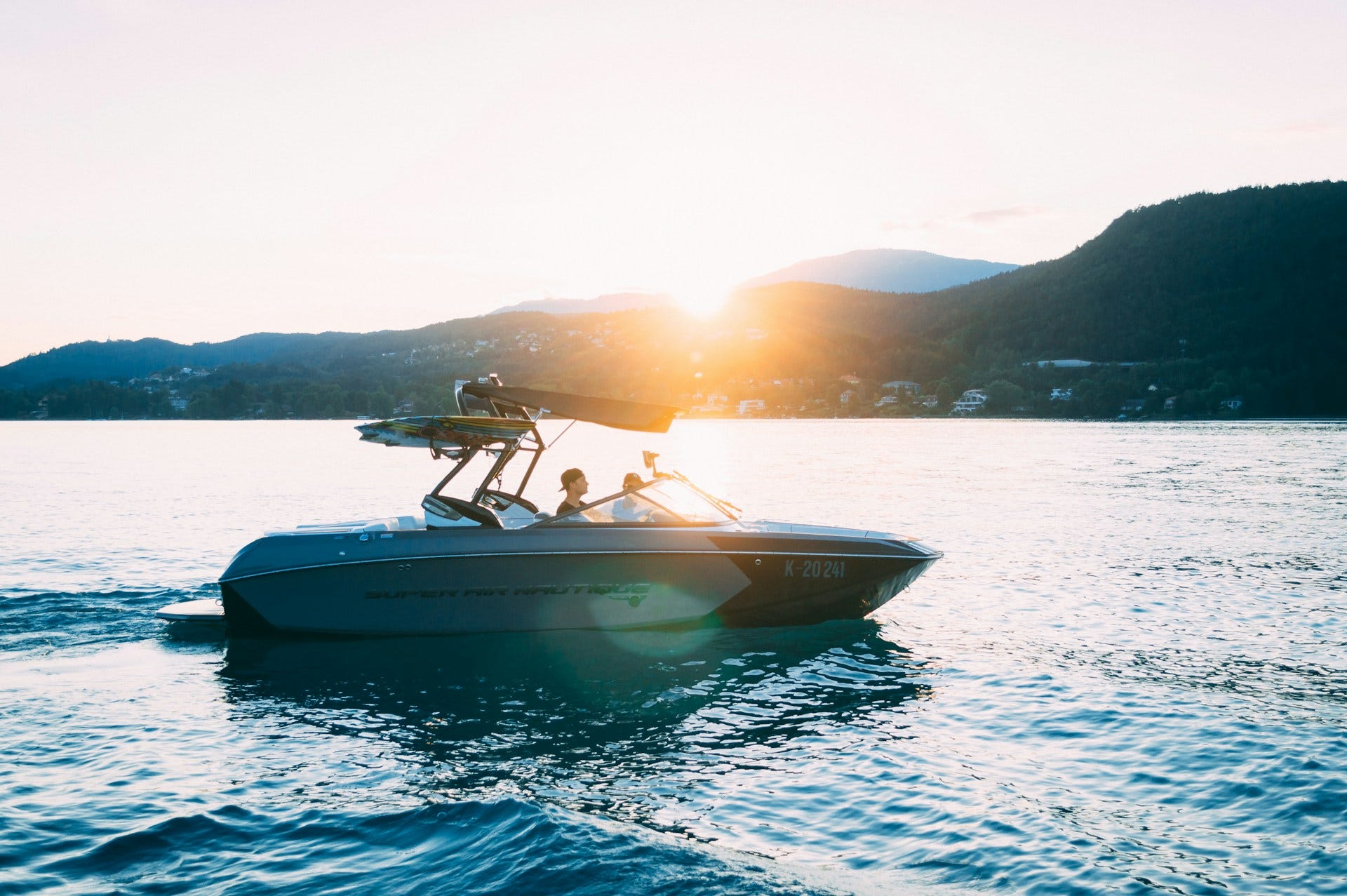
It’s a Saturday this summer. You’re on the beach at one of the Vermont lakes where wake surfing is no longer allowed. The water’s been calm for long stretches — no surfer carving a chest-high trough behind a ballast-heavy inboard. Then a set of waves rolls in and slaps the shoreline hard enough to rock the dock and skid your kid’s float up the sand.
You look out. It wasn’t a wake boat.
That moment is the gap at the center of Vermont’s revised wakesports rule, which took effect June 11, 2026. The rule does real things, and it does them to a narrowly defined kind of boat. What it does not do is set a general limit on the size, height, or energy of a boat wake itself — which means many of the waves washing up on Vermont shorelines this summer will come from boats the wakesports rule never touches.
What the rule actually does
The new rule tightens where wakesports can happen. It restricts wake surfing and riding an enhanced wake to designated wakesports zones on a shrinking list of inland lakes — the state removed wakesports from a dozen lakes this spring, leaving the activity on 18 inland waters, plus the big cross-boundary lakes like Champlain and Memphremagog. The list shrank because the state tightened the geometry of a legal wakesports zone: a zone now has to hold at least 100 contiguous acres with a straight run of 3,000 feet, up from 50 acres — a bar a dozen smaller lakes can no longer clear.
Alongside that, the rule adds a 500-foot safety offset from other users when a wake boat is throwing an enhanced wake; a wake boat running with empty ballast and making no enhanced wake reverts to the standard 200-foot offset. It also adds a 500-foot buffer from signed loon nesting sites during nesting season and a hot-water decontamination requirement for ballasted vessels moving between water bodies — replacing the previous “home lake” rule that had tied each wake boat to a single lake.
The hinge of the whole thing is one definition. Under the rule, a “wakeboat” is a motorboat with one or more ballast tanks, ballast bags, or other devices or design features used to increase the size of its wake. “Wakesports” means operating that boat with the ballast engaged, or riding the enhanced wake behind it. And the state draws the boundary explicitly: ordinary motorboats, speedboats, ski boats, even pontoons all throw wakes, but none of them count as “wakeboats” under the rule.
So the line isn’t the wave. It’s the boat. A conventional boat with no ballast is never a “wakeboat,” no matter how big a wake it throws — and if it isn’t being used for wakesports, it sits outside this rule entirely, though still subject to Vermont’s general boating laws.
What restricts a regular boat’s wake? No limit on the wake itself.
If you own a conventional powerboat — a ski boat, a runabout, a cabin cruiser, a heavy pontoon — the wakesports rule doesn’t reach you unless your boat fits the wakeboat definition and you’re using it for wakesports. The rules that still touch your wake are the general boating rules that apply to everyone, plus any lake-specific restrictions. None of them set a number for how big your wake can be.
Under the Use of Public Waters Rules and Title 23, the limits are:
No more than 5 mph within 200 feet of shore on lakes larger than 75 acres, and 5 mph everywhere on lakes smaller than 75 acres.
No-wake speed within 200 feet of swim areas, anyone in the water, other boats, canoes and kayaks, moored boats, and docks.
A catch-all barring careless or negligent operation, or operating in any manner that endangers the safety, life, or property of another person.
That’s the general statewide toolkit. There’s no wake-height limit, no wake-energy standard, no equivalent of a noise cap for waves. Once a conventional boat is clear of the 200-foot shoreline zone on a lake that allows speeds above 5 mph, no rule caps the size of the wake it throws — though a reckless or negligent operator can still be cited, and a given lake may carry its own restrictions.
You don’t need ballast to throw a big wake
Here’s why that matters. The biggest drivers of how large a wake a boat throws are speed, hull behavior, and weight — not whether the weight happens to come from a factory ballast tank.
Reviews of the boat-wake research consistently find that a boat’s wake grows with its speed — and that for a planing hull the biggest wake comes not at full throttle but near the transition from displacement, or plowing, mode to planing mode. In that condition the bow rides high, the stern digs in, and the boat hasn’t yet climbed fully onto plane; a boat moving in that range throws a large wake. Weight compounds it: heavier boats displace more water and make bigger waves, and a boat towing a skier produces more wave energy than the same boat running empty.
A regular boat, in other words, can do much of what the rule is worried about — without a drop of ballast.
What surf mode does that a regular boat usually doesn’t
That’s the case for why a conventional boat’s wake goes largely unaddressed by the new rule. It is not the case for treating a wake boat in surf mode as the same thing — because it isn’t.
A wake boat running in surf mode produces a wave you generally don’t see off a normal boat: a steep, sustained, oversized wave thrown by a hull deliberately plowed deep and weighted down with water, often circling the same stretch over and over to keep a surfer up. Researchers at the University of Minnesota’s St. Anthony Falls Laboratory put numbers to that difference in a 2022 field study. Measuring the height, energy, and power of waves from four boats — two wakesurf boats and two ordinary recreational boats — they found the wakesurf boats produced the largest waves by every measure.
In plain terms: a wake-surf wave can hit the shore harder than the wake off a typical runabout, and it stays large much farther out. The study found that, in typical operation, a wakesurf boat had to be more than 500 feet from shore before its waves calmed to levels similar to a normal boat’s. That’s the condition the rule most directly targets — the sustained, oversized wave that drove the citizen petitions and the erosion, wildlife, and safety complaints in the first place. Targeting it is a defensible call.
The line the state drew, and the line it didn’t
But notice what that leaves. The rule’s line is the boat — its equipment and how it’s used. The wave’s line is physics — speed, hull behavior, weight. Those aren’t the same line.
This is the interpretive heart of the piece, so it’s worth stating plainly: by regulating wakeboats and wakesports rather than the wake itself, Vermont has reined in the most extreme case while leaving a much larger group of boats outside the new rule — the heavy cruiser plowing at displacement speed, the loaded boat towing a skier, the runabout running just below plane. The reach is narrow by design: greeters at Vermont’s boat launches tallied 114 wake boats among 12,793 motorboats launched statewide in 2025 — under 1 percent of the motorboats in that data set — while the far larger number of conventional boats capable of a big wake stays outside the rule entirely. Whether that’s sensible triage or a meaningful gap depends on what you think the rule is for. If it exists to stop one specific recreational activity, it does that cleanly. If it exists to protect shorelines and small craft from large boat wakes generally, it reaches only a slice of the problem.
That tension wasn’t imported from outside the process. It surfaced inside the rulemaking, among the more than 1,500 public comments the agency reviewed before the rule’s May 2026 approval. Wake-boat owners and industry representatives argued that it is arbitrary to single out wake boats when other watercraft also make wakes and can carry invasive species between lakes. You can disagree with where those commenters want the rule to land and still grant that, on the wake-physics merits, they have a point about what it covers and what it doesn’t.
Which brings us back to the beach. You’ll still feel the wake roll in this summer. It just won’t always be the boat the rule had in mind.
This is a follow-up to our earlier reporting, “The Wake Boat Controversy Is Still Making Waves Across Vermont.”
Compass Vermont is independent and reader-supported. We bring the data. You form the opinions.