


Vermont’s new $250 tax credit for low-income veterans has returned about $439,000 so far this filing season. The Joint Fiscal Office projected it would return $1.4 million.
That is 31 cents of every dollar the state expected the credit to pay out. It is the widest gap of the five tax changes in Act 71 of 2025, the package Gov. Phil Scott signed last June and whose results his administration presented at the Statehouse on Wednesday.
The other four changes landed much closer to what analysts expected. Set the Joint Fiscal Office’s projections next to the figures Tax Commissioner Bill Shouldice gave Wednesday, and the veteran credit stands alone:
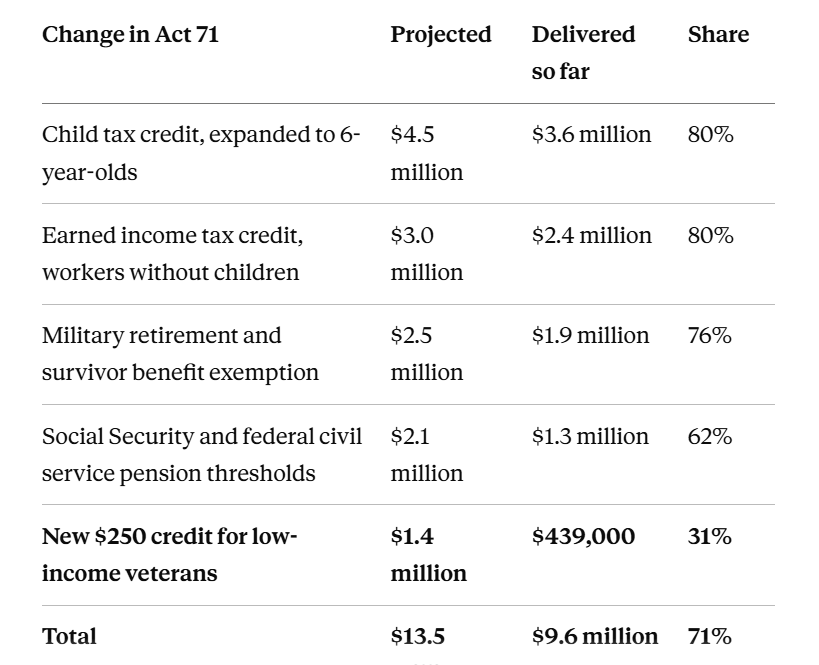
The Joint Fiscal Office is the Legislature’s nonpartisan budget analysis shop. Its estimates are annual, and the filing season is not finished — Vermonters who requested an extension have until October 15, so these numbers can still move. VTDigger noted the gap between the $13.5 million projection and the roughly $10 million total on Wednesday.
But the veteran credit would need to more than triple in the next eight weeks to reach its projection. The other four would need a fraction of that.
Why a credit can be funded and still not reach people
The veteran credit is refundable. A refundable credit pays you even if you owe the state nothing — it is not a discount on a tax bill, it is a check. Vermont’s child tax credit and earned income tax credit work the same way.
The catch is that a refundable credit only pays out if you file a return asking for it.
The Department of Taxes estimates roughly 35,000 Vermonters may qualify for one of the state’s refundable credits and are not receiving them. The reason is structural: their income is low enough that the IRS does not require them to file a federal return. Having no federal obligation, they file no state return either — and the state has no way to send money to someone who has not asked for it.
That is the population the veteran credit was aimed at. Under Act 71, a veteran with an adjusted gross income of $25,000 or less gets the full $250, with a partial credit phasing out at $30,000. Adjusted gross income is the number at the bottom of the first page of a federal return: total income minus a handful of specific deductions.
The credit with the lowest take-up in the package is the one written for the Vermonters least likely to be required to file.
Two explanations, and the documents support both
The first is the one above — that eligible veterans are not filing.
The second is that the eligible group was never as large as projected. The Joint Fiscal Office built its estimate from Census data showing about 34,076 veterans in Vermont, roughly 15% of whom live in households with income of $25,000 or less. That produced the figure of about 5,200 eligible veterans. The credit reached 1,888.
The two measures are not the same thing. The Census figure counts household income; Act 71 is written against a filer’s adjusted gross income. A veteran living with a working spouse or an adult child can sit in a low-income household and still file with an adjusted gross income above $25,000. If that describes a meaningful share of the 5,200, the pool of people who actually qualify is smaller than the projection assumed, and the credit is doing better than 31% against the group that was genuinely eligible.
Nothing in the public record settles which explanation dominates. Both are consistent with the filings.
Veteran and military retiree are not the same word
Act 71 contains two separate provisions for people who served, and the difference between them is the difference between 34,076 Vermonters and 3,900.
A veteran is anyone who has served in a branch of the military — generally, anyone who completed basic training. There are about 34,076 in Vermont. The $250 refundable credit is aimed at the low-income portion of this group.
A military retiree is a veteran who served at least 20 years and draws a military pension. There are about 3,900 in Vermont, plus 751 people receiving survivor benefits. The pension exemption applies to this much smaller group.
Every military retiree is a veteran. Most veterans are not military retirees. The pension exemption — which Compass covered when the governor signed it, after a decade-long push — removed the old $10,000 cap and now fully exempts military retirement and survivor benefits for households under $125,000 in adjusted gross income, with a partial exemption to $175,000. It returned $1.9 million to more than 2,400 people, about $778 apiece.
Adjutant General Hank Harder, who runs the Vermont National Guard, told the press conference that Vermont is the only New England state that still taxes military retirement pay, and that New York does not tax it either. Both statements hold up. Connecticut, Maine, Massachusetts and Rhode Island fully exempt military retirement pay; New Hampshire has no income tax on it. Vermont’s exemption, unlike theirs, has an income ceiling.
What the debate was about
Scott has pushed to eliminate the tax on military pensions for years, arguing it would draw veterans to Vermont and grow the economy. Democrats who resisted argued the break would benefit some high-income households and single out one deserving group over others. The compromise was the income ceiling.
Act 71 passed both chambers with overwhelming support and took effect retroactively to January 1, 2025.
If you think you are owed money
The filing deadline for a 2025 Vermont return is October 15. Filing costs nothing if you use one of the state’s free options, and a refundable credit is money regardless of whether you owe tax.
Child tax credit — $1,000 per child age 6 or younger, for households under $125,000
Earned income tax credit — up to $649 for workers without children
Veteran credit — $250 for veterans with adjusted gross income of $25,000 or less, partial to $30,000
Free filing help — the Volunteer Income Tax Assistance program prepares returns at no cost. Capstone Community Action alone filed 1,800 returns for central Vermonters this year, generating $600,000 in refunds
Department of Taxes — tax.vermont.gov, or 802-828-2865
Laura Sudhoff, who coordinates Capstone’s free tax preparation program, put the stakes in ordinary terms at Wednesday’s press conference: a refund can cover back rent, a utility bill, groceries, childcare, or a car repair.
Shouldice made the same point from the other direction. “This isn’t the State’s money. It’s Vermonters’ money,” he said — and it belongs in circulation, helping families make ends meet, rather than sitting in state coffers.
It has eight weeks to get there.