


ANALYSIS
All five Democrats running for governor and lieutenant governor have said they would raise taxes on second homes. Between them, they have attached that money to universal primary care, community health clinics, housing construction, and lower property tax bills for year-round Vermonters.
The Vermont Department of Taxes has already told the Legislature, in writing, that it cannot yet say how many houses would pay.
The state says it can’t count them
In December, the Department of Taxes delivered a report to the House Ways and Means and Senate Finance committees on how the new second-home tax class would actually work. It runs 44 pages, and it is unusually candid.
On the size of the tax base, the Department writes that the data to quantify it does not currently exist. Its working estimate — that second homes make up somewhere between 30 and 40 percent of the existing nonhomestead grand list — is a triangulation, not a count. The analysis in the report splits the difference and assumes 35 percent.
The reasons are practical, and they are all in the report:
Owners of second homes and short-term rentals are not required to file any attestation with the state today. Nothing in the system asks them to identify themselves.
Dwelling units not suitable for year-round living are not consistently monitored or recorded anywhere.
Individual dwelling units have no unique identifier and no separate taxable value. Towns would have to go find them, measure them, and name them.
The Department asked Vermont’s listers and assessors whether they could reliably tell a year-round house from a seasonal camp. Of 96 who answered, 60 said yes and 36 said no.
There is also a gap the report flags on the other side of the ledger. Vermont receives roughly 173,000 homestead declarations a year, but the Census counts closer to 200,000 owner-occupied homes. Under current law, a homeowner who doesn’t file gets taxed as nonhomestead. Under the new system, some of those Vermonters — often people whose income is low enough that they don’t file a tax return at all — would be taxed as second-home owners on their own primary residence.
The state also modeled the rate
The same report does what no campaign has done. It puts numbers on what a second-home rate would actually be.
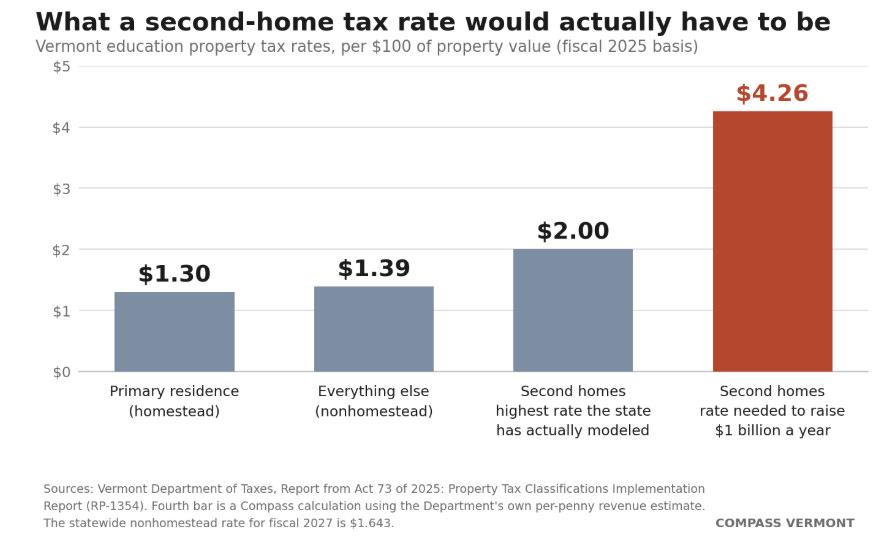
The Legislature asked the Department for two sets of rate scenarios. Both were built on fiscal 2025 data, when the average homestead rate was about $1.30 per $100 of value and the nonhomestead rate was about $1.39. Across every scenario the Department modeled, the second-home rate lands between $1.60 and $2.00.
The Department spells out what its own top scenario means for a house. A full dollar of separation between the primary-residence rate and the second-home rate works out to about $5,000 more a year on a house worth $500,000.
That is a real tax increase, and it is roughly the size of the change Vermont is actually contemplating.
Now set it against the promises. Amanda Janoo, one of two Democratic candidates for governor, said in a social media video that taxing second homes and vacation rentals could bring in $1 billion a year. Asked about the figure, she described it as a rough estimate tied to a broad restructuring of property taxation rather than a completed analysis. The Department’s highest modeled second-home rate — the $2.00 scenario — generates about $138.6 million. Reaching $1 billion means roughly seven times the revenue of the most aggressive rate the state’s own tax analysts have put on paper.
The Department also flags why the gap can’t simply be closed by pushing the rate higher. The wider the spread between the primary-residence rate and the second-home rate, the greater the incentive for owners to file a homestead declaration they aren’t entitled to, or to claim a unit is a long-term rental when it isn’t. A larger differential increases the tax-avoidance incentive, and the compliance burden that follows.
The category can erase itself
Act 73 of 2025, the education overhaul Gov. Phil Scott signed, created the second-home tax class. It did not set a rate for it, and it did not guarantee the class survives.
Two contingencies are written into the law. The work of classifying properties does not proceed at all unless the General Assembly first enacts new school district boundaries. And the classifications are repealed outright unless three things happen by the statutory deadline: the Legislature acts on tax rate multipliers, the new school districts are operating and educating all resident students, and the foundation formula cost report reaches the General Assembly. Act 170 of 2026 extended that timeline further, shifting to district-led mergers with town votes in March 2028 and pushing the foundation formula and the statewide tax rate to July 2029.
Setting a rate also means passing a bill. In Vermont, education property tax rates are set in the annual yield bill, and the yield bill goes to the governor. In June 2024, Scott vetoed it. Lawmakers overrode him, 103–42 in the House and 22–7 in the Senate. The last fight over education property tax rates required an override to settle, and a second-home rate is a larger fight than the one that produced it.
So what happens between now and then?
This is the part the campaign conversation skips, and it is the part that lands on Vermonters first.
Nothing about second-home taxation changes in the meantime. Until the new class takes effect, a lakeside second home pays the same statewide nonhomestead rate as a dairy farm, a hardware store, and an apartment building — $1.643 per $100 of value this year. Every argument the candidates are making about fairness describes a system that stays exactly as it is through the entire term they are running for.
Meanwhile, the money already spent has to be replaced.
Vermont held this year’s average education property tax increase to about 3.5 percent by deploying $104.9 million in one-time General Fund money in a single year, plus roughly $22 million in Education Fund surplus. Without them, lawmakers’ own analysis put the increase near 10 percent. Without any of the relief layered in, closer to 12 percent — in the range of the 11.9 percent the Tax Commissioner had projected in December.
None of that money comes back next year. The next governor writes the fiscal 2028 and 2029 budgets in exactly the window where the one-time relief is gone and the second-home revenue has not arrived. Over the same stretch, the cap on school spending tightens on a schedule already in statute, from 118 percent of average per-pupil spending this year to 115.5 percent next year and downward each year after.
The question for every candidate isn’t what the second-home money would buy. It’s what happens in the three budgets before it exists.
The incumbents are leaning on the same forecast problem
Scott and Lt. Gov. John Rodgers both say they are wary of new taxes, pointing instead to controlling education spending and growing the tax base.
That position depends on the same kind of projection. The one-time transfer that held this year’s increase to 3.5 percent was the governor’s own recommendation, deployed in full in a single year rather than split across two. A tax base that grows enough to replace it is a forecast in exactly the way second-home revenue is a forecast. Both sides of this race are spending money that has to be predicted before it can be collected.
Vermont has already tested a forecast like this
The second-home tax isn’t hypothetical. Vermont enacted one two years ago.
Act 181 of 2024 raised the property transfer tax on second homes fit for year-round living from 1.45 percent to 3.62 percent, effective that August. The Joint Fiscal Office projected $15.7 million in the first year and $18.6 million in the second — $34.3 million across two years.
Preliminary Department of Taxes figures put the actual take at about $28 million across roughly 7,300 purchases, around $6 million under forecast. The first year captured eleven months rather than twelve and the numbers are preliminary, which explains part of the gap but not all of it.
That tax is a one-time charge on a sale, not an annual property tax, so it is not the same instrument being proposed now. But it is the only real Vermont data on what second-home tax forecasts do when they meet the market. It runs about $14 million a year. The largest number being campaigned on is $1 billion a year.
What we know, what we don’t, and what to watch
Known: Act 73 created the second-home tax class and set no rate for it. The Department of Taxes has modeled second-home rates between $1.60 and $2.00, worth roughly $5,000 a year on a $500,000 house at the top of that range. Setting any rate requires a bill and a governor’s signature. The 2024 second-home transfer tax came in under forecast.
Not known: How many properties are in the class — the state says the data to count them does not yet exist. What rate a future Legislature would set. Whether the class survives its own repeal provisions.
Worth watching: The dwelling-identification work that towns and listers would have to complete before any of this is billable, and the yield bills of the 2027 and 2028 sessions, where a second-home rate would have to appear.
Vermont’s primary is August 11.
Compass Vermont is independent and reader-supported.