


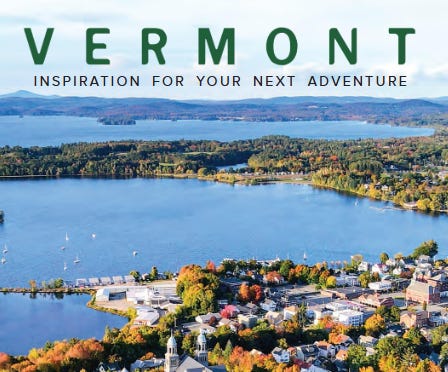
Vermont’s Department of Tourism and Marketing released the state’s first-ever Destination Management Plan on May 12, presenting a vision for sustaining what the department calls a $4.2 billion industry that supports 9 percent of state GDP and 16 million annual visitors.
The plan’s most direct finding is about money. Funding for destination marketing in Vermont is “woefully below our neighboring states and other competitive destinations,” the plan states.
The plan, prepared over the past year and a half by Oregon-based consulting firm Coraggio Group, identifies four strategic imperatives for the state’s tourism industry and recommends investments in ongoing visitor research, a new consumer brand identity, workforce development, and exploration of tourism improvement districts as a potential dedicated revenue source. VDTM Commissioner Heather Pelham first presented the plan’s findings at the Vermont Tourism Summit in Killington in late April before the formal public launch.
The plan does not identify a dedicated funding source for the recommendations.
What Vermont spends
According to VDTM’s own internal budget submission to the legislature, the department’s destination marketing base in fiscal year 2024 was $3.75 million. The department’s comparison cited New Hampshire at $10.4 million in the same year, Massachusetts at $6.9 million, and Maine at $19.1 million.
The U.S. Travel Association’s state tourism office dashboard, drawn from fiscal year 2025 reporting, shows a national median of $15.8 million in state marketing spending.
Vermont’s tourism marketing operation has been supplemented since 2022 by a one-time $10.4 million federal grant from the Economic Development Administration, awarded under the American Rescue Plan Act to help states recover from pandemic-related tourism losses. That money funded the development of the Destination Management Plan itself, a primary visitor survey now underway for the first time since 2014, and expanded brand advertising campaigns.
The federal grant fully expires on June 30, 2026, the last day of the current state fiscal year.
The legislature’s response
The state’s enacted fiscal year 2026 budget, signed into law on May 21, 2025 as Act 27, appropriates $9,042,997 for the Department of Tourism and Marketing. Of that, $4,960,125 is general fund, $4,007,872 is the final installment of the expiring federal grant, and $75,000 is interdepartmental transfers from other state agencies that use the department’s Chief Marketing Office.
Based on the Act 27 fund breakdown, VDTM’s ongoing state-funded base would be approximately $5 million after the federal funds expire on June 30, absent replacement funding.
The fiscal year 2026 appropriation process showed mixed legislative appetite for expanding the department’s work. Gov. Phil Scott’s January 2025 budget proposal recommended increasing the department’s Grants for Relocation Outreach Work program — known as GROW, which funds regional partners that help recruit new residents — from $700,000 to $1.05 million.
The House Appropriations Committee zeroed out the entire $350,000 increase in March 2025, with a note in the budget reading “Do not fund grants for Relocation Outreach Work.” The Senate restored most of it. The conference committee that produced the final bill settled on $1,020,000 for GROW — $30,000 below the governor’s proposal.
The GROW program currently funds 15 regional organizations including the Chamber & Economic Development of the Rutland Region, the Lake Champlain Regional Chamber of Commerce, the Brattleboro Development Credit Corporation, and the Vermont Professionals of Color Network. According to VDTM’s program reports, 97 new Vermonters relocated to the state through the GROW network in 2024, with Rutland County alone welcoming 34 new residents.
A long-acknowledged gap
The Destination Management Plan’s framing of funding as woefully inadequate echoes critiques VDTM has been making in budget submissions for years.
The department’s fiscal year 2026 budget narrative to the legislature states that “resources allocated to the Department for us to achieve our primary mission of growing the visitor economy through destination marketing have remained flat for over ten years.”
The same narrative warns that without the expiring federal funds, the state risks losing tourism market share to better-resourced competitors — not only its closest neighbors but other destinations that are increasing their tourism investment.
VDTM’s general fund appropriation has grown modestly in nominal terms over the past decade — from $3.09 million enacted in fiscal year 2018 to $4.79 million in fiscal year 2025 and $4.96 million in fiscal year 2026, roughly 60 percent nominal growth over eight years. Adjusted for inflation and for the expanded mission the department has taken on during that period — including relocation marketing, the Chief Marketing Office, and now the Destination Management Plan — the department’s own characterization of flat funding is what its narrative reflects.
The dedicated-revenue model
The structural difference between Vermont’s tourism funding and Maine’s or New Hampshire’s is not just dollar amount. It is mechanism.
Maine’s Office of Tourism is funded through a dedicated Tourism Marketing Promotion Fund established in state statute, which receives 5 percent of revenue from Maine’s 8 percent prepared food tax and 5 percent of revenue from its 9 percent lodging tax. The fund scales automatically with tourism activity. Maine recorded 14.8 million visitors and $9.2 billion in tourism spending in 2024, according to the Maine Office of Tourism’s annual report — Maine’s tourism spending is more than double Vermont’s $4.2 billion.
New Hampshire’s Division of Travel and Tourism Development is funded through allocations from the state’s Meals and Rentals tax. The allocation has been suspended in some budget years but operates as a designated revenue stream rather than an annual general fund appropriation.
Unlike Maine and New Hampshire, Vermont’s Department of Tourism and Marketing is funded primarily through annual appropriations rather than a dedicated tourism-promotion fund. The department’s funding competes annually against every other general fund priority in the budget cycle.
Rep. Heidi Scheuermann, R-Stowe, introduced legislation in 2021 — H.179 — that would have created a Vermont Tourism and Marketing Promotion Fund tied to excess rooms-and-meals tax revenue. Commissioner Heather Pelham, who still leads the department, supported the bill and requested $1 million in seed funding. The bill did not advance out of the House Commerce and Economic Development Committee.
A Compass Vermont search of the Legislature’s bill database did not identify a successor bill in the 2025-2026 session as of publication.
The unanswered question
The Destination Management Plan commits the department to exploring tourism improvement districts — a mechanism, authorized by statute in other states, by which lodging properties within a defined geographic area collectively fund destination marketing through a local assessment. The plan does not identify candidate districts or estimate potential revenue.
The plan also commits to ongoing visitor research, expanded workforce development partnerships, refreshed brand creative, and new measurement systems. The department’s research line in the fiscal year 2026 budget is $88,000.
Fiscal year 2027 begins July 1, the day after the federal tourism recovery funds fully expire. It will be the first state fiscal year since 2023 written without that federal support.
What VDTM has asked for in its fiscal year 2027 budget, and whether the legislature will provide it, remains a central budget question facing a $4.2 billion industry that the state’s own first strategic plan now says has been underfunded for a decade.