


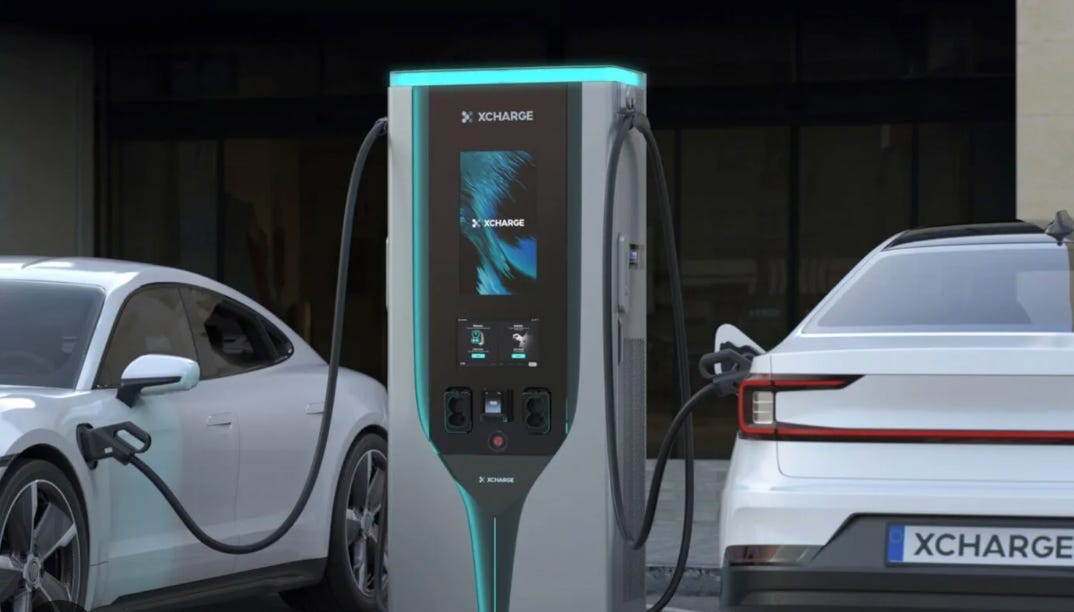
A new electric vehicle charging station featuring some of the fastest chargers available has opened in Winhall, bringing high-powered charging infrastructure to the Stratton Mountain corridor for the first time.
What’s Been Installed
Cellerate Power, a Vermont-based charging operator, launched the new station in late October 2025 at 40 Vermont Route 30 in Winhall. The facility features XCharge C7 Ultra-Fast Chargers capable of delivering up to 400 kilowatts of power—significantly faster than the 50-150kW chargers commonly found at many public charging stations.
According to industry reporting, the chargers can provide both CCS (Combined Charging System) and NACS connectors, the latter being the standard used by Tesla vehicles. This dual-connector approach means the station can serve virtually all electric vehicles on the road today without requiring drivers to use adapters.
The site currently charges $0.49 per kilowatt-hour, comparable to Tesla Supercharger pricing but notably higher than typical home electricity rates in Vermont.
Filling a Geographic Gap
The Winhall location addresses a significant gap in southern Vermont’s charging infrastructure. The Route 30 corridor serves as the primary access route to Stratton Mountain Resort, attracting visitors from metropolitan areas like New York and Boston.
Previously, drivers of non-Tesla electric vehicles traveling to Stratton faced limited fast-charging options. While Tesla Superchargers operate in nearby Manchester, other EV drivers had to rely on slower chargers or make significant detours to Brattleboro or Rutland. The mountainous terrain and elevation gain to Stratton can increase energy consumption by 30-50% compared to flat driving, making the availability of fast charging particularly important for this route.
Technical Capabilities and Limitations
The 400kW maximum output represents the cutting edge of current charging technology. However, most electric vehicles on the road today cannot actually accept charging at that rate. According to technical specifications, the C7 chargers can deliver up to 600 amps of current across a voltage range of 200-1000 volts DC.
For context, popular EVs like the Chevrolet Bolt are limited to about 50kW charging speeds, while Tesla Model Y vehicles typically max out around 250kW. Only a handful of vehicles—including the Lucid Air and certain configurations of the GMC Hummer EV—can approach the station’s maximum 400kW capability.
The chargers use liquid-cooled cables to manage the heat generated by high-amperage charging. Vermont’s cold winters present an additional challenge: lithium-ion batteries accept charge much more slowly in cold temperatures unless they’ve been “preconditioned” (warmed up) by the vehicle’s thermal management system. Plans include installing a canopy to protect both users and equipment from weather exposure.
Not Actually Vermont’s First
While promotional materials described these as “Vermont’s first 400kW EV chargers,” this claim overlooks existing infrastructure. Mercedes-Benz High-Power Charging launched its North American network in late 2023, including a location in St. Johnsbury, Vermont, equipped with chargers capable of 400kW output—nearly two years before the Winhall installation.
The Winhall site does represent the first such high-powered charging in southern Vermont and the first to offer native Tesla NACS connectors alongside CCS.
Financial Support and Business Model
Cellerate Power, led by founder Erik Moses, received $100,000 in financing from the Vermont Economic Development Authority in 2025 to support the project. This public investment helps offset the challenging economics of operating fast chargers in rural areas, where utility demand charges can exceed revenue during early years of operation, particularly in locations with seasonal traffic patterns like ski resorts.
The business model targets high-value tourism corridors that major national charging networks like Electrify America have not prioritized. The chargers also feature 21.5-inch digital screens designed for advertising, potentially generating additional revenue from promoting ski resort services, dining, and real estate to a captive audience of charging drivers.
Questions About Hardware Supplier
The chargers’ manufacturer, XCHG Limited (parent company of XCharge North America), faces significant financial challenges. According to the company’s own financial disclosures, revenue declined 38.2% in the first half of 2025 compared to the same period in 2024, while net losses increased by 630%. The company’s stock price has fallen more than 94% over the past year.
XCHG has announced a strategic reorganization establishing dual headquarters in Hamburg, Germany, and Austin, Texas, and has pursued new partnerships in Saudi Arabia and Oregon to diversify its market presence. The company’s financial viability could affect long-term maintenance and software support for installed equipment.
What Happens Next
The Winhall installation serves as a proof-of-concept for high-powered charging in rural Vermont tourism corridors. If utilization from ski season traffic proves strong, similar installations could appear at other independent ski resorts throughout the state that currently lack adequate fast-charging infrastructure.
The dual-connector strategy positions the site to serve the evolving EV market, as major automakers including Ford, GM, and Rivian have adopted Tesla’s NACS connector standard for future vehicles while continuing to support the CCS standard during the transition period.
For Vermont’s electric vehicle infrastructure, the station represents both an expansion of the charging network and a test case for the viability of high-powered charging in seasonal tourism locations. The success or challenges of this model will likely influence future infrastructure development in similar communities across the state.
Thank you for the comprehensive and well-researched article about our Winhall charging station. We appreciate the depth of technical detail and context you provided for Vermont's EV infrastructure landscape.
I wanted to offer a few clarifications that might be helpful for the accuracy of the piece:
Regarding Mercedes-Benz High-Power Charging in St. Johnsbury:
The article states that Mercedes-Benz launched their St. Johnsbury location "in late 2023," but that facility actually opened in November 2025—a few weeks after our Winhall installation. It appears there may have been confusion between the opening year and an EV model year of 2023 mentioned in a customer's review.
Regarding Manchester charging infrastructure:
The article mentions "Tesla Superchargers operate in nearby Manchester," but Manchester actually does not have Tesla Superchargers. The Manchester location behind Walgreens has 150kW CCS chargers operated by ViaLynk. The closest Tesla Superchargers to the Stratton corridor are located in Bennington and Brattleboro, both respectively about 45 minutes away.
These details don't diminish the quality of your analysis, and your technical discussion of charging capabilities, Vermont's infrastructure gaps, and the business model challenges in seasonal tourism corridors was excellent. We'd be happy to serve as a resource for any future questions about EV charging infrastructure in Vermont.
Thanks again for covering this important development in Vermont's clean transportation infrastructure.
Best regards,
Erik Moses
President & Founder
Cellerate Power Inc.
(802) 444-3043
erikmoses@celleratepower.com