


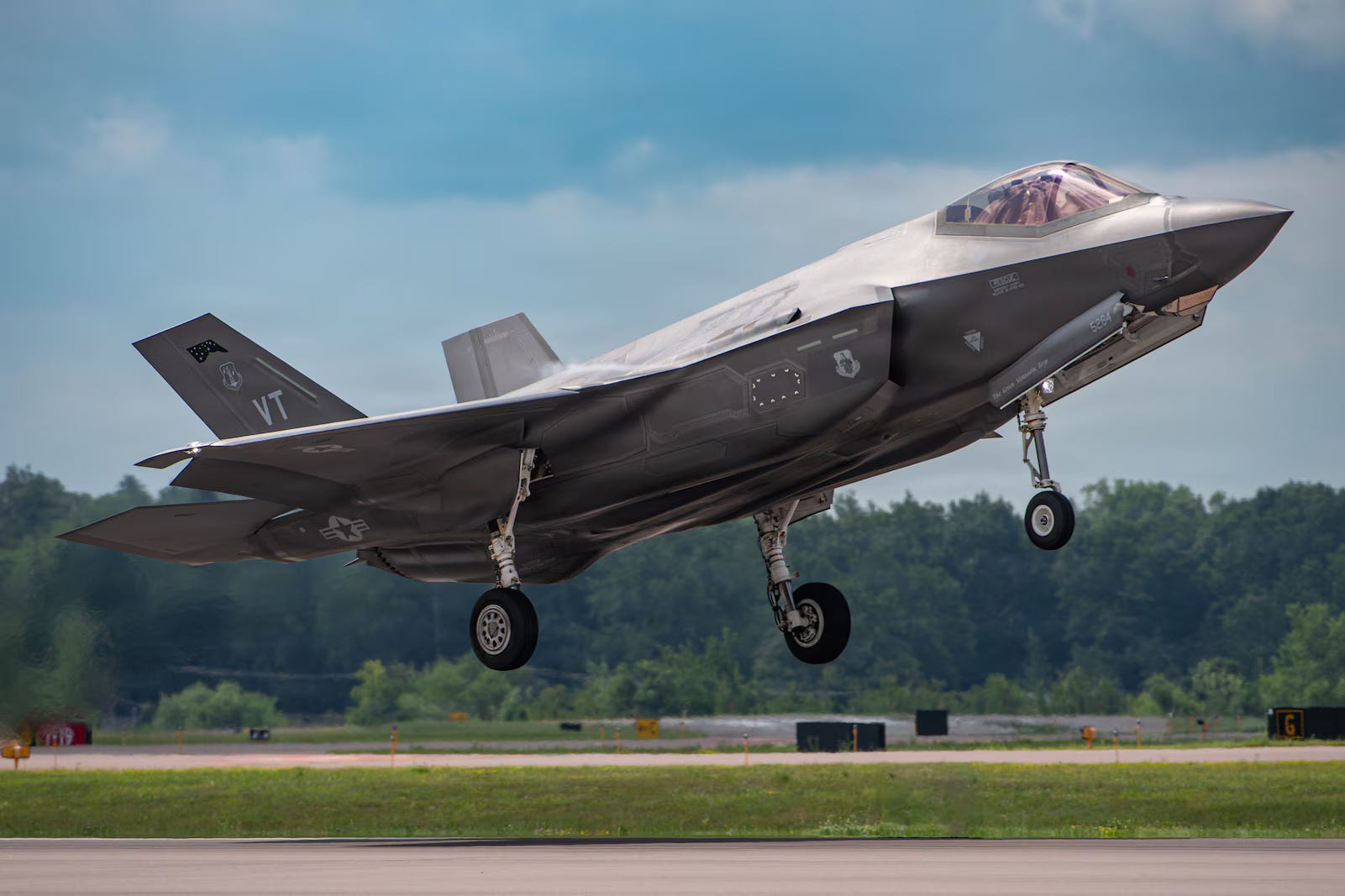
Vermont’s F-35s have started for home.
Eight jets from the 158th Fighter Wing landed at RAF Lakenheath in England on Sept. 4 on the first leg of the flight back to Burlington, according to The Aviationist, which tracked them in. The remaining four of the twelve Vermont jets that deployed to the Middle East in February are expected to make the same stop this weekend.
They are being relieved, not recalled. Air & Space Forces Magazine reported Friday that the Air Force is rotating fresh fighter squadrons into the region to free up units that have been there far past a normal tour, with F-16s from the Ohio Air National Guard’s 180th Fighter Wing among those heading in. U.S. Central Command did not respond to that publication’s request for comment.
The Vermont Air National Guard had not announced the return as of Friday evening. The wing told Compass in January that it would not release information until a mission is complete and everyone is back on base. Vermont is learning its own jets are coming home from flight trackers and aviation photographers standing at the fence in Suffolk, England.
How long it’s been
The Pentagon’s mobilization order was announced Dec. 12. Counted to Sept. 4, that is 266 days.
A National Guard air unit typically deploys for six months at a time, once every three years — about 183 days — Guard spokesman Joseph Brooks told Vermont Public in August. Vermont’s airmen are roughly three months past that. And members normally know their return date the day they leave. These didn’t.
How many Vermonters are still deployed is not publicly known, and the two officials who have addressed it gave different answers five months apart. In late March, Adjutant Gen. Henry Harder told Vermont Edition he could not confirm a number but put it somewhere in the hundreds. In an Aug. 19 report, Brooks put it at roughly 200. Compass reported in January that the Caribbean deployment involved approximately 1,000 citizen airmen. No exact figure has been released, and no updated count has been given since August.
Coming home also does not end the mobilization. The 158th is federalized under Title 10 — the section of federal law that puts a state’s Guard under the President’s direct command instead of the governor’s. Brooks said a mobilization of this kind can legally run up to two years. Nothing in the public record says the order has been lifted.
Gov. Phil Scott has said he has no say in it. “This is a federal issue. They don’t talk with us much about what they’re doing and what they’re not doing,” he said at a press conference this summer, adding that his administration continues to push for the unit’s return.
If you have someone in the 158th
Three things Vermont’s delegation asked the Pentagon to fix, and three things worth pulling up when your service member gets home:
Operational duty location records — where the paperwork says they were, month by month
Activation and deployment dates — the start and end dates written on the orders
Pay and tax treatment — whether combat-zone pay was actually treated as combat-zone pay
Family support and Guard contacts are at vt.public.ng.mil. Casework on federal pay and benefits runs through the Vermont offices of Sen. Welch, Sen. Sanders and Rep. Balint.
Four operations, one set of orders
What makes this deployment different from any the Vermont Guard has run before is not the flying.
The wing went out in December under Operation Southern Spear, described publicly at the time as a counternarcotics mission in the Caribbean. It rolled into Operation Absolute Resolve — the mission that ended with the capture of Venezuelan President Nicolás Maduro, which Compass covered in January — and then into Operations Spartan Shield and Epic Fury in the Middle East. Four named operations, one continuous set of orders. Compass reported the wing’s January return from the Caribbean; what the delegation established later is that the orders themselves never lapsed.
In a June 26 letter to Defense Secretary Pete Hegseth, Sens. Peter Welch and Bernie Sanders and Rep. Becca Balint wrote that the 158th was the first National Guard unit to transition directly across multiple named operations without a change in duty status — meaning the paperwork governing who they worked for, where, and under what pay rules never got reissued. The wing’s skills, they wrote, were requested by name.
The Pentagon’s personnel systems were not built for that. Each operation carried a different funding authority, and the handoffs were fast. The result, the delegation told Hegseth, is that Vermont airmen were credited to one operation in the records while flying missions for another.
That is not a filing problem. In plain English, the delegation says it has already produced:
Combat zone tax errors. Pay earned in a designated combat zone is exempt from federal income tax. If the record puts you somewhere else, you are taxed on money that shouldn’t be taxed.
Housing allowance gaps. Basic Allowance for Housing is keyed to duty location. Wrong location, wrong allowance.
Wrong deployment histories. The dates and places on the record are what VA benefits and Post-9/11 GI Bill eligibility get calculated from years later.
Pay and entitlement miscalculations, which the delegation said have put real financial pressure on families back in Vermont.
The delegation also wrote that they were disappointed reforms to prevent a repeat were left out of the Senate’s FY27 defense authorization bill as it came out of committee on June 11.
A Welch spokesperson said in August that the immediate pay and benefits problems had been resolved and that the senator would keep pushing for a long-term fix to the records. The delegation asked for a Pentagon response by July 24. None has been made public.
What the landing settles
The delegation closed its letter with the line that matters most to the families who will be standing at the fence in South Burlington: “Additional impacts may not be fully understood until members return to Vermont.”
The homecoming isn’t the end of the accounting. It’s the start of it.
Excellent reporting!