


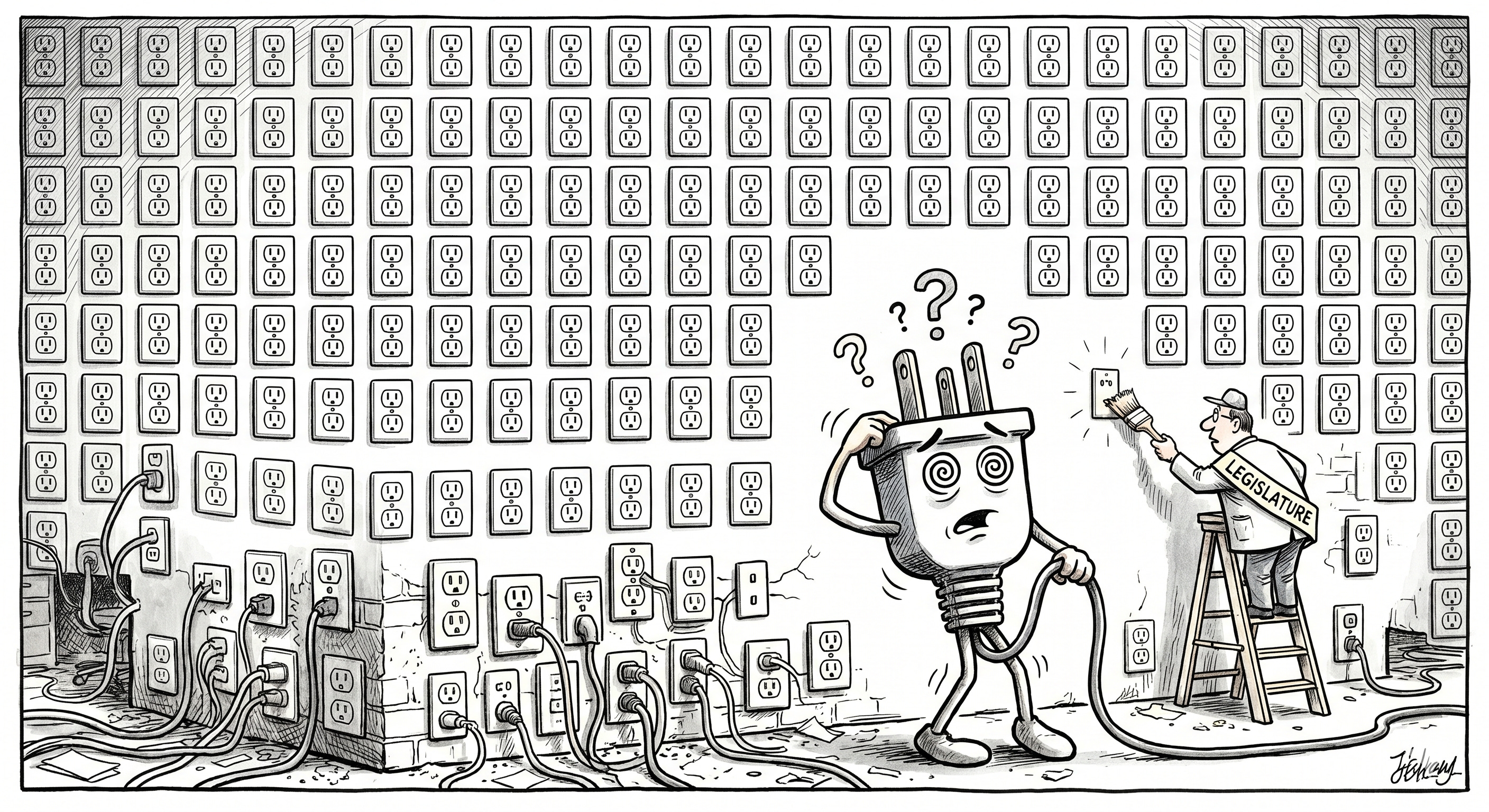
In March 2026, a program called Green Savings Smart quietly shut down. Run through Vermont’s Community Action Partnership, it did something most of the state’s energy programs don’t — it helped Vermonters across a range of incomes navigate the maze of weatherization incentives, heat pump rebates, and contractor decisions that determine whether a household’s heating bill goes down or stays stuck.
It worked. Then the money ran out.
Six weeks later, Peter Walke, managing director of Efficiency Vermont, sat before the House Committee on Energy and Digital Infrastructure and warned legislators not to build another program on top of the pile. Green Savings Smart, he noted, was born from a 2021 state report on energy savings counseling. “That is the report that said we should start Green Savings Smart,” Walke told the committee. “I don’t think a lot has changed since 2021 in terms of the needs from that report.” The needs haven’t changed. The program is gone.
The bill in front of the committee, S.219, would appropriate $35,000 — $25,000 to the Department of Public Service for a third-party consultant and $10,000 to the Climate Economy Action Center of Addison County — to design a new statewide energy navigator and coaching program. The consultant’s report is due in March 2027.
There is a reason Walke was worried. And it isn’t the $35,000.
The state’s own regulators already answered this question
On December 1, 2025, the Public Utility Commission delivered to the Legislature a report it had been directed to produce by Act 142 of 2024. The assignment was specific: study whether Vermont needs a statewide program to reduce energy burden for low- and moderate-income households and, if so, design one.
The PUC’s answer was unequivocal. Vermont needs help with energy burden — but not another program.
“The issue is not a lack of programs,” the PUC wrote. “The issue is a lack of funds.”
The Commission recommended that the Legislature “adopt a stable, long-term funding source to enhance the existing programs that address energy burden.” It proposed phasing in an increase to the fuel tax on heating oil, propane, and kerosene, with revenues directed to community action agencies’ weatherization programs. It recommended dedicating general fund dollars to expand LIHEAP benefits.
And it said this: “The creation of an overarching statewide program to address energy burden would not solve this complexity and could exacerbate it.”
The Commission went further: “Given the number and variety of programs currently available, the Commission does not recommend that the Legislature create another statewide program.”
S.219 was drafted on February 27, 2026 — 88 days after that report landed on legislators’ desks.
More than 100 programs, no front door
The PUC’s investigation identified more than 100 publicly funded energy programs currently serving Vermonters. They span federal, state, and local funding sources and include weatherization assistance, utility rebates, efficiency incentives, transportation programs, and various forms of energy cost relief. They are administered by different agencies with different eligibility requirements, different application processes, and different definitions of who qualifies.
Here is what the navigation landscape looks like right now for a Vermont homeowner trying to figure out how to lower a heating bill:
Weatherization Assistance Program energy coaches are embedded at the state’s five community action agencies. They serve households that meet WAP income eligibility — roughly 200% of the federal poverty level. Efficiency Vermont partially funds these positions.
Efficiency Vermont runs virtual home energy visits — 778 completed in 2025. These are statewide, available by appointment, and typically take about 90 minutes. The consultants are BPI-certified with engineering backgrounds.
The Climate Economy Action Center of Addison County operates an in-person energy navigator program with a program director and Middlebury College interns. It serves Addison County. This is the model S.219 would scale statewide.
Green Mountain Power, Vermont Electric Cooperative, Vermont Gas Systems, and Burlington Electric Department each operate their own rebate and incentive structures with separate eligibility criteria and program rules.
Green Savings Smart served a broader income range than WAP coaches and offered more comprehensive navigation than income-restricted services. It was funded by state ARPA dollars and a mix of partners. It is no longer operating.
Walke told the committee that building another program is “not as simple in my mind as a layering of a new activity over top. It’s the opportunity to look at how do we help people come through one door and access all of the available incentives.”
The metrics trap
The question behind the program graveyard is structural: why do the programs that serve the most vulnerable Vermonters keep dying?
Part of the answer is federal funding cycles. Green Savings Smart ran on ARPA dollars. When ARPA was exhausted, the program ended. The PUC’s Act 142 report noted this pattern explicitly: “A stable funding source is critical because federal funds that supported these activities are no longer available or are time limited.”
But there is a deeper problem embedded in how Vermont evaluates the performance of its energy programs.
Efficiency Vermont is a regulated energy efficiency utility. The Public Utility Commission sets its performance targets and evaluates its results based on metrics including cost per unit of energy saved and total resource benefits delivered. These metrics determine whether Efficiency Vermont is meeting its obligations, and they shape how it allocates its budget.
Walke told the House committee that the easier path is always to create new programs, but “what we should be thinking about is how to align those programs to be able to drive to shared outcomes.” He said he read S.219 as “suggesting an outcome that presupposes the results of an evaluation” — designing a new program before understanding what existing programs can do.
The cost dynamics reinforce his concern. Serving low- and moderate-income households raises per-customer costs and can reduce a portfolio’s measured cost-effectiveness. Weatherizing a poorly insulated 100-year-old farmhouse in the Northeast Kingdom costs more per BTU saved than upgrading a well-maintained home in a Chittenden County suburb. The household in the farmhouse has a higher energy burden. The household in the suburb generates better numbers.
Efficiency Vermont’s own 2023 Energy Burden Report acknowledges this tension directly. Programs supporting low-income households, the report states, are “largely driven by policy preferences of legislators and regulators and made possible by Efficiency Vermont balancing the overall budget impact of these programs against other programs that generate much higher” cost-effectiveness ratios. The report adds that the current cost-effectiveness focus “drives a different set of program priorities than would a focus on reducing energy burden.”
The same report found that towns and regions with high energy burdens did not use energy savings programs as much as towns and regions with low energy burdens. “These programs may not yet be reaching the customers who could most benefit from energy and cost savings,” the report concluded.
Efficiency Vermont has minimum low-income spending requirements — 11% of its electric resource acquisition budget and 17% of its total thermal budget. These floors exist precisely because the cost-effectiveness framework creates pressure to spend elsewhere.
The result is a cycle. The Legislature creates a pilot to serve low-income households. The pilot runs on one-time federal or state appropriations. The pilot works, but its per-customer costs look high compared to mainstream programs. The funding expires. The pilot dies. The Legislature creates another one.
The numbers behind the burden
The PUC’s Act 142 report puts the scope of the problem in plain terms.
The average Vermont household spends $7,071 per year on energy. Transportation accounts for 45% of that ($3,217), heating for 35% ($2,447), and electricity for 20% ($1,417). The statewide average energy burden — energy spending as a percentage of household income — is 11%.
Roughly 38% of Vermont households have incomes at or below 80% of area median income, and another 20% fall in the 80–120% range. Together, households with low and moderate incomes represent approximately 58% of all households in the state.
Energy burden varies dramatically by geography. Some census blocks in Vermont’s cities face extreme burdens: southeastern Barre City has a calculated energy burden of 44%, on a median household income of $13,550. Northwestern Rutland City is at 29%.
And the pressure is increasing. In 2022, approximately 1,600 utility customers owed arrears greater than $300 and faced disconnection. By 2025, that number had grown nearly 20%, to approximately 1,900.
Who trains the navigators?
There is another dimension to S.219 that received less attention than the structural questions but matters for any homeowner who would use the service.
Walke drew a distinction between the qualifications of Efficiency Vermont’s current navigators and the training models promoted by national organizations. “The 4-hour virtual training that Rewiring America provides isn’t the same thing as being BPI certified and the ability to speak technically on the issues at hand,” he told the committee.
Rewiring America’s Electric Coach program is a free, four-week training series designed to turn community volunteers into electrification advocates. BPI Energy Auditor certification requires a 100-question written exam, a four-hour hands-on field exam that includes combustion safety and carbon monoxide testing, and recertification with 30 continuing education units every five years.
These produce fundamentally different levels of competency. One creates community advocates who can talk about the benefits of heat pumps. The other produces professionals qualified to evaluate the specific conditions of a home and make equipment recommendations that affect safety and spending.
S.219 does not specify certification requirements for the navigators who would staff the program it asks the consultant to design. The bill directs the consultant to develop a program that would “advise residential consumers on accessing available grants, rebates, financing, and other assistance programs” and “help residential consumers connect to local contractors and review and analyze contractor recommendations regarding cost, payment, and other relevant factors.”
Walke’s point was that Vermonters interacting with navigators need to “come away with confidence in their answers and to be able to be supported through that process.” When asked about his own staff’s qualifications, he was direct: “They are BPI certified. They are engineers by training.”
What this means
Walke closed his testimony with a request that applies whether S.219 moves forward or not: “Please be thoughtful and careful when dealing with people’s homes, particularly for our most vulnerable residents.” He asked the committee to “prioritize the health, safety, and customer experience” and noted that many low-income Vermonters “are less driven by a desire to act on climate and more on their desire to save money and be able to keep their homes warm.”
He also described the current state of energy program coordination with a phrase that captures the absurdity of Vermont’s approach: the work, he said, involves “navigating the navigators.”
If you are a Vermont homeowner trying to lower your energy costs, more than 100 programs might help you — but there is no single place to find out which ones you qualify for, in what order to pursue them, or whether the contractor sitting in your kitchen is giving you good advice.
The programs that were designed to solve that problem keep getting built, defunded, and rebuilt. The regulatory metrics that govern Vermont’s energy efficiency system reward serving customers who need the least help— pressure that minimum spending requirements exist to counteract, but cannot fully eliminate. The state’s own utility commission studied this problem for a year and told the Legislature that the answer is stable funding for existing infrastructure — not another program.
The Legislature’s response was a $35,000 appropriation for a consultant to design another program, with a report due eleven months from now.
The PUC’s recommendation — a fuel tax increase dedicated to weatherization — is not a small ask. It requires political will to raise costs in the short term for long-term savings. It requires making low-income households whole through tax credits or rebates. It is the kind of structural investment that doesn’t fit neatly into a single bill session.
But neither does telling 1,900 Vermonters who can’t pay their energy bills that a consultant is working on it.
The full text of S.219 (Draft 1.3) is available on the Vermont Legislature’s website. The PUC’s Act 142 report (December 1, 2025) and Efficiency Vermont’s 2023 Energy Burden Report are available through the Legislature’s reports page and efficiencyvermont.com, respectively. Peter Walke’s testimony before the House Committee on Energy and Digital Infrastructure was delivered on April 13, 2026.
Peter Walke
https://www.veic.org/organization/team/peter-walke
It should be obvious by now that Vt is on the precipice of real trouble. Decades of liberal control and voters with their head in the sand are finally catching up with us.