


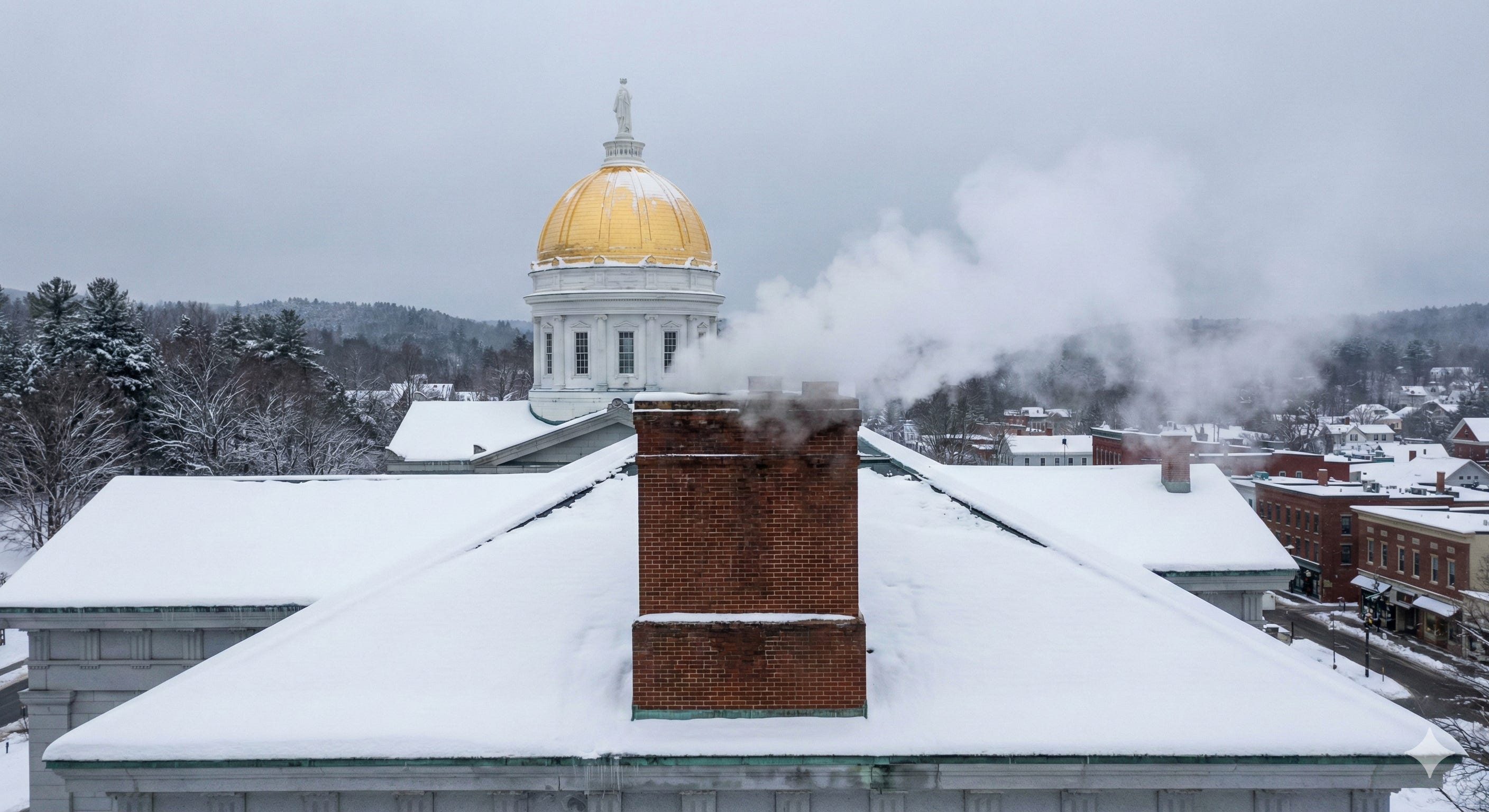
Vermont’s Department of Buildings and General Services cannot determine whether state government is meeting its energy reduction goals because it has stopped measuring progress altogether, according to a blistering performance audit released by State Auditor Doug Hoffer in January 2026. The findings arrive as Vermont faces the likelihood of missing its first legally binding greenhouse gas reduction deadline under the Global Warming Solutions Act, raising fundamental questions about the state’s capacity to implement its ambitious climate legislation.
$1.6 Million in Overstated Savings
The audit examined 13 energy efficiency projects completed by BGS between fiscal years 2018 and 2025, finding that the department overstated lifetime dollar savings by $1,666,511 compared to calculations by Efficiency Vermont, the state’s energy efficiency utility. VTDigger reported these discrepancies as “miscalculations,” but the audit reveals a more complex picture involving questionable accounting practices that allowed financially wasteful projects to proceed.
The Barre Courthouse and the “Bundling” Problem
The most striking example involves a lighting retrofit at the Barre Courthouse that cost $143,170 more than its expected lifetime savings. The project should have been rejected on its own financial merits, but BGS allowed it to proceed by “bundling” it with a cost-effective project at another location, making the combined portfolio appear profitable on paper. This cross-subsidization practice—which the auditor recommends the legislature reform—meant taxpayer dollars funded an efficiency upgrade that will never pay for itself, while the accounting system masked the loss.
A second project at 133 State Street in Montpelier similarly failed to deliver promised returns. These failures occurred even as state agencies spent approximately $137 million on building energy costs between 2016 and 2025, according to the audit.
Dramatic Decline in Project Completion
The energy efficiency program’s productivity has collapsed. Between 2016 and 2020, BGS completed more than eight energy projects per year on average. Over the last three fiscal years, that dropped to just one or two projects annually—an 87.5% reduction in output. This decline occurred despite Efficiency Vermont’s agreement to fund two energy project manager positions that have remained vacant since 2021.
Massive Gaps in Energy Tracking
BGS cannot provide a complete picture of state government energy use because huge portions of the state’s building portfolio are not tracked. The audit identifies 424 buildings owned by the Agency of Transportation, totaling 1,403,897 square feet, that are entirely excluded from energy monitoring systems. Additionally, leased buildings—which constitute 12% of state-occupied space—are not included in energy tracking, meaning BGS cannot work with private building owners to identify efficiency opportunities in that substantial portion of the state’s footprint.
Perhaps most significantly for Vermont’s climate goals, BGS has no system to quantify transportation fuel used by state employees. Transportation accounts for roughly 38-39% of Vermont’s total greenhouse gas emissions, making it the largest emissions sector, yet state government cannot measure or manage its own contribution.
Claimed Progress Built on Incomplete Data
The 2021 State Agency Energy Plan reported that Vermont was “on track to achieve a 40% reduction by 2025,” maintaining a requested 5% annual reduction. The 2026 audit exposes this optimism as unsupported, demonstrating that the data used to claim “on track” status systematically excluded transportation fuels, leased buildings, and the entire AOT portfolio. The state’s reported progress was an accounting illusion rather than measured reality.
Abandoned Accountability Requirements
BGS stopped submitting required biennial energy reports to the Secretary of Administration, according to the audit. This cessation of mandatory reporting allowed measurement failures to remain hidden from legislative oversight for years. The auditor characterized this as “sidestepping an important accountability lever” that prevented timely detection and correction of problems.
Agency Response: Staffing Crisis Acknowledged
Buildings and General Services Commissioner Wanda Minoli agreed with nearly all of the auditor’s findings, citing staffing shortages as the primary constraint. Despite Efficiency Vermont providing funding for two energy project manager positions, BGS has been unable to fill one or both roles since 2021.
Job listings from the 2025-2026 period reveal these are demanding positions requiring oversight of complex renovations in challenging environments like psychiatric and correctional facilities. The positions are classified as “limited service” appointments authorized only through June 30, 2027, which may have hindered recruitment in a competitive engineering labor market.
A Tactical Pivot: Controls Treasure Hunts
While the audit focuses on failed capital projects, BGS is attempting a new approach. The department’s 2026 report describes “Controls Treasure Hunts” where BGS and Efficiency Vermont investigate building control systems at facilities like the Rutland District and Family Courthouse to find “significant savings opportunities at a low upfront cost.” This shift toward operational tuning and sensor adjustments aims to recoup savings without extensive construction management—a recognition that the large capital project model has broken down.
Statewide Climate Targets in Jeopardy
The BGS audit coincides with broader concerns about Vermont’s climate commitments. The Vermont Climate Council’s January 2026 report to the General Assembly concludes that Vermont likely did not meet its January 1, 2025 emissions requirement—a 26% reduction from 2005 levels. While fuel sales for building heat decreased in 2024, gasoline and diesel sales for transportation increased, highlighting why the state government’s inability to track its own fleet fuel consumption is particularly damaging.
Federal Funding Cliff Approaches
The audit’s timing is critical. The Agency of Natural Resources notes that “unprecedented federal investment in climate action is abruptly ending,” requiring significant changes to financial assumptions. Programs like the Municipal Energy Resilience Program, which authorized $45 million in ARPA funding, are reaching the end of their obligation periods. If BGS cannot efficiently deploy available resources, remaining federal climate dollars will expire unused.
Meanwhile, wholesale electricity market prices in 2025 were “substantially higher” than the previous two years, putting upward pressure on utility rates. In this environment, the $1,666,511 in overstated savings represents not just accounting errors but tangible losses of anticipated fiscal relief for taxpayers.
Legislative Response Beginning
Lawmakers are responding to identified gaps in energy policy implementation. Some legislators have stated they lack a “detailed roadmap” to debate costly climate policies because of unreliable energy data. Bill S.65 proposes amending energy efficiency utility regulations to prioritize greenhouse gas reductions and mandate that at least 25% of annual budgets target low-to-moderate-income services, suggesting a shift toward more verifiable statewide programs rather than relying on internal government building management.
What Happens Next
The auditor’s recommendations require more than filling vacant positions. Fundamental reforms include:
BGS must expand data boundaries to integrate all 424 AOT buildings and leased space energy use into central tracking systems. Without this, the state cannot identify efficiency opportunities across its full footprint.
The department needs standardized savings methodologies aligned with Efficiency Vermont’s assessment frameworks to eliminate the $1.6 million calculation gap and prevent future overstatements.
A rigorous system for tracking state employee transportation fuel is essential both for meeting broader climate targets and demonstrating government leadership in the state’s largest emissions sector.
The practice of “bundling” projects must be reformed or eliminated to prevent fiscally wasteful upgrades from proceeding under portfolio-level accounting that masks individual project losses.
BGS must resume submitting biennial energy reports to the Secretary of Administration to restore legislative oversight and early detection of implementation problems.
The audit serves as a test case for Vermont’s broader climate policy challenge: the state has enacted aggressive environmental mandates but has not yet built the administrative infrastructure and measurement systems required to prove compliance or guide effective implementation. Whether the 2026 legislative session produces reforms that bridge the gap between statutory ambition and operational capacity will determine if Vermont’s energy reduction goals remain aspirational or become achievable.