


Act 75 reaches any digitally created or manipulated image of a candidate that injures the candidate’s reputation. It contains no requirement that the image be false. It also expressly protects satire — which raises the question at the center of a federal lawsuit: what happens when the state decides your joke isn’t one?
Vermont turned up in a Comedy Central segment on AI political ads on July 10, alongside Texas, Louisiana, Florida and Michigan. The framing was national and unkind: the 2026 midterms have produced a wave of machine-generated campaign video, most of it strange, some of it deceptive, all of it arriving faster than the law can sort it out.
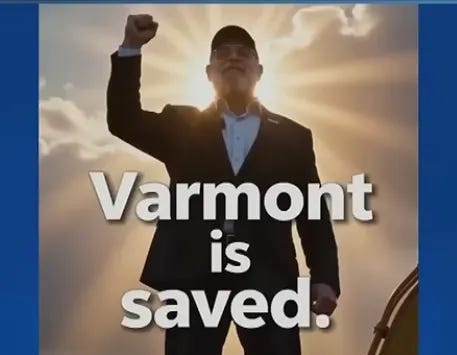
The Vermont entry was a 49-second video posted June 7 by Hank Poitras, a Brattleboro content creator who goes by “Planet Hank.” Using AI-generated likenesses of real people, it depicts U.S. Rep. Becca Balint (D-Vt.) making statements she never made, then shows Republican congressional candidate Mark Coester climbing into an excavator, scooping her up, and depositing her in a dumpster. Balint, in the video, is wearing a beret.
Editor's note: The video embedded above depicts U.S. Rep. Becca Balint and Mark Coester saying and doing things neither said nor did. It is AI-generated. Compass includes this statement because Vermont law requires publications to make it — a requirement explained below.
It ends on Coester, fist raised, above two words in enormous type:
Varmont is saved.
The state’s name is misspelled.
Vermont’s Attorney General is investigating that video. And the law she is investigating under is not what almost anyone — including, in its own correspondence, her office — has been calling it.
Start with the definitions
Every outlet in Vermont has described Act 75 as the state’s AI law. Read § 2031(2):
“’Synthetic media’ means an image, an audio recording, or a video recording of an individual’s appearance, speech, or conduct that has been created or intentionally manipulated with the use of digital technology, including artificial intelligence.”
Including. Artificial intelligence is offered as an example of digital technology, not as the boundary of the statute. The regulated category is digital manipulation, full stop.
Now read the trigger, § 2031(1)(A). “Deceptive and fraudulent synthetic media” means synthetic media that appears to a reasonable person to be a realistic representation of:
“(A) a political candidate that injures the reputation of a political candidate”
That is the entire prong. Three elements: it looks realistic, it depicts a candidate, it injures that candidate’s reputation.
Note what isn’t there. Prong (B), covering media aimed at influencing an election’s outcome, requires “materially false information to voters.” Prong (A) contains no falsity element at all.
Put the two together and Act 75 reaches any digitally created or manipulated realistic image of a candidate that damages that candidate’s reputation — whether or not it was made with AI, and whether or not it is false. A cropped photograph. A color-corrected still. A clip trimmed in editing software. Read as written, a true but unflattering image of a candidate, digitally altered in any respect, falls inside the definition and must carry the state’s disclaimer or qualify for an exemption.
Poitras’s lawsuit raises exactly this, asking whether the law extends to truthful but unflattering portrayals. The text does not foreclose it.
The intent requirement left somewhere along the way
S.23, as introduced and as passed by the Senate, defined the regulated category as synthetic media created “with the intent to injure the reputation of a candidate, to influence the outcome of an election, or to otherwise deceive a voter.”
Act 75, as enacted, dropped that language from the definition.
Intent survives elsewhere in the act — § 2032(a) reaches only a person who knows the media is deceptive, and § 2033 penalizes only knowing and intentional violations. But the category itself is now defined by effect rather than purpose. What the media does to a candidate’s reputation, not what its maker set out to do.
The change occurred between Senate passage and enactment. Both versions are public on the Legislature’s website.
Vermont wrote the exemption California didn’t have
This is the part that deserves to be taken seriously, because Vermont’s drafters were not careless. They were watching.
In October 2024, a federal judge blocked California’s AB 2839. Judge John Mendez found the law swept protected humor in with deception, called most of it “a hammer instead of a scalpel,” and held that forcing satirists to carry a state-written disclaimer was compelled speech that diluted their own message. The court also reasoned that the better response to a misleading deepfake is counter-speech — the subject publicly calling it out — rather than state enforcement. That reasoning is not binding in Vermont; it came from a district court in another circuit, on a preliminary motion, construing a different statute. But it is the reasoning Vermont’s law now has to survive. The case is before the Ninth Circuit. Minnesota’s comparable law is in First Amendment litigation headed for the Eighth.
Vermont’s Legislature heard testimony on precisely this problem across two sessions, including from at least one national free speech organization. It responded by requiring a label rather than banning content, by setting a 90-day window rather than California’s 120-before-and-60-after — and by writing an express carve-out into § 2032(b)(3):
The disclosure requirement does not apply to “a person that produces or distributes deceptive and fraudulent synthetic media constituting satire or parody.”
On paper, Act 75 may be the most carefully constructed law of its kind in the country.
Which is what makes what happened next the story.
If it’s satire, no disclosure was owed
On June 12, Attorney General Charity Clark’s office notified Poitras he was under investigation for potential violations of Act 75. As reported by Seven Days, VTDigger, and Vermont News First, the letter demanded written answers to 15 questions under oath, and told him the office would consider the matter closed if he brought the video into compliance — that is, if he added the caption. Compass has not independently reviewed the letter or the filings in the case.
But § 2032(b)(3) says that if the video is satire, no caption was ever owed.
Which means the Attorney General’s position, necessarily, is that the video is not satire.
A 49-second synthetic video in which a logger uses an excavator to deposit a beret-wearing member of Congress into a dumpster, closing on a misspelling of the state’s name, is — in the state’s view — a realistic representation that a reasonable person might take for a record of events.
That is the case. Not a formatting dispute. A question about who decides what a joke is.
What the law asks for
The disclosure is prescribed word for word, at 17 words:
“This media has been manipulated or generated by digital technology and depicts speech or conduct that did not occur.”
And under § 2032(a)(1), for video it “shall appear for the full duration of the video recording.”
Not an end card. Every second.
The Michigan ad in the comedy segment — whose AI disclosure ran at the end, and became the segment’s punchline — could not have complied with Vermont’s law in that form. The compliant version of the Poitras video is forty-nine seconds of a congresswoman being dumped into a dumpster with a government-authored sentence riding across the frame throughout, explaining that this did not really happen.
That is the compelled-speech question, and it is squarely the one California lost on.
The machinery
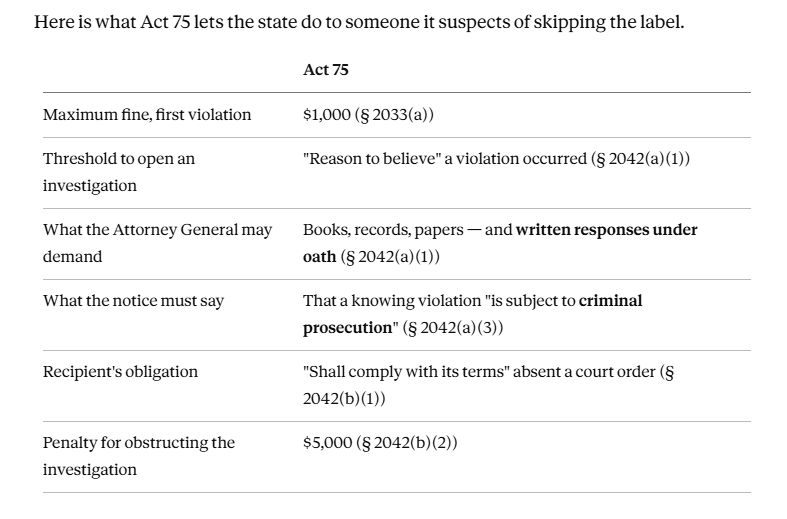
A thousand-dollar offense, investigated under oath, under a warning about criminal prosecution — and getting in the way of the inquiry costs five times more than the thing being investigated.
Poitras did not answer. On July 8 he sued Clark in federal court, represented by Brady Toensing — a former vice chair of the Vermont Republican Party who later served in the U.S. Department of Justice — and Texas attorney Matthew Hardin. The case is Poitras v. Clark, No. 2:26-cv-00234 (D. Vt.). Clark’s office has agreed to suspend the investigative demand while the parties brief the constitutional questions.
Poitras is not a sympathetic plaintiff. Vermont Public and others have documented a record of misogynistic and racist posts, and the chair of the Vermont GOP criticized him publicly this year. That is beside the point, and deliberately so. The machinery above is available against any Vermonter who posts an image the Attorney General has reason to believe crossed a line. First Amendment cases are rarely brought by people you would invite to dinner.
Both sides skipped a remedy the statute handed them
§ 2033(b) gives a candidate whose appearance, speech, conduct or environment is misrepresented the right to seek injunctive relief directly. Balint has that remedy available to her under the law as written. She has not used it.
§ 2042(d) gives any person aggrieved by a civil investigation an express route to Superior Court — and directs that such proceedings “shall take precedence on the docket over all other cases.” Poitras had a fast state remedy written into the statute. He filed in federal court.
Neither choice is improper. Both are choices. Expect the Attorney General to raise the second one.
Everyone is behaving predictably
Balint condemned the video publicly, calling it deceptive and dangerous and saying “this kind of deception has no place in our democracy.” She has pointed to the federal NO FAKES Act, which she co-sponsors, as the remedy. She did not ask the Attorney General to investigate, and there is no indication in the record that she did.
Coester — the video’s other subject, depicted operating heavy equipment against a colleague — told Seven Days he found it hilarious.
That is not a throwaway. Prong (A)’s trigger is injury to “the reputation of a political candidate.” Coester is a political candidate. He is depicted committing an assault on a sitting member of Congress. He is delighted. The lawsuit asks a question the state has not answered: who is to say Coester was not the one negatively depicted?
Clark’s office has declined to comment, citing pending litigation. The Solicitor General assigned to the case told Vermont News First that office policy bars him from discussing it.
Poitras wrote in a court affidavit that he is not willing to alter his satire to carry the government’s message, according to Vermont News First. His attorney says the right to mock political leaders is “not a privilege the government grants us.”
The question before the court
Roughly 30 states carry election deepfake laws into the 2026 midterms. The two tested hardest have not held.
Vermont drafted around those failures. Disclosure rather than a ban. A shorter window. An express satire carve-out. On the page, the state did the work, and Vermont now gets to find out something no other state has had to answer: whether a satire exemption protects anything when the government decides who qualifies for it.
Act 75 gives that decision to the Attorney General, backed by sworn interrogatories and a statutory warning about criminal prosecution, in the 90 days before an election. Vermont’s primary is August 11. The 90-day window opened May 13. Poitras posted on June 7. The law is live, the window is open, and the constitutional question is unresolved.
Varmont is saved. Whether Vermont’s law is remains a matter before the United States District Court.
Compass Vermont is independent and reader-supported.