


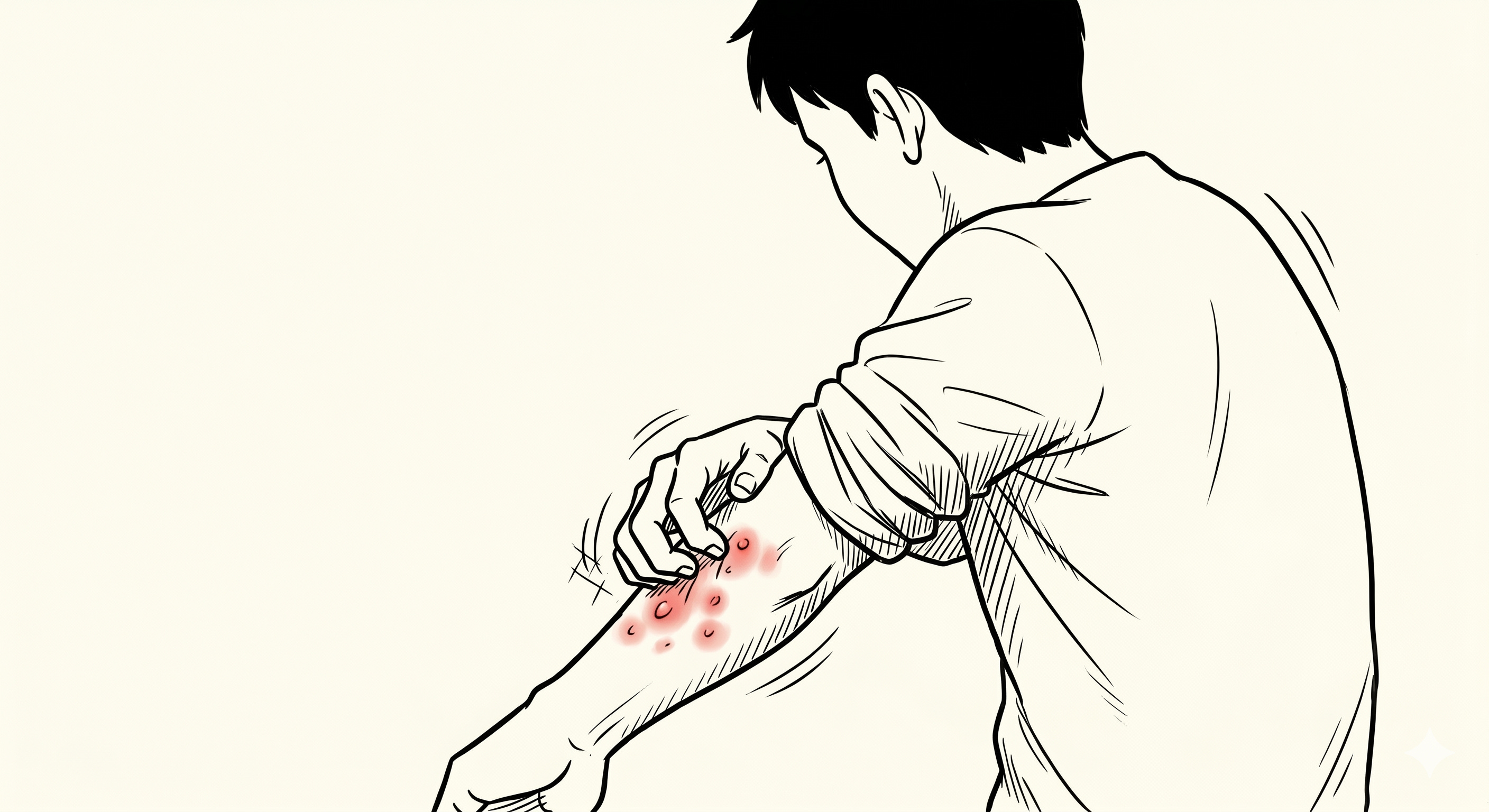
It happens every year around now. First warm weekend of the season, someone you know is at a cookout, half a beer in, absently scratching at a forearm or the back of a neck. By the time the burgers come off the grill, the conversation has turned to what got them. Was that a gnat? A no-see-um — are those the same thing? It’s too early for mosquitos.
What it almost certainly was is a black fly. And whoever got bitten will be telling people about it for the next three or four days, as the welts develop, harden, and itch with a persistence that mosquito bites never quite match.
Which raises the annual Vermont question: of all the things that bite you here between Memorial Day and Labor Day, which one is actually the worst?
The cast
Vermont has roughly five things that will bite you between May and October, and most of us don’t distinguish them very well. Here’s the lineup.
Black flies (family Simuliidae) are what most Vermonters call gnats. Small, dark, hump-backed, breed in running water — which Vermont has rather a lot of. Of the many species in the state, only a handful bite humans. These are the ones whose welts you’ll be picking at on Tuesday from a bite you got on Sunday.
No-see-ums (Ceratopogonidae) are biting midges. Tiny enough to pass through a standard window screen, which is how they end up in your bed at three in the morning. A different family from black flies, often confused with them.
Deer flies and horse flies are different sizes of the same problem (family Tabanidae). Deer flies are smaller and target your head; horse flies are larger, bite harder, and announce themselves with an audible drone. Both use cutting mouthparts rather than the surgical needle of a mosquito.
Mosquitos (Culicidae) need no introduction. Several species in Vermont transmit disease.
Ticks aren’t part of this. They’re arachnids, active year-round now, and plenty has been written about them elsewhere.
The calendar
The biters arrive in order, with overlap. Black flies come first, usually somewhere in mid-May, and they run for about six weeks before tailing off in late June. The folk rule is Mother’s Day to Father’s Day — roughly right in a normal spring, off in any year that delivers a late snowmelt or a warm April.
No-see-ums overlap with the back half of black fly season and linger into late summer, varying by where you live and how much damp ground sits nearby.
Deer flies and horse flies are the June-through-August act, peaking in July — precisely when most of us are trying to enjoy the outdoors.
Mosquitos cover everyone. They show up in May, they’re still here in October, and they are the long-haul biter of the Vermont summer — the one who’s still buzzing your ear after everybody else has gone home.
Ranking the misery
Most attempts to rank biting insects start with pain on the bite, which is the wrong question. Pain is one second. Misery is what happens for the rest of the week. A useful ranking has to account for four things at once: whether the bug announces itself, what the bite feels like in the moment, what the welt does afterward, and how long the itch lasts.
Walked through that way, Vermont’s biters sort out roughly like this.
Deer flies and horse flies win on pain. The bite is immediate, sharp, and usually draws blood. You feel it the instant it happens. You also hear the bug coming — both species drone, especially horse flies, which sound like a small engine on approach. The good news is you generally escape after one or two bites. The welts are angry but resolve in a day or two. Pain is real; misery is short.
No-see-ums win on per-bite intensity of itch. The bites are small — pinpoint red bumps, often clustered — but the itch is disproportionate to the size. They get into bedrooms through standard window screens, which is why they end up in stories about ruined nights of sleep. Volume is usually moderate; duration is two to three days. Pound for pound the most aggravating bite in the state, but they don’t usually swarm.
Mosquitos win on familiarity. The buzz announces them, the bite is barely felt at the moment (their proboscis is a surgical needle, not a cutting tool), the welt rises within an hour and peaks fast, the itch is the universal baseline most people calibrate everything else against. The arithmetic actually favors mosquitos: because you hear them, you swat them, which means most encounters end at one or two bites. The lone mosquito at 2 a.m. is its own special problem, but in daylight, the math holds.
Black flies win the overall misery crown — which is the answer most Vermonters would give without thinking about it, and the entomology backs them up.
They are quiet on approach. By the time you notice, four or five welts are already forming. Their mouthparts don’t pierce like a mosquito’s; they cut and pool the blood, which is why the bites sometimes leave a small dark center where the wound was. The welts develop slowly — sometimes over hours — then harden into raised, red, persistent bumps that can swell well beyond the bite itself. The itch is severe and runs for days, occasionally more than a week. Multiple bites can produce a systemic reaction medical literature calls “black fly fever” — not an infection, but the body’s response to the insect’s saliva — with low-grade fever, headache, nausea, and swollen lymph nodes.
So it is not that a single black fly bite is worse than a single deer fly bite — it probably isn’t. It’s that you don’t get one black fly bite. You get fifteen, you didn’t see them coming, and on Thursday you’re still picking at them.
One small thing in the black fly’s defense: its larvae require clean, well-oxygenated, fast-flowing water to develop. Every cloud of them you walk through is also evidence that the rivers beside you run clean and well-oxygenated. Of all the bugs in this lineup, only the black fly’s abundance flatters the state.
That is the misery hierarchy. Black flies first. No-see-ums second on per-bite intensity. Deer and horse flies third on pure pain. Mosquitos fourth — the familiar background hum of the Vermont summer.
A footnote
This is the misery ranking, not the disease ranking. Mosquitos win the latter alone — the only biters in this lineup that carry viruses Vermont actively surveils, and the reason the state runs a vector-tracking program at all. Black flies, for all the misery they cause, do not transmit disease to humans in the United States.
Then the bugs come back in their order. Black flies first. So do we, every May, surprised again.
At night, once it’s dark out, my walls are covered with tiny black bugs 1 - 3 mm long. They come thru the screens but they don’t seem to bite. Even if I turn all my lights out, if I’m reading my phone or kindle they will cover that screen. The last time this same thing happened to me was about 10 yrs ago, also in Vermont, but at a different location. Anyone out there have a similar experience ?
Deer flies! Those guys hurt!