


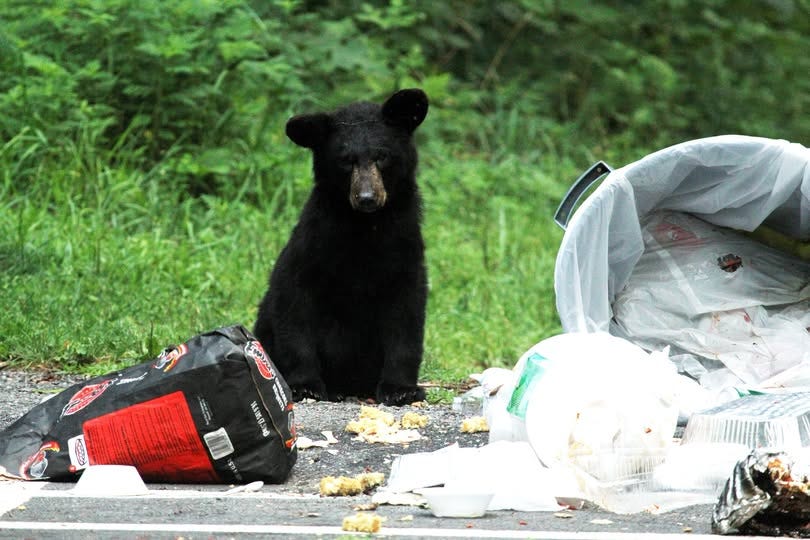
Six years ago this month, Vermont told you to stop throwing food in the trash.
If you didn’t want to pay a hauler or drive to a drop-off every week, the state’s answer was a compost pile or bin in your backyard. Maybe that backyard is a hillside with room to put the bin far from the house. Maybe it’s a half-acre village lot where “far from the house” means fifty feet from the kitchen door — and the tree line.
Vermont’s wildlife agency knew what that meant. It said so, in writing, in the ten-year management plan it was finalizing while the mandate took hold. The Legislature has never gone back.
That’s the whole story. Here’s the record.
What the law actually says
The composting mandate comes from Act 148 of 2012, the Universal Recycling Law. It phased in over eight years, and on July 1, 2020, it reached everyone: 10 V.S.A. § 6621a bans food residuals from the landfill, and the companion section, § 6605k, requires every generator — including every household — to separate food scraps and either compost them, manage them on site, or send them to a hauler or drop-off.
Two things about the law that are easy to miss:
First, the chicken bones. The question everyone asked in 2020 — what am I supposed to do with meat scraps? — has an answer, and it’s hiding in the definitions. Under § 6602(31), “food residual” does not include meat and meat-related products when a resident composts at home. Translation: if you compost in your backyard, your meat scraps and bones can legally go in the trash. State composting guidance discourages putting meat in a backyard pile — for odor, for pathogens, and for exactly the reason this piece exists. Households using a curbside hauler or a drop-off never needed the exemption; those services take all food waste, meat included. But for the backyard composter, the exemption is conditioned on composting at home, it appears nowhere on the trash can, and the state’s guidance for the days between pickups is to keep meat in the freezer until trash day.
Second, enforcement. There are no garbage police. Nobody is inspecting your trash, and the mandate works, to the extent it works, because Vermonters comply.
So the practical effect of the law came down to a choice. A household could pay a hauler, drive scraps to a drop-off every week, or take the free option: a compost pile or bin on the property. The state’s own bear plan predicted which way many Vermonters would go — more backyard composting, specifically to avoid the fees. For those households, food waste that used to leave the property in a sealed can every week now stays on it, and unless the pile or bin is managed to keep wildlife out, it stays reachable.
The warning, in the state’s own plan
The Vermont Fish & Wildlife Department’s 2020–2030 Big Game Management Plan — the ten-year document that guides the department’s bear management — was posted in draft in March 2020, took public comment through August 13, 2020, six weeks after the residential ban took effect, and was finalized in 2021. Its black bear chapter addresses the composting mandate directly.
The plan states that the mandated composting law could, “at least temporarily, increase problems statewide” without proactive measures aimed at reducing bear-human conflict. And it identifies the specific gap: the law has “no requirement for bear-proof food scrap containers.”
The plan also documents that this was not a prediction waiting to come true. It had already started. In the three years before the plan was drafted — while the mandate still applied only to large generators, before it reached a single household — the department had logged more than one hundred reports of bears damaging compost structures. The plan expected that number to rise as more Vermonters started backyard composting to avoid hauler fees.
Set that against the trajectory the same chapter records. In 1990, the department received 24 bear complaints statewide and counted 8 incidental mortalities. By 2016 it was 866 complaints and 203 incidental mortalities, 158 of them road deaths. The plan’s own characterization is that the rise was out of proportion to bear numbers: while the population roughly doubled since 1990, reports of bears causing damage and bears killed by means other than hunting increased twenty- to thirty-fold. The department wrote that the volume of bear-human interactions was already taxing it beyond its capacity to respond.
Into that trend, in that year, the state made food-scrap diversion universal — and its own wildlife plan flagged the missing safeguard by name.
What the Legislature did next
Here is what the Vermont General Assembly has done to these statutes since the ban took effect. This comes from the amendment history printed at the bottom of each section and the enacted text of each act — the public record of what passed, not of what was discussed.
§ 6605k, the food residuals mandate: untouched. Its last amendment is Act 208 of 2018, effective July 1, 2020 — the section has not been changed since before the residential ban took effect.
§ 6621a, the landfill disposal ban itself: reopened three times.
Act 58 of 2023 (H.67) added household hazardous products to the banned-materials list.
Act 152 of 2024 (S.254) updated the battery entries to match an expanded battery stewardship program.
Act 59 of 2025 (H.484) — a miscellaneous agriculture omnibus — moved the household-hazardous-products deadline from 2025 to 2026. One line.
Three reopenings of the exact statute. A new banned material, a list update, a date fix. List maintenance and deadline management. Nothing that touches food scraps, compost, containers, or wildlife.
The disposal ban’s one express exception for food residuals — for scraps collected at litter-cleanup events, subsection (d) — predates the residential requirement entirely: the amendment history shows it was in place by 2016 at the latest. The Legislature wrote that exception years before the ban reached households, and has added nothing to the section since.
The picture is the same from the other direction, with a caveat about method. The Legislature’s bill search is keyword-based and imperfect — it does not reliably surface every bill that touches a given statute section, and this review found bills it missed. What a Compass review of bear-related legislation across the 2021–22, 2023–24, and 2025–26 bienniums did surface was trapping and furbearer regulation, and bills concerning bears damaging agricultural crops. None imposed safeguards for residential food-scrap management. The one bill found proposing to amend the disposal ban outside the three enacted acts, H.292 of 2025, concerned PFAS in biosolids; as of this writing it has not moved since its first reading in February 2025. What committees discussed along the way isn’t captured in session law. What passed is — and none of it reached the gap the bear plan named.
Meanwhile the fix migrated to you. Fish & Wildlife’s guidance for composting in bear country: use three times as many browns as greens, keep the pile in a sturdy bin, take down your bird feeders — and if a bear does come, stop composting at home until it leaves the area or surround the bin with an electric fence. The statute mandates the diversion; the agency documents the risk; the resident buys the fence.
What can’t be measured — and what can
Honesty requires saying what this record does not prove. Nobody can isolate the composting law’s share of Vermont’s bear-conflict numbers, and this piece does not claim to. The bear population has grown and pushed into lower-elevation towns where more people live. Bears now occupy nearly twice as many Vermont towns as a few decades ago. Habitat has shifted, and the plan points to natural food supply as a driver of year-to-year swings — a bad berry or acorn year sends bears looking elsewhere, and the department expects drought and temperature extremes to make those years more frequent. 2020 also kept more people home, plausibly generating more household food waste. Changes in how conflicts get reported may account for part of the rise. And the plan notes that most Vermonters already composted before the mandate — the hundred-plus damage reports predate the ban precisely because voluntary compost was already drawing bears. That last point cuts both ways: it shrinks the mandate’s marginal contribution, and it means the state universalized a known attractant with the damage already in its own records. The plan’s own hedge — “at least temporarily” — is a hedge, and its account of rising conflicts is multi-causal. All of that is real.
But the argument here was never that composting caused Vermont’s bear problem. It is narrower, and every piece of it is documented: the Legislature made a known attractant universal and mandatory; the state’s own wildlife agency identified the missing safeguard in writing, in the ten-year plan it was finalizing as the mandate reached every household, with the damage already showing up in its records; and three legislatures since have opened the relevant statute three times without ever reaching it. State guidance on avoiding bear conflicts leads with trash cans and bird feeders — choices individual residents make. The record shows a third attractant the law extended to every remaining household, and a safeguard that one arm of state government named while another never wrote it into the statute.
What to watch
Three markers, going forward. The next Legislature convenes in January 2027; any bill addressing compost containers, wildlife-conflict funding, or small-lot accommodations would appear there first. The Fish & Wildlife Department’s current big game plan expires in 2030, and the drafting of its successor will show whether the department repeats the warning — or records that it was answered. And the household-hazardous-products deadline the Legislature pushed back by a year took effect on July 1 of this year — a reminder of how routinely this statute gets adjusted when someone asks.
The question this piece began with — did the composting mandate make the bear problem worse? — may never get a measured answer. The question the record does answer is narrower: the state’s own wildlife experts put the missing safeguard in writing, in a public plan, as the mandate reached every household. Six years of session law shows no one wrote it into the law.
Sources: Vermont Fish & Wildlife Department, Big Game Management Plan 2020–2030 (finalized 2021; bear chapter, pp. 29–35, composting discussion and quotes at pp. 30–31); Vermont Fish & Wildlife, Composting in Bear Country; 10 V.S.A. §§ 6602, 6605k, and 6621a with amendment histories (Vermont Statutes Online is an unofficial convenience copy); Acts 58 (2023), 152 (2024), and 59 (2025) as enacted; H.292 of 2025 bill status; DEC Universal Recycling.
Compass Vermont is independent and reader-supported.
The State stumbles where it has no business treading.
Not withstanding the list of stupid decisions Vermont’s lawmakers have made in recent decades and this is right near the top, voters own a big share of the blame. When you keep electing idiots and crooks, you get dumb laws and corruption. Vermont used to be known for its conservative, common sense government.....until liberal flatlanders migrated here and took over.