


Vermont is home to roughly 1% of the U.S. population. It produces nowhere near 1% of the country’s cheese by volume — Wisconsin alone accounts for about a quarter of all American cheese production. Yet when Food & Wine magazine published its list of the 25 Essential American Cheeses to Try Right Now in March 2026, Vermont claimed five of the 25 spots — more than any other state in the country.
Wisconsin, widely known as “America’s Dairyland,” placed four cheeses on the list. California, Pennsylvania, Connecticut, and New York each placed two. Oregon, North Carolina, Virginia, Indiana, Maryland, and New Jersey each placed one. Vermont, despite its size, led the field.
Why Vermont?
The state’s outsized presence on lists like this one is not accidental. Vermont leads the nation in artisan cheese production per capita, according to the American Cheese Society, which tracks the country’s estimated 663 artisan cheesemakers. The Vermont Cheese Council represents more than 40 cheesemakers across the state — a concentration that, relative to population and land area, is unmatched nationally.
The reasons are structural. Vermont’s small-farm dairy economy, challenged for decades by the economics of commodity milk production, drove many farmers toward value-added products in the 1980s and 1990s. Making cheese from raw milk became a way to survive — and in many cases, to thrive. The state’s cooler climate, pasture diversity, and deep agricultural tradition provided the raw materials. Institutions like the University of Vermont’s dairy science program and a culture of cheesemaker collaboration and education provided the infrastructure.
Food & Wine contributor Tenaya Darlington, who wrote the piece, has spent 15 years following the U.S. cheese scene and authored two books on the subject. In the article’s introduction, she notes that the 25 cheeses selected “embody the high quality and wide variety of styles of cheesemaking taking place across the U.S. today.”
The Five Vermont Cheeses
Cabot Clothbound Cheddar — Jasper Hill Farm, Greensboro
This is arguably the cheese that put Vermont’s artisan scene on the national map. In 2003, Cabot Creamery — a cooperative of Northeast dairy farmers — approached the recently founded Jasper Hill Farm about aging a special batch of cheddar at the farm. The result was Cabot Clothbound Cheddar, which won Best of Show at the American Cheese Society in 2006 and a Gold Medal at the World Cheese Awards in 2004, less than a year after its introduction.
The collaboration proved so successful that Jasper Hill brothers Andy and Mateo Kehler built the Cellars at Jasper Hill — a 22,000-square-foot underground aging facility with seven climate-controlled vaults — to scale the operation and eventually age cheeses for other Vermont producers as well. Food & Wine describes the cheddar as “earthy with notes of caramel” and calls it reminiscent of “the great cheddars of southern England.”
Calderwood — Jasper Hill Farm, Greensboro
Jasper Hill’s second entry on the list is an Alpine-style wheel rolled in dried hay — a technique that lends a grassy sweetness to the rind. Calderwood was created exclusively in partnership with the late Anne Saxelby, who founded Saxelby Cheesemongers in New York City as a dedicated showcase for American artisan cheese. The cheese won 1st Runner-Up for Best of Show at the American Cheese Society in 2018. Its inclusion on the Food & Wine list alongside the more widely distributed Cabot Clothbound reflects the range of Jasper Hill’s production — from large-scale collaborative cheddar to small-batch, retailer-specific wheels.
2-Year Cheddar (Extra Sharp) — Shelburne Farms, Shelburne
Shelburne Farms is a 1,400-acre nonprofit agricultural estate on the eastern shore of Lake Champlain, established in 1886 by Dr. William Seward Webb and Lila Vanderbilt Webb and converted to an educational nonprofit in 1972. Its cheesemaking operation, which began in 1980, relies on raw milk from a herd of approximately 125 purebred Brown Swiss cows raised on the property. The farm produces over 170,000 pounds of cheddar annually in varieties ranging from 6 months to 3 years of aging, all made by hand in small batches and non-GMO verified. The property is a National Historic Landmark and a Certified Humane dairy operation.
Food & Wine calls the 2-year extra sharp “the gold standard for sharp block Cheddar” — brightly acidic, fruity, and savory, produced on what was once a Vanderbilt estate. Shelburne’s cheesemakers have long described the cheese’s flavor as inseparable from the specific soil, grasses, and animals of this particular farm — a terroir argument more commonly associated with wine than with American cheddar.
Cornerstone — Parish Hill Creamery, Westminster West
Parish Hill Creamery is operated by Peter Dixon and Rachel Fritz Schaal in the small village of Westminster West in Windham County. Dixon has more than 40 years of cheesemaking experience, including work at Shelburne Farms and Vermont Creamery, and has consulted for dairy producers as far afield as Macedonia, Armenia, China, and India through USDA rural development programs. He and Fritz Schaal founded Parish Hill in 2013 with a specific philosophy: make cheese exclusively during the months when their milk cows are on pasture (roughly May through September), use no commercial starter cultures, and rely instead on cultures propagated from the raw milk of four individual cows from neighboring Elm Lea Farm at the Putney School.
The result has been described as the “natural wine” of American cheesemaking — highly localized, seasonally variable, and deeply tied to the specific microbiome of Westminster West. Parish Hill’s Cornerstone has won a Gold Medal at the World Cheese Awards (2022), and the creamery as a whole received two Super Gold awards at the 2024–25 World Cheese Awards — among only seven U.S. producers to receive that distinction. Food & Wine describes Cornerstone as “earthy and complex,” shaped like a paving stone and made without commercial starter cultures.
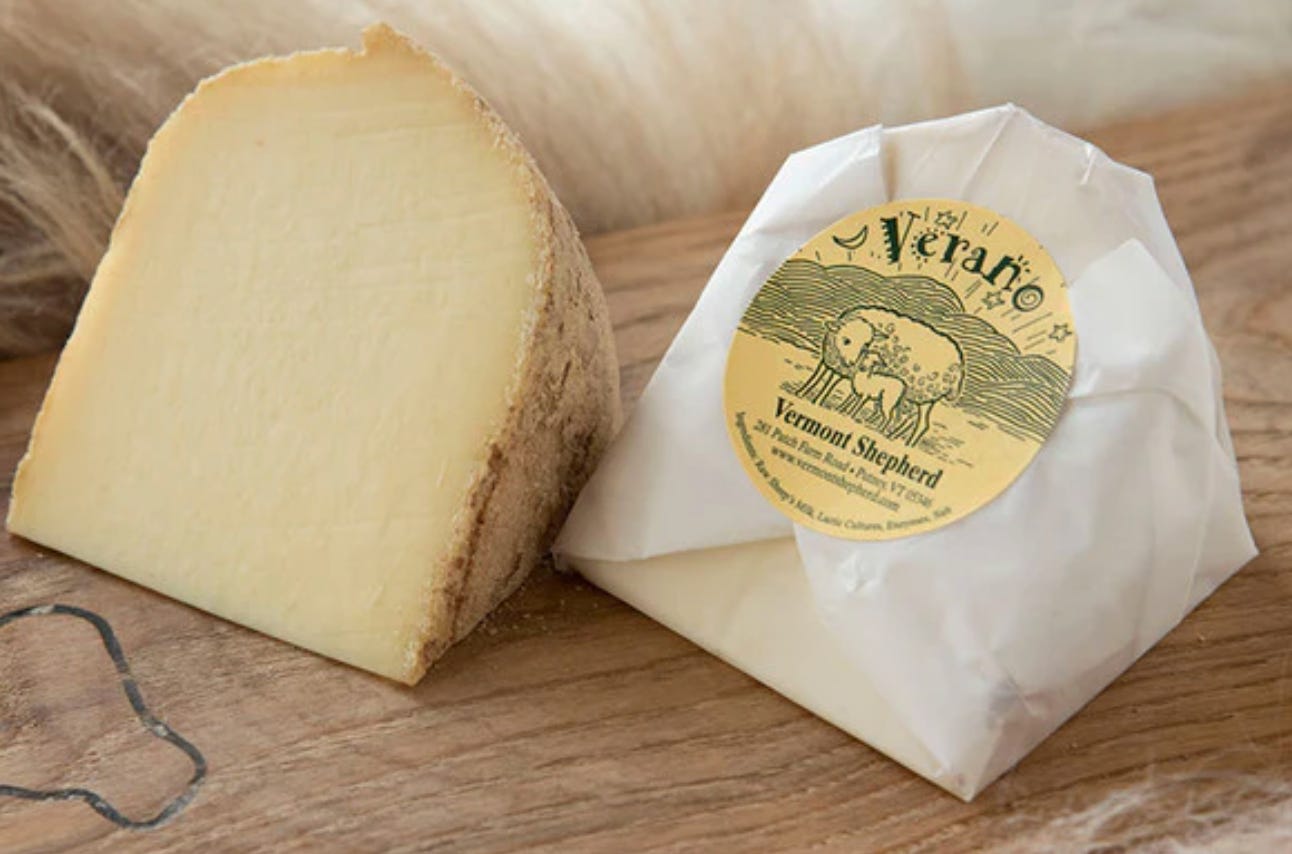
Verano — Vermont Shepherd, Westminster West
Vermont Shepherd is a 250-acre sheep dairy in Westminster West — the same small Windham County village as Parish Hill — operated by the Major and Ielpi families. It is widely considered the oldest sheep dairy in the United States, with the Major family having raised sheep on the land since 1965 and milking their flock since 1987. Owner David Major learned sheep’s milk cheesemaking by apprenticing in the Pyrenees region of France, then built a hillside cave on the farm’s property for aging wheels on wooden boards. The farm runs on solar panels, uses intensive rotational grazing with pasture moves every 12 hours, and has won two conservation awards for improvements to its soils, pastures, and water resources.
Verano — Spanish for “summer” — is made exclusively from sheep’s milk when the ewes are grazing on pastures abundant with wildflowers, grasses, clover, mint, and thyme. It ages three to five months in the cave before release each August. Food & Wine calls it “one of the few award-winning aged sheep-milk cheeses produced in the U.S.” and notes it is both “rich and herbaceous” with a “waxen texture” — a rare find, and best paired with red wine. Vermont Shepherd’s cheeses have won multiple Best in Show awards at the American Cheese Society dating back to its landmark first win in 1993 — a record of recognition that has made it one of the most decorated sheep dairies in the country.
What the List Suggests About Vermont’s Cheese Economy
The state’s five-cheese showing reflects something beyond individual craftsmanship. Vermont’s artisan cheese sector has built a distinct ecosystem: a university pipeline for dairy science education, shared aging infrastructure (Jasper Hill’s Cellars ages cheese for multiple producers), an active industry association, a dedicated consumer festival, and a history of mentorship in which veteran makers like Dixon have trained and consulted for dozens of other operations.
That ecosystem has also drawn national attention and distribution. Several of the Vermont cheeses on the Food & Wine list are available not just through Vermont retailers but through national specialty cheese shops, including Murray’s Cheese in New York City, which hand-selects wheels of Cabot Clothbound. The economic footprint extends beyond farm gates.
Vermont’s artisan cheese industry sits at the intersection of two of the state’s defining economic challenges — the long-term decline of commodity dairy farming and the need to develop higher-value agricultural products that can sustain small farm operations.
The producers on the Food & Wine list represent different responses to that challenge: a farmer-owned cooperative partnering with an artisan cave-ager, a nonprofit estate turning raw milk into a conservation mission, a minimalist natural cheesemaker working in a root cellar, and a multigenerational sheep dairy that built its own hillside cave.
Wisconsin makes more cheese. Vermont, it appears, makes a different kind of argument.
Sources: Food & Wine, Jasper Hill Farm, Shelburne Farms, Parish Hill Creamery, Vermont Shepherd, American Cheese Society, Vermont Cheese Council, Vermont Public, The Cheese Professor, Saxelby Cheesemongers