


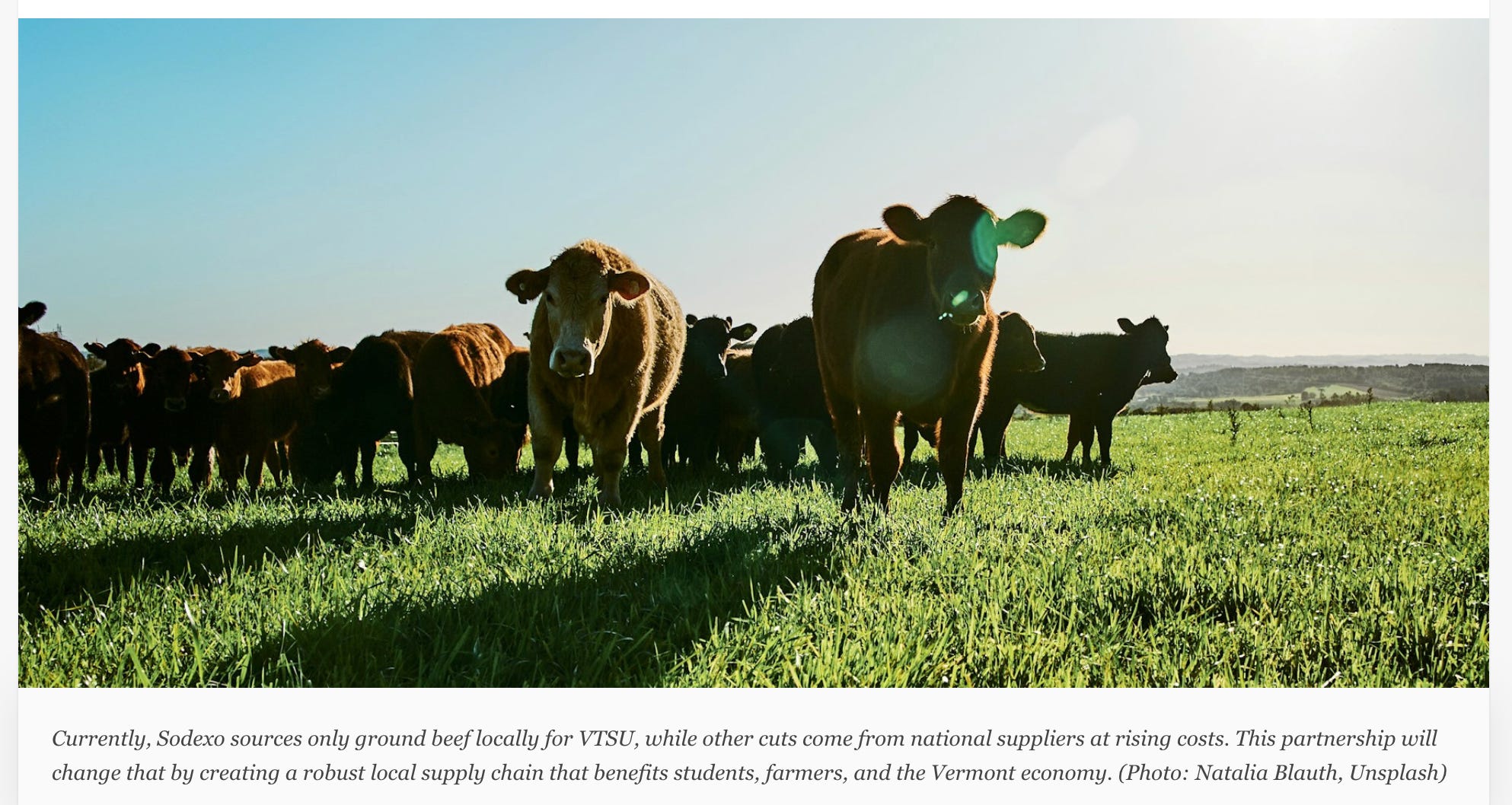
Vermont State University, dining services provider Sodexo, and the Northeast Grass-Fed Beef Initiative announced today an ambitious plan to build what they call a “fully established supply chain” for local grass-fed beef serving the university’s five campuses. The partnership, funded by a $98,540 grant from the Henry P. Kendall Foundation, aims to have the system operating independently by the end of 2027.
The project represents a significant commitment to local food sourcing in Vermont, but also faces a series of operational and financial challenges that will test whether such a system can survive without ongoing philanthropic support. A detailed analysis of the partnership reveals both promising educational opportunities and substantial economic hurdles.
Who’s Involved
The partnership brings together three organizations with different roles. Vermont State University, formed from the consolidation of the Vermont State Colleges system, provides the infrastructure through its newly constructed processing facility. Sodexo, the French multinational corporation that manages dining services on campus through its “Vermont First” program, will purchase and serve the beef. The Northeast Grass-Fed Beef Initiative, led by Executive Director Ridge Shinn, will coordinate cattle aggregation from local farms practicing regenerative agriculture.
A key element involves Shinn’s dual role. While leading the nonprofit NGBI, he also founded and runs Big Picture Beef, a for-profit company that aggregates and sells grass-fed beef to institutions. This overlap between nonprofit advocacy and private business raises questions about competitive bidding and whether philanthropic funds are effectively subsidizing a specific company’s business development.
The 1787 Butchery: Classroom and Processing Plant
At the center of the plan sits the 1787 Butchery, a facility that opened in May 2025 on VTSU’s Randolph campus. Described as a “living laboratory,” the butchery was built to address Vermont’s critical shortage of trained meat cutters through one-day workshops, longer apprenticeships, and student training programs.
This dual purpose—education and commercial production—creates what industry analysts call a “throughput paradox.” A commercially viable processing plant depends on speed and continuous operation to maintain thin profit margins. But a teaching facility must regularly stop production so instructors can demonstrate techniques and students can learn. Every hour spent teaching is an hour of lost commercial capacity.
The facility also processes deer for hunters during Vermont’s October-through-December hunting season, which coincides with the prime harvest window for grass-fed cattle at the end of the pasture season. Processing wild game alongside commercial beef requires strict separation to avoid cross-contamination and maintain USDA inspection status, further reducing available capacity during critical months.
The Price Gap
The partnership announcement cited “rising costs” from national suppliers as motivation for the switch to local sourcing. However, market data shows that Northeast grass-fed beef is significantly more expensive than conventional beef, even at today’s record-high commodity prices.
Ground beef from national suppliers currently costs about $6.25 per pound, while local grass-fed ground beef ranges from $10.46 to $12.87 per pound—a premium of 67% to 105%. Similar gaps exist across all cuts, with grass-fed ribeye steaks costing about $27 per pound compared to $16.49 for conventional beef.
If VTSU’s five campuses consume an estimated 20,000 pounds of beef per academic year, the price difference creates an approximately $100,000 annual deficit between conventional and grass-fed purchasing. The $98,540 grant would cover this gap for roughly one year of operations, leaving no clear funding mechanism after the grant expires in 2027.
VTSU’s current meal plans range from $5,506 to $8,388 per year. The higher costs of local beef would require either raising meal plan prices—politically difficult in higher education—or absorbing costs through smaller portions or menu changes.
The Whole Animal Challenge
The partnership plans to shift from purchasing specific cuts of beef to processing whole animals. While this approach supports farmers by ensuring they can sell entire carcasses, it creates significant logistical challenges for institutional dining.
A beef animal yields a fixed ratio of cuts: about 15% high-value steaks, 35% roasts and slow-cook cuts, 40% ground beef and trim, and 10% bones, fat, and organs. If a dining hall needs steaks for a special dinner, processing enough animals to meet that need also generates large quantities of roasts and ground beef that must be used quickly to avoid waste.
University dining halls typically operate on standardized cycle menus designed for predictability and efficiency. Managing the surplus from whole-animal processing often requires “grinding down” higher-value roasts into hamburger just to move volume, effectively paying roast prices for ground beef. This further increases the actual cost per pound of the final product served to students.
The challenge intensifies because Sodexo has committed to a 50% plant-based menu by 2025, meaning the university is simultaneously investing in beef infrastructure while its dining operator aims to serve less meat overall.
Seasonal and Biological Constraints
Vermont’s climate creates additional challenges for year-round grass-fed beef supply. The high-energy pasture needed to properly finish cattle for slaughter only exists during two narrow windows each year: the spring flush in May and June, and the fall flush in September and October.
During Vermont’s long winter—November through April—pasture lies dormant and cattle must subsist on stored hay. It’s extremely difficult to maintain weight gain, let alone properly finish animals, during these months. This means producers harvest most cattle in late autumn, requiring the supply chain to slaughter beef in November, process and freeze it, then store it for up to five months to serve spring semester diners.
The partnership announcement makes no mention of cold storage infrastructure or which entity—NGBI, the university, or Sodexo—will bear the capital costs of maintaining frozen inventory for half the year.
The Educational Mission
While the commercial supply chain faces significant obstacles, the workforce development aspect shows clearer promise. Vermont and the broader Northeast face a critical shortage of skilled meat cutters, with few training programs available. The 1787 Butchery directly addresses this gap.
From this perspective, the facility operates more like a teaching hospital than a commercial plant. Just as teaching hospitals perform procedures more slowly and expensively because they’re training residents, the 1787 Butchery will process meat less efficiently than a private facility—but with the benefit of producing trained butchers who can strengthen the regional food system.
The higher cost of beef processed at the facility might be better understood as an educational subsidy rather than a food cost. Students eating the burgers effectively help fund the education of the student butchers who processed them.
Environmental Considerations
The partnership emphasizes “regenerative” agriculture and grass-fed production as environmental benefits. The science on this remains complex and debated. Proponents argue that rotational grazing builds soil health and sequesters carbon, offsetting cattle emissions.
However, grass-fed cattle take significantly longer to reach market weight—24 to 28 months compared to 14 to 16 months for grain-fed cattle—meaning grass-fed animals live longer and produce methane emissions for an additional year. Some lifecycle analyses suggest grass-fed beef may have a higher methane footprint per pound of meat than conventional production.
The environmental tradeoff involves choosing between visible local land stewardship benefits versus global greenhouse gas efficiency metrics. The partnership prioritizes the former, though both considerations have scientific merit.
What Happens Next
The partnership has until the end of 2027 to establish what it calls a “fully independent” supply chain. Success will depend on resolving several key questions that remain unanswered in the public announcement:
First, how will the operation balance the 1787 Butchery’s educational mission with commercial processing demands? The facility cannot simultaneously maximize student learning and commercial throughput—one goal will necessarily take priority.
Second, what happens when the grant funding expires? Without a viable plan to bridge the 60-to-100% price premium between grass-fed and conventional beef, the partnership will face difficult choices: raise student meal plan costs, reduce beef purchases significantly, or seek ongoing subsidies.
Third, how will VTSU address the governance questions around NGBI leader Ridge Shinn’s dual role directing both the nonprofit coordinating entity and a for-profit company positioned to benefit from the supply chain? Clear procurement policies and competitive processes will be essential to maintain public trust.
Fourth, can the campus kitchens successfully manage whole-animal utilization within the constraints of institutional food service? Menu changes will be inevitable, with traditional steak nights likely giving way to meat-as-flavoring approaches like blended burgers and vegetable-forward dishes with beef components.
The partnership begins with grant funding covering one year of the price premium. By late 2026, whether the operation can truly become “independent” should be clear. If successful, the model could provide a template for other institutions seeking to strengthen local food systems. If operational and financial challenges prove too steep, the 1787 Butchery’s most lasting contribution may be the skilled meat cutters it trains rather than the volume of beef it processes for campus dining halls.
VTSU, Sodexo, and NGBI plan to begin operations in early 2026, with the supply chain expected to ramp up throughout the year. Students on the Randolph campus will likely see the first changes to their dining hall menus by fall 2026, as the partnership works through the initial challenges of coordinating farmers, processing schedules, and campus kitchens.