


At the bottom of this story, find the 988 crisis line, a free national referral line for treatment, and the community mental health agency that serves your area.
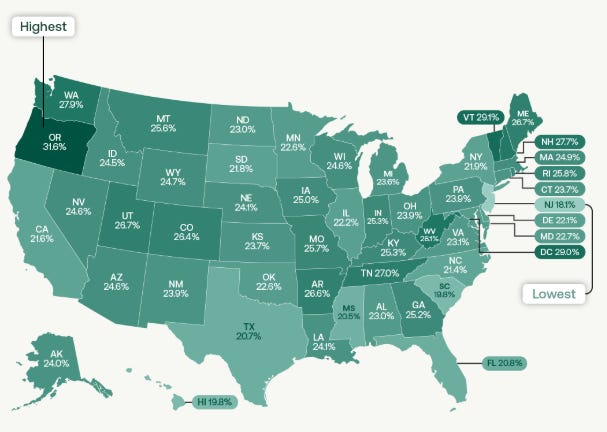
Mental Health America ranked Vermont third-best in the country for mental health on November 9. The same report puts Vermont next to last for the share of adults who experienced a mental illness. Nearly three in ten Vermont adults did in an average year. Only Oregon had a higher estimate.
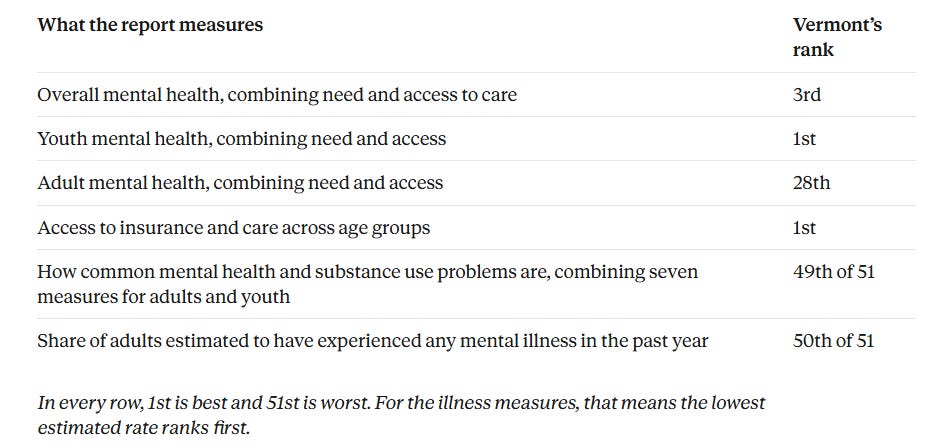
Vermont reached the top three on the strength of two measures involving children and on access to care, where it ranked first. For adults, weighing illness and care together, Vermont ranked 28th.
The difference starts with what earns a state a higher score. When schools identify more students who qualify for special education because of emotional or behavioral problems, the state’s score for access to care improves. A higher share of adults experiencing mental illness lowers its overall score. Vermont stands out on both measures.
Where Vermont Ranks
Mental Health America compares all 50 states and the District of Columbia. It combines 17 measures for the overall ranking. The other rankings group those measures by age or by the question they answer. The last row below shows the individual measure behind the headline.
How a Checkup and a School Plan Lifted Vermont’s Score
The report’s authors identify two measures that had the largest effect on Vermont’s overall score. One was an ordinary part of growing up. In the combined 2023–2024 survey, 89.7% of Vermonters ages 12 to 17 had a preventive health visit in the previous year. That was the highest share in the country. A routine checkup counts toward this measure.
The other was what happened at school. In the 2024–25 school year, Vermont identified 28.63 of every 1,000 students for an individualized education program under the federal special education category of emotional disturbance. That category covers students whose difficulties, such as persistent depression or an inability to build relationships with classmates and teachers, are pronounced, last a long time and affect their learning.
Nationally, the figure was 6.51 per 1,000, so Vermont’s rate was more than four times as high. An individualized education program, or IEP, spells out the services and supports a student is entitled to receive at school. The report gives states credit for identifying eligible students. The figures tell readers how often schools use that eligibility category. Measuring how many children experience mental illness takes a different survey.
More Than Four in Ten Young Adults
At age 18, a Vermonter appears on the adult side of the federal mental health survey. Among 18- to 25-year-olds, an estimated 41.4% in Vermont experienced a mental illness in the prior year, compared with 33.5% nationally. For illness serious enough to substantially interfere with daily life, the estimates were 15.5% in Vermont and 9.9% nationally. These figures describe the same age group over the same two years, 2023 and 2024. (Vermont tables)
Across all adults, the federal Substance Abuse and Mental Health Services Administration estimated that 154,000 Vermonters, or 29.1%, experienced a mental illness in an average year, compared with 23.1% nationwide. The survey’s margin of error puts Vermont anywhere from 25.9% to 32.6%, a range that overlaps several states near it in the rankings. Five of the ten highest estimates came from northern New England and the Pacific Northwest. They were Oregon, Vermont, Washington state, New Hampshire and Maine. The agency estimates illness from survey answers, so a Vermonter can count even if they have never seen a therapist or received a diagnosis.
What First for Access Means When Someone Needs Care
In 2025, Vermont had one mental health provider for every 170 residents, compared with one for every 290 nationally. That ranked Vermont sixth for providers per resident. The count tells a patient little about whether a nearby provider has an opening or takes their insurance. (Access-to-care rankings)
A separate survey asked adults about their mental health and whether cost had kept them from seeing a doctor. Among Vermont adults who reported at least 14 days of poor mental health in the previous month, 19.1% said there had been a time in the past year when they needed to see a doctor and could not afford to go. Nationally, 27.7% said the same. Vermont ranked third on that measure. Even so, nearly one in five Vermonters in that group had gone without a needed doctor’s visit. The question covered a visit to any doctor.
Vermont’s 2025 Household Health Insurance Survey asked specifically about putting off mental health care or counseling because of cost. Fifteen percent of uninsured Vermonters said they had, compared with 3% of insured Vermonters. Because far more Vermonters have coverage, insured residents made up roughly seven in eight of the estimated 25,000 people who put it off. The report’s two tables give slightly different totals, 24,600 and 25,100.
In 2024, 29.1% of Vermont adults received mental health treatment, the fourth-highest share among the states and D.C. Nationally, 22.9% received treatment. Those figures count everyone who got treatment as a share of all adults.
Vermont’s own health plan tracks a question closer to what a family wants to know. Of the adults who have a mental health condition, how many get treatment? The state’s last estimate from the federal survey, covering 2017–2019, found that 58.7% of Vermont adults with a mental illness received mental health services in the previous year, compared with 43.6% nationally. The state has since changed how it measures this and says its newer figures can’t be compared directly with the earlier ones.
Neither the federal survey nor the rankings explain why Vermont’s estimated illness rate is so high.
Related Compass Vermont reporting from April examined how statewide health rankings can obscure differences between rural counties and Chittenden County: Vermont’s Health Ranking: Great for Headlines, Harder for Rural Families
Where to Find Help in Vermont
In a crisis or emotional distress: Call or text 988 to reach the 988 Suicide & Crisis Lifeline.
To find treatment for mental health or substance use: Call the SAMHSA National Helpline at 1-800-662-4357. It offers free, confidential referrals around the clock in English and Spanish.
For care close to home: Use the Vermont Care Partners agency map to find the community mental health agency that serves your area, then contact it directly. The map works best on a computer. On a phone, use the agency list on the same page.
Compass Vermont is built on giving you the information and the next step so you can decide for yourself. If you find that useful, a paid subscription is the best way to support us, and it’s greatly appreciated.