


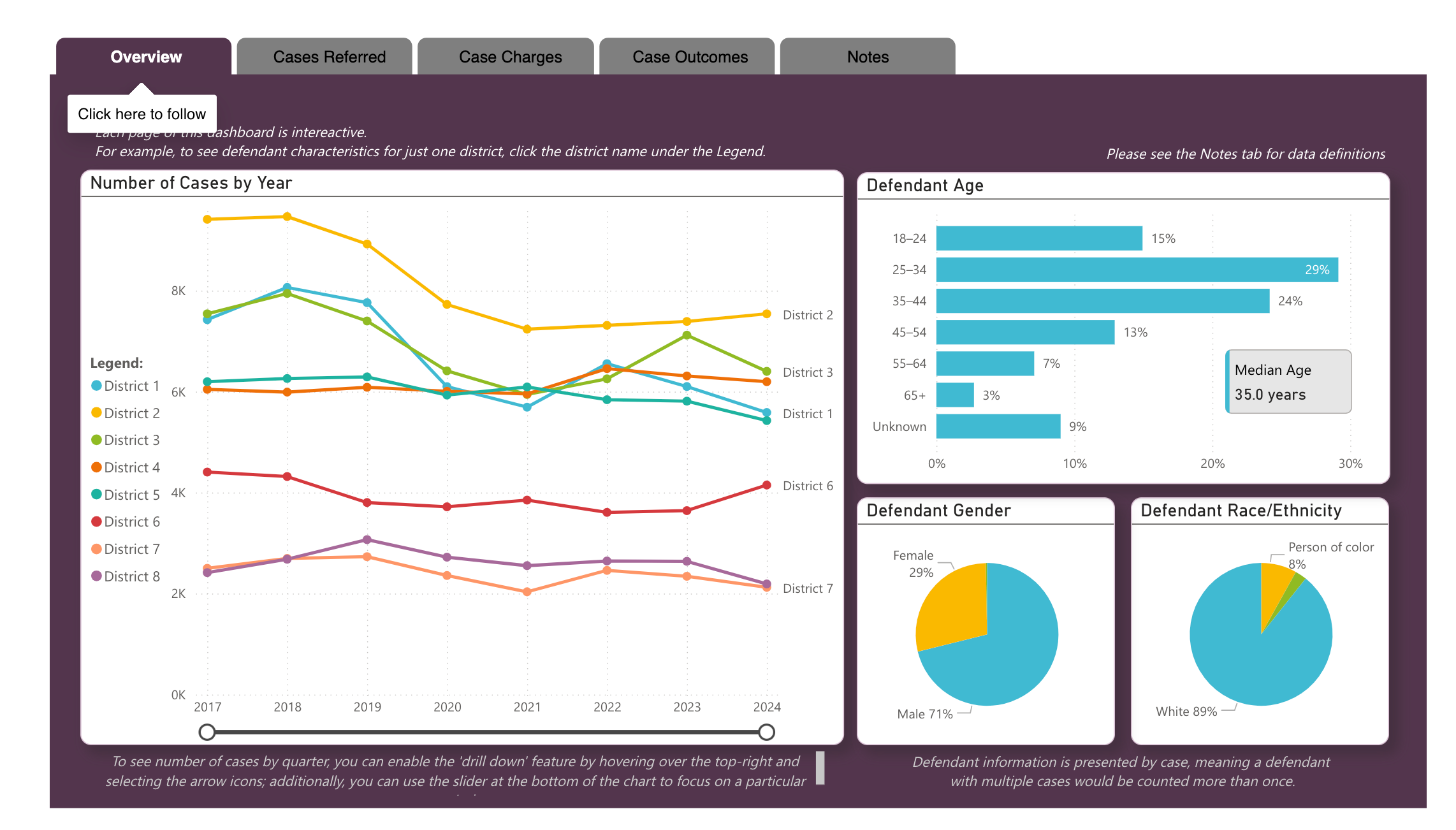
The office that decides who gets charged with crimes, who gets offered bail, and who goes to prison in Chittenden County operates largely outside public view. While State’s Attorney Sarah George has implemented nationally recognized progressive policies on issues like cash bail and traffic stop prosecutions, her office provides minimal public data about the outcomes of those policies—a sharp contrast to how prosecutors in other reform-minded jurisdictions operate.
A comprehensive analysis comparing Vermont’s prosecutorial transparency practices to peer jurisdictions reveals what researchers call a “transparency paradox”: while Chittenden County has adopted cutting-edge criminal justice policies, it operates what critics describe as a “data vacuum” that makes objective public evaluation of those policies nearly impossible.
How Baltimore Does It
The Baltimore City State’s Attorney’s Office under Ivan Bates illustrates a dramatically different approach to public accountability. In April 2024, Bates released a 23-page strategic plan that identified “Transparency” as a core pillar alongside Fairness and Accountability, committing to specific mechanisms of disclosure rather than general promises.
The centerpiece of Baltimore’s approach is an interactive data dashboard built on Microsoft Power BI that provides unprecedented public access to prosecutorial operations. The tool allows users to filter data by arrests and indictments, track unit-specific performance for divisions like the Homicide Unit or Gun Violence Enforcement Division, examine convictions and sentences, and analyze longitudinal trends comparing performance across years.
When Baltimore officials released their 2024 accountability analysis, they could cite specific, verifiable numbers: 1,064 violent offenders removed from Baltimore’s streets and a 22 percent decrease in homicides. The city’s mid-year 2025 crime report showed a 24.3 percent decrease in homicides and 18.3 percent decrease in non-fatal shootings, with a homicide clearance rate of 64.3 percent.
Baltimore’s transparency extends beyond numbers to qualitative explanations. The office publishes detailed reports explaining why it declined to charge police officers in use-of-force incidents, transforming controversial “no charge” decisions into publicly available legal arguments.
Vermont’s Legal Framework: What’s Required vs. What’s Chosen
Vermont’s transparency obligations are governed by the Public Records Act, which begins with a broad presumption that “all public records are open to public inspection.” However, prosecutors operate under significant exemptions.
The “investigative privilege” exemption protects records dealing with the “detection and investigation of crime” if their release would interfere with enforcement proceedings, deprive someone of a fair trial, constitute an unwarranted invasion of personal privacy, or disclose confidential sources. State’s Attorneys often interpret this exemption to cover almost their entire case files.
A separate exemption strictly protects “personal data of a victim or witness of child abuse, domestic violence, human trafficking, sexual assault, violent felony, or stalking.”
The Vermont Legislature attempted to address these limitations through H.382, the Vermont Justice Transparency Act, which would have required prosecutors and other criminal justice agencies to collect and publicly post data on pretrial release determinations, sentencing, and case diversions, broken down by demographics and county. The bill died in committee during the 2023-2024 session, leaving Vermont in a state where transparency remains almost entirely discretionary.
What Chittenden County Provides
State’s Attorney Sarah George has publicly stated that she “went to law school to dismantle the criminal legal system” and has implemented several distinctive policies, including declining to prosecute charges from non-public safety traffic stops and eliminating requests for cash bail.
These policies are released as written memos, some available through the ACLU, but the outcomes of these policies are not tracked publicly. There is no dashboard showing how many people were diverted under the buprenorphine policy, how recidivism rates compare for people released without bail versus those who post bond, or how racial disparities in traffic stops changed following the 2022 policy.
When The Rake Vermont requested data on charges from 2017-2022 to analyze the office’s record on race, they received 1,700 pages of data in an uneditable PDF format. The office stated the data was “not available in an easily searchable spreadsheet.”
The Technology Challenge
Vermont’s criminal justice system operates on three separate, non-integrated software platforms that don’t efficiently share data with each other.
Police agencies use Valcour, a Computer Aided Dispatch and Records Management System that tracks initial incident reports and arrests but doesn’t follow cases beyond the police handoff to prosecutors.
The Department of State’s Attorneys uses JustWare to track charging decisions, plea offers, and victim interactions. When officials have claimed difficulty extracting aggregate data from JustWare, technical experts note this is contentious since JustWare is a SQL-based system that should support data exports.
The Vermont Judiciary uses Odyssey, which tracks court filings and final dispositions but cannot capture prosecutorial decisions that happen before cases reach court, such as declinations to charge.
Creating a unified dashboard would require middleware solutions to pull data from all three systems—a project requiring funding and coordination that the legislature has not yet provided.
The Maine Comparison
Vermont prosecutors sometimes argue they cannot be compared to major cities like Baltimore because they lack resources and population scale. This makes the comparison with Maine particularly significant.
Maine is also a small, rural state with a similar population to Vermont and also uses the JustWare case management system. Despite these similarities, Maine has established a statewide Prosecutorial Data Dashboard created in partnership with the Maine Statistical Analysis Center. The tool tracks cases referred, charges filed, and outcomes from 2017 to the present.
Cumberland County, Maine’s most populous county encompassing Portland, operates under prosecutor Jacqueline Sartoris and demonstrates that small-state prosecutors can extract data from JustWare and publish it while respecting privacy concerns.
Other jurisdictions have adopted standardized Prosecutorial Performance Indicators, including Cook County (Chicago) and Philadelphia. Vermont is not a participant in this national project.
The Battle of Narratives
Without trusted public data, discourse in Chittenden County has become what researchers describe as a “war of narratives” between law enforcement and the prosecutor’s office.
Police unions and chiefs have criticized George’s policies. During her 2022 reelection campaign, law enforcement went “all in” for her opponent. A Winooski police officer was recorded telling residents that neighborhood crime was “the product of Sarah George’s super-progressive, soft-on-crime approach.”
George has pushed back against police criticism, even issuing Brady letters indicating she won’t accept cases from officers with credibility issues.
In a recent community safety update, Burlington officials discussed ongoing public safety concerns, but without prosecutorial outcome data, the public cannot verify competing claims about recidivism rates or the effectiveness of diversion programs.
The ACLU of Vermont, typically a supporter of progressive reform, has found itself in the position of pressing prosecutors for data. The organization notes that State’s Attorneys “decide if someone will go to prison... yet do not currently release data on the decisions they make.”
The Privacy Argument
The most consistent defense of limited transparency is privacy protection. In a small state, officials argue, granular data can inadvertently identify individuals.
The concern centers on the “small N” problem: if a dashboard reports one person of a specific demographic charged with a particular crime in a small town, and only one person matching that description lives there, the data has effectively identified them despite being presented in aggregate form. This “mosaic effect” is a legitimate consideration in small jurisdictions.
Vermont’s victim privacy statutes strictly protect personal data of victims in cases involving child abuse, domestic violence, human trafficking, sexual assault, violent felonies, or stalking. Prosecutors often cite these statutes when denying broad data requests.
Governor Phil Scott’s recent veto of the Vermont Data Privacy Act (H.121) reflected broader political culture in Vermont that remains cautious about data collection and aggregation, though that bill focused on consumer data rather than criminal justice.
Transparency advocates counter that the privacy argument doesn’t justify current opacity levels. Standard data practices used by the Census Bureau and health departments involve suppressing data cells with fewer than five or ten individuals. Reporting that “Chittenden County dismissed 30 percent of drug cases” poses no individual privacy risk. Maine’s dashboard likely employs similar suppression rules.
Vermont’s Decentralized Structure
Vermont has 14 counties, each electing its own State’s Attorney. While the Department of State’s Attorneys and Sheriffs provides administrative support for budgeting, IT, and HR, the State’s Attorneys themselves are constitutional officers with significant autonomy.
This structure creates what researchers call a “transparency patchwork.” Unlike Baltimore, where a single State’s Attorney can mandate office-wide data practices, Vermont relies on 14 independent officials to voluntarily adopt transparency measures, or on the legislature to mandate them statewide. Most Vermont State’s Attorneys provide minimal public data, though some participate in community meetings and contribute to annual town reports.
The Vermont Judiciary publishes court statistics and reports, but these track judicial activity rather than prosecutorial decision-making that occurs before cases reach court.
What Happens Next
The failed H.382 legislation demonstrates that political will to mandate transparency has not yet overcome bureaucratic and resource-based objections. Without legislative action, transparency remains discretionary for each of Vermont’s 14 State’s Attorneys.
The contrast with peer jurisdictions suggests three potential paths forward for Vermont:
First, the legislature could revive and pass a version of H.382 that mandates publication of aggregate criminal justice data with appropriate privacy protections built in through data suppression rules.
Second, the state could fund a technological solution linking the three separate data systems—Valcour, JustWare, and Odyssey—automating data flow to a public dashboard similar to Maine’s model.
Third, individual State’s Attorneys could voluntarily adopt transparency measures using existing technology, as Maine prosecutors have done with the same JustWare system Vermont uses.
The question facing Vermont is whether criminal justice policy should be evaluated through public data or public trust. Baltimore has demonstrated that progressive prosecution and transparency are compatible. Whether Vermont follows that model remains an open question as debates over public safety, prosecutorial discretion, and democratic accountability continue.
I am not sure why you would single out the Chittenden County SA, insinuating that they have something to hide. Also, it's a resource issue. Not everyone can do a data extraction and none of these offices has dedicated data folks.