


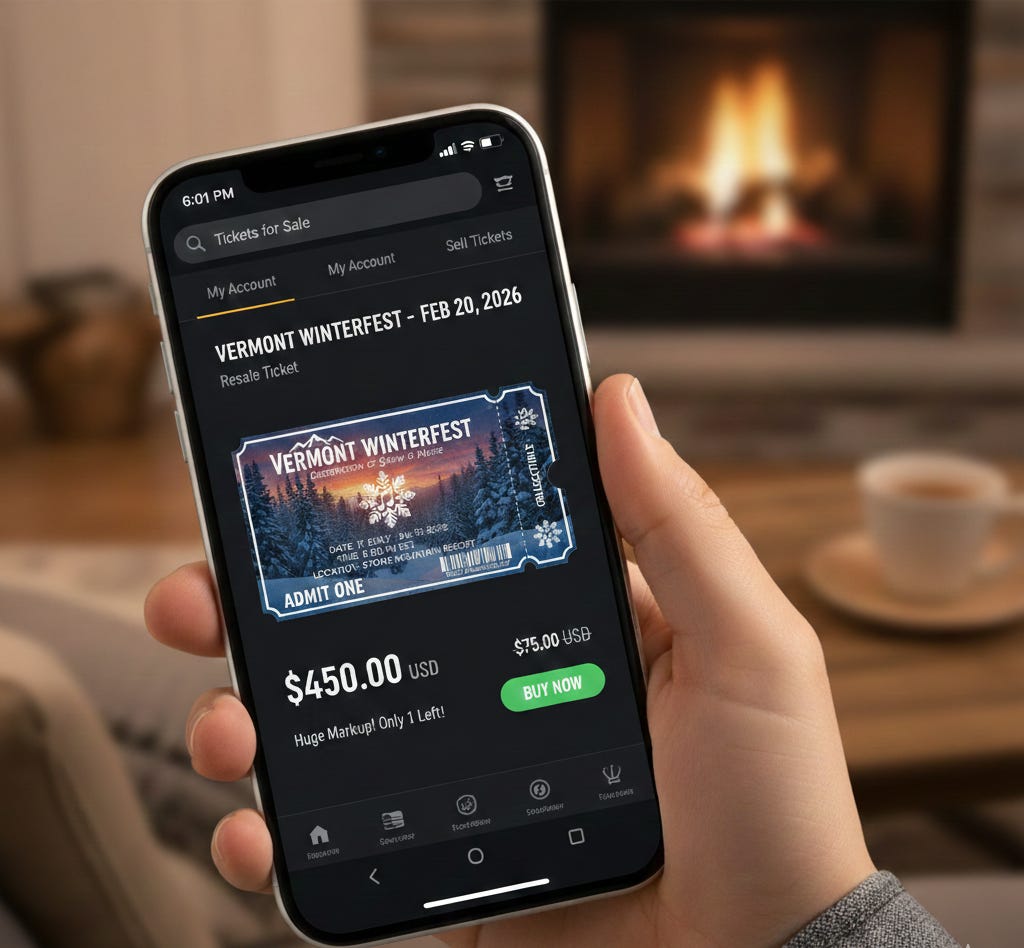
Vermont’s House Committee on Commerce and Economic Development is advancing legislation that would impose some of the nation’s strictest regulations on the online ticket resale market, following similar action taken by Maine last fall.
On January 29, 2026, the committee examined a comprehensive rewrite of House Bill H.512, originally introduced in April 2025, that would create new consumer protections governing how tickets to Vermont events can be resold. The legislation targets practices lawmakers say have harmed both consumers and the state’s creative economy, including price gouging, deceptive websites, and the sale of tickets that don’t yet exist.
What the Bill Would Do
The strike-all amendment — a legislative tool that replaces a bill’s entire original text with new language — would add a new section to Vermont’s Consumer Protection Act specifically addressing event tickets.
Under the proposed framework, ticket resellers would face several new restrictions:
Price Limits: Resellers could not charge more than 110% of the original ticket price, including all taxes and fees. This means a ticket originally sold for $100 would have a maximum resale price of $110. According to legislative documents, this cap applies to the total amount paid, preventing resellers from adding excessive fees on top of a face-value price.
Registration Requirements: Professional resellers would need to register with the Vermont Secretary of State. Anyone selling 100 or more tickets annually would need to provide their legal name, physical address, and employer identification number. Those selling more than 1,000 tickets per year would also need to maintain a surety bond between $10,000 and $20,000 to provide funds for consumer restitution in cases of fraud.
Ban on Speculative Ticketing: The bill would prohibit listing tickets for sale before the seller actually has them in hand or has a contractual right to them. This practice, sometimes called “short selling,” involves advertising tickets the seller hopes to acquire later.
Restrictions on Deceptive Marketing: Secondary ticket sites would be barred from using venue or artist names, logos, or graphics in ways that imply they are official sellers. They also couldn’t use terms like “official” in website addresses or search engine optimization strategies.
Why Supporters Say It’s Needed
Vermont arts organizations and venues testified that current resale practices are draining resources from the state’s creative economy.
Susan Evans McClure, executive director of the Vermont Arts Council, told lawmakers the state’s creative economy generates $1.2 billion in economic activity. She provided examples of extreme markups on Vermont events, including UVM men’s soccer tickets resold for $300 on an original $18 price — a 1,566% increase — and Indigo Girls tickets at The Flynn resold for $250 on $45-$65 face values.
Kevin Sweeney, director of marketing and sales for The Flynn in Burlington, testified that his venue spends approximately $50,000 annually managing fraud and assisting consumers who purchased tickets from deceptive third-party sites. This includes employing a half-time box office supervisor primarily focused on anti-scam monitoring.
Sweeney said resellers invest heavily in search engine optimization to place their listings above official venue websites in Google and Yelp results, often using site designs that mimic the venue’s actual website to confuse consumers.
The Vermont Attorney General’s Office expressed general support for the bill, according to hearing summaries, though officials noted that tracking down operators of deceptive websites can be technically challenging.
Industry Opposition
The Chamber of Progress, a technology industry coalition funded by companies including Amazon, Google, Meta, and StubHub, testified in opposition to the price cap provisions.
The group’s policy manager argued that price caps would drive ticket sales to unregulated platforms like Facebook, Reddit, or Discord, where consumers would have no protections against fraud. The Chamber cited studies from jurisdictions with price caps, including Ireland and Victoria, Australia, claiming fraud rates are significantly higher than in markets without such restrictions.
The industry position holds that fees charged by major secondary platforms fund anti-fraud technology and buyer guarantees that protect consumers from fake tickets.
Bill supporters counter that the current market is already distorted by automated bots that buy up tickets in bulk, creating artificial scarcity that benefits resellers at the expense of actual fans.
How Vermont Compares to Other States
Vermont’s approach closely mirrors Maine’s law, which took effect in September 2025 and also imposes a 110% price cap. The District of Columbia Council is weighing similar legislation with even stricter penalties — up to $10,000 per ticket for violations.
According to legislative documents, Vermont’s proposed penalties would reach up to $10,000 per violation under the state’s existing consumer protection statutes.
Maine’s implementation has revealed potential enforcement challenges. StubHub announced it would require Maine resellers to self-certify their prices comply with the cap, saying the platform lacks visibility into what sellers originally paid for tickets.
Unresolved Questions
Several practical implementation issues remain under discussion:
The bill currently lacks a fiscal note showing what it would cost the state to establish and maintain the reseller registry, monitor online listings, or fund a consumer education campaign. It’s unclear whether proposed registration fees would cover these costs.
Legislative counsel noted that statutory language connecting the surety bond requirement to specific consumer restitution obligations needs refinement to ensure enforceability under Vermont’s Consumer Protection Act.
Questions also remain about how Vermont would assert authority over out-of-state or international resellers who don’t have a physical presence in the state, and how the Secretary of State would verify whether sellers have crossed the 100-ticket registration threshold without access to platform data.
The legislation would apply only to events taking place at Vermont venues, meaning it wouldn’t restrict Vermont residents from reselling tickets to out-of-state events like professional sports championships.
What Happens Next
The House Committee on Commerce and Economic Development has indicated it will continue taking testimony, particularly from the Secretary of State’s office regarding the feasibility of operating a reseller registry.
Committee members are seeking more technical evidence on whether price caps effectively reduce fraud or drive transactions to unregulated markets, and whether the bill’s enforcement mechanisms are workable given the digital nature of ticket sales.
The bill would need to pass the full House, then the Senate, before reaching the governor’s desk. The Legislature’s 2026 session runs through May.
If enacted, Vermont would join Maine as the only states with comprehensive price cap regulations on ticket resales, potentially creating a regional regulatory block that could pressure national platforms to modify their business practices.
The legislation represents Vermont’s most significant attempt to regulate the online ticketing marketplace, which supporters say has become a “Wild West” of predatory practices, while opponents warn of unintended consequences for consumers seeking access to high-demand events.