


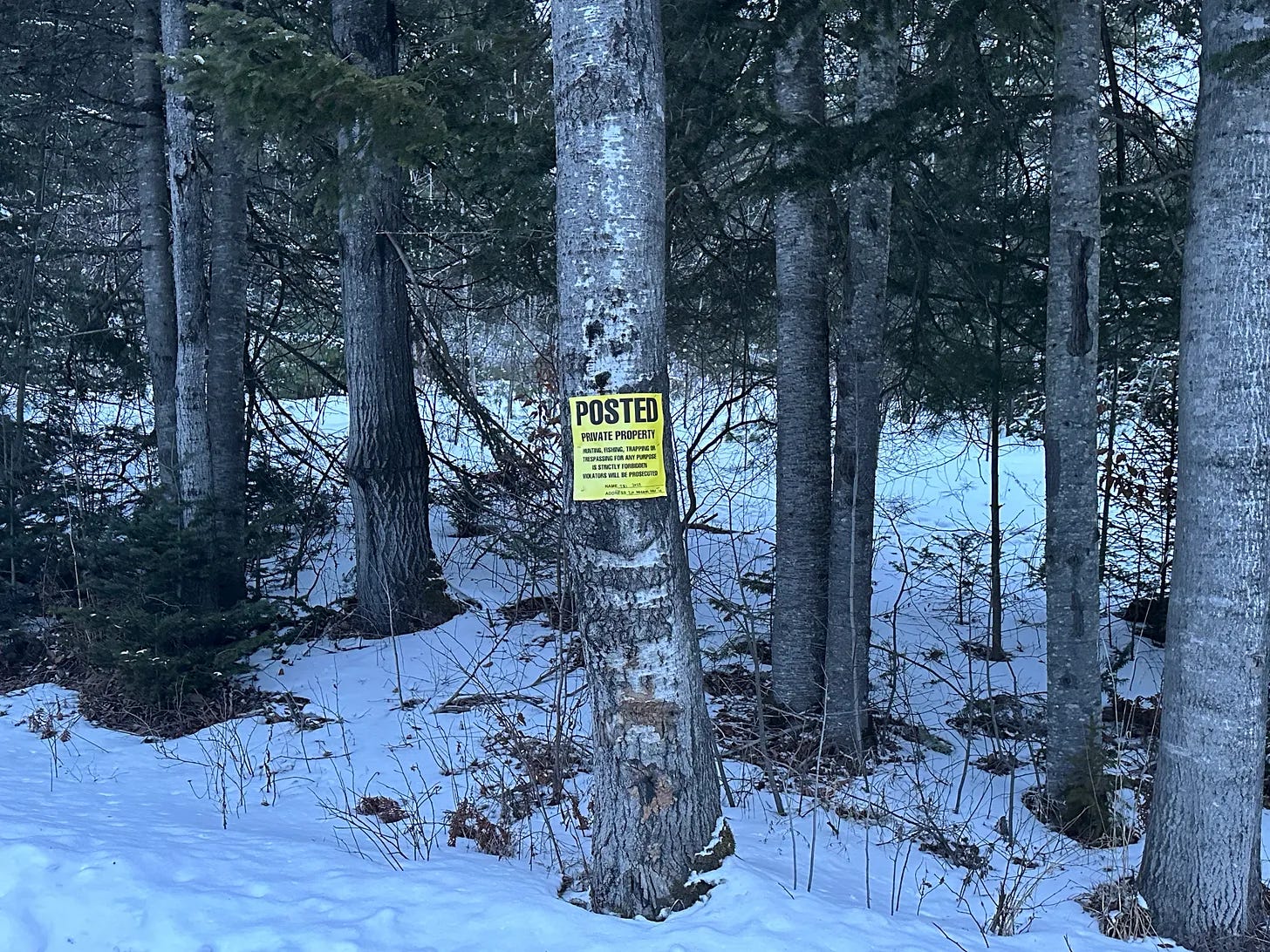
If you’re a Vermont landowner who dreaded January’s annual scramble to update your posting signs, help may be on the way — with a catch.
H.723, a bill that passed the House on March 18 and is now before the Senate Natural Resources and Energy Committee, would fix the calendar-year confusion that [left landowners, town clerks, and even state wardens at odds earlier this year. But the House added provisions that go well beyond the original fix, and the state’s own Fish and Wildlife Department is warning that some of those changes could make trespass prosecutions harder.
Here’s what the bill would do and what it could mean for you.
The Fix Landowners Have Been Waiting For
The core change is straightforward: under H.723, your posting would be valid for 365 days from the date you file with the town clerk — not until December 31st.
That single change would eliminate the problem that Compass Vermont documented in January, when the Fish and Wildlife Department’s calendar-year interpretation — formalized in a letter from Chief Warden Justin Stedman to town clerks last fall — meant a landowner who posted in October got barely two months of protection while someone who posted in January got nearly twelve. Both paid the same $5 recording fee.
Under H.723, the date you record with the clerk is the date your clock starts, and it runs for a full year. Post on September 15th, you’d be covered until September 14th of the following year. Post on March 1st, you’d be good until the last day of February. No more mad dash through the snow on January 2nd to re-date signs across your entire boundary.
Carol Dawes, treasurer of Barre City and a leader of the Vermont Municipal Clerks and Treasurers Association legislative committee, told the Senate committee on March 26 that the change would also resolve a timing headache for clerks: the old system’s requirement to register on or before January 1st — a holiday — created confusion about when the recording window actually opened and closed.
For context, Vermont is unusual in requiring landowners to actively “post” their land at all. Section 67 of the Vermont Constitution guarantees Vermonters the right to hunt and fish on “lands not enclosed,” making the state one of the few with a constitutional right to roam on private property. Compass Vermont’s January report explored this framework in detail.
What Else Changed — and Why It Matters
When Representatives Zon Eastes of Guilford and Larry Satcowitz of Randolph introduced H.723 in January, it was a narrow, three-page bill: add the 365-day language and update some pronouns.
The House Environment Committee spent nearly two months — from a January 29 introduction through a March 11 vote — reworking it into a five-page bill with three additional changes landowners should know about.
Your signs would no longer need to be dated. Current law requires that posting signs “shall be dated each year.” The House struck that language. Under the bill as passed, the clerk’s recording — not the date written on a sign — would be what triggers a posting’s validity. Signs would still need to be legible and maintained at all times under the statute, but the annual re-dating ritual would end.
This provision responds directly to testimony from landowners like Morgan Gold of Goldshaw Farm, who told the committee that maintaining date stamps on dozens of fragile signs spread across miles of boundary is physically impractical, particularly for farmers working remote fence lines.
A fallen sign wouldn’t automatically void your posting — but there’s a catch. Under the current system, wardens and prosecutors have described situations where a single missing or damaged sign effectively renders an entire property’s posting unenforceable, even when every other sign is in place. The House added a new provision stating that “accidental or unintentional deviations” from sign requirements would still be deemed effective if a “reasonable person” would understand the land is posted.
Here’s the part landowners need to read carefully: the bill includes an “actual notice” trigger. If you know your signs are out of compliance — a neighbor tells you one blew down, or you see it yourself — you are required to take “reasonable steps” to fix them. Once you have actual notice, the reasonable-person protection no longer covers you. A windstorm that takes down a sign in a remote corner of your property wouldn’t blow up your posting — but ignoring a problem you know about could.
Both posting and recording would be explicitly required. The House tightened the definition of “enclosed” land to specify that property must be both physically posted with signs and recorded with the town clerk. Under the current statute, as legislative counsel and committee members discussed during deliberations, there was some ambiguity about whether signs alone or recording alone could meet the constitutional threshold for “enclosure.”
The law would take effect immediately. The original bill set a July 1, 2026, start date. The House changed it to “on passage,” meaning it would take effect the moment the governor signs it — potentially in time for the 2026 fall hunting season.
The Enforcement Concern
Not everyone sees these changes as an improvement.
Fish and Wildlife Commissioner Jason Batchelder told the Senate committee on March 26 that his department supports the 365-day recording rule but has reservations about removing dated signs and adopting the reasonableness standard.
Batchelder and Chief Warden Stedman — the same Colonel Stedman whose letter to town clerks last fall set off the calendar-year confusion — argued that the current system’s strict approach, where technical noncompliance can lead to prosecution, gives wardens a clear enforcement path. Converting to a “reasonable person” test, they warned, would shift judgment calls to individual officers and prosecutors, increasing the number of incidents that end with a warning rather than charges.
Landowner Jeff Mack offered a counterpoint from experience. He described an incident in which security cameras captured what appeared to be a clear trespass, but prosecutors declined to bring charges because a single sign on the property was defective. When the system is rigid enough that one bad sign negates camera evidence, Mack argued, the strictness is creating loopholes rather than protecting landowners.
The Hunting Access Question
The debate isn’t only between landowners and enforcement. Hunting advocates are watching the bill with concern.
Mike Covey, executive director of the Vermont Traditions Coalition, testified before the House Environment Committee on February 25 that access to private land is the primary barrier to hunting in Vermont. Covey argued that making posting easier — and particularly the potential introduction of purple paint marking, which can last years without maintenance — could further restrict the land available to hunters who don’t own property themselves.
That concern introduces a dimension the 365-day fix alone doesn’t raise: in a state where the constitution guarantees hunting on “lands not enclosed,” anything that makes enclosure simpler could shift the balance between property rights and public access.
What Comes Next
The Senate Natural Resources and Energy Committee took testimony on March 26 and signaled it would continue deliberations, potentially with amendments.
One possibility worth watching: the House Environment Committee actually considered purple paint language in an earlier draft of H.723 but removed it before the final vote. The Senate could revisit that option. Maine already allows landowners to mark boundary trees with purple paint instead of maintaining paper signs — a system that’s been in effect there since 2012. If the Senate adds purple paint provisions back into H.723, the bill would represent an even more significant overhaul of Vermont’s posting system than what the House passed.
The bill’s path forward depends on whether the Senate accepts the House’s broader rewrite or narrows it back toward the original scope. The 365-day fix drew no opposition from any witness who testified in either chamber. The reasonableness standard is where the tension lies.
For landowners, the practical question is timing: if the bill gets caught in extended Senate deliberation or bounces back to the House for concurrence on amendments, the fix might not arrive before the next posting season.
The current law — and all the confusion that comes with it — remains in effect until something changes.