


On December 12, 2025, Vermont Attorney General Charity Clark joined a coalition of 19 other states to sue the Trump Administration. The lawsuit challenges a Presidential Proclamation that imposes a $100,000 fee on new H-1B visa petitions.
For many Vermonters, the H-1B visa might seem like a distant issue regarding “big tech” in Silicon Valley. However, this policy has direct implications for Vermont’s rural hospitals, university research, and local school districts. This guide breaks down the legal arguments, the economic reality, and what happens next.
The Core Issue: A $100,000 “Condition of Entry”
The controversy centers on the H-1B visa, which allows U.S. employers to hire foreign workers for “specialty occupations”—jobs that require specialized knowledge and usually a bachelor’s degree.
On September 19, 2025, President Trump signed a Proclamation on Restriction on Entry of Certain Nonimmigrant Workers. The order mandates that employers pay a $100,000 fee for new H-1B beneficiaries seeking to enter the United States.
The Administration’s Argument: The White House argues that the visa system is being abused by outsourcing firms that “spam” the lottery system to crowd out legitimate employers. They assert that low-cost foreign labor drives down American wages. By setting a $100,000 price tag, the Administration claims it will ensure only high-value workers enter the country, effectively putting “America First”.
The State’s Argument: Attorney General Clark argues that this is an “unlawful policy” that violates the separation of powers. The lawsuit contends that Congress—not the President—has the “power of the purse” to set fees and taxes. They argue the fee creates a “devastating” barrier for public sector employers who simply cannot afford six-figure fees for teachers or nurses.
Why Vermont? The Local Impact
While the national conversation often focuses on tech giants, the H-1B program is a critical staffing tool for two sectors vital to Vermont: healthcare and education.
1. The Healthcare Crisis
Vermont’s healthcare system relies heavily on international medical graduates.
The Rural Factor: Many foreign doctors work in rural, underserved areas through the “Conrad 30” waiver program.
The Cost: Rural hospitals operate on thin margins. A $100,000 fee per doctor is a prohibitive cost that could leave positions vacant.
The Shortage: The U.S. is projecting a shortfall of 86,000 physicians by 2036. The lawsuit argues this fee will exacerbate that shortage in states like Vermont.
2. Education and Research
Higher Ed: Universities like UVM are “cap-exempt,” meaning they can hire researchers year-round without entering the visa lottery. However, they are generally not exempt from this new fee.
K-12 Schools: With 74% of school districts nationally reporting trouble filling positions in math, science, and special education, schools often use visas to retain qualified international teachers. Public school budgets, funded by taxpayers, do not have the flexibility to absorb a $100,000 surcharge.
The Fine Print: A Crucial Exemption
It is important to understand a key detail that was clarified after the initial announcement. The fee applies to entry.
According to USCIS clarification guidance, the fee generally does not apply to “Change of Status” petitions for individuals already inside the United States.
What this means: If an international student graduates from a Vermont college and switches to a work visa without leaving the country, the employer likely won’t have to pay the $100,000.
The Catch: It does apply to anyone recruited directly from abroad. This severs the pipeline for experienced professionals (like seasoned doctors or researchers) currently living overseas.
The Legal Battlefield: President vs. Congress
The lawsuit is not just about the money; it is a constitutional debate.
Section 212(f): The President is using a section of the Immigration and Nationality Act that allows him to “suspend the entry” of foreigners if it is “detrimental to the interests of the United States”. The Administration claims low-wage labor is detrimental, and the fee is a condition to cure that detriment.
The “Power of the Purse”: The states argue that allowing a President to unilaterally impose a $100,000 fee bypasses Congress. If the President can charge $100,000, he is effectively creating a new tax, which is a legislative power, not an executive one.
Procedural Issues: The lawsuit also claims the Administration skipped required steps, such as public notice and comment periods, violating the Administrative Procedure Act.
The Economics: A Look at the Costs
To understand why employers are suing, one must look at the math. The fee acts as a massive tariff on hiring.
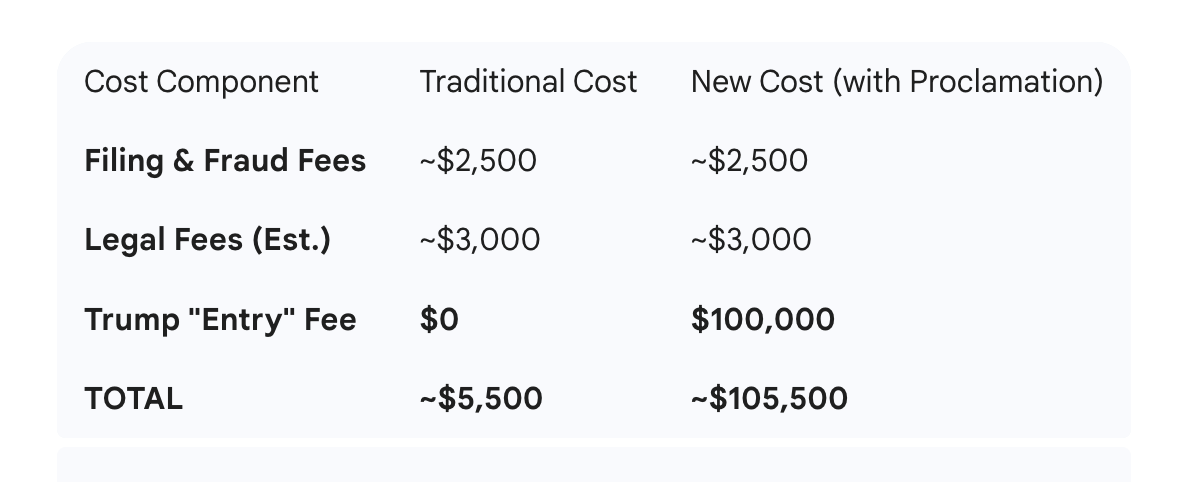
For a tech giant, this might be absorbable. For a non-profit research center in Vermont, this is an increase of over 1,000%, effectively banning them from the international talent market.
What Happens Next?
Now that the lawsuit has been filed, several things will happen in rapid succession:
Request for Injunction: The Attorney General and the coalition will likely ask a federal judge for a “preliminary injunction.” This would create a temporary court order stopping the Administration from collecting the fee while the legal case proceeds.
Federal Court Review: The courts will have to decide if the President’s power to control borders includes the power to levy massive fees. This could eventually reach the Supreme Court.
Employer Uncertainty: Until a judge rules, Vermont employers are in limbo. They must decide whether to rescind job offers to international candidates or wait to see if the fee is blocked.
The outcome of the lawsuit will determine not only the cost of hiring a doctor or teacher but also the limits of presidential power over the U.S. economy.